

Friday, July 17, 2026
Science
No Result
View All Result
  • Login
  • HOME
  • SCIENCE NEWS
  • CONTACT US
  • HOME
  • SCIENCE NEWS
  • CONTACT US
No Result
View All Result
Scienmag
No Result
View All Result
Home Science News Earth Science

El Niño Impacts Global Water Storage Through Asymmetric Hydrological Patterns

July 17, 2026
in Earth Science
Reading Time: 2 mins read
0
El Niño Impacts Global Water Storage Through Asymmetric Hydrological Patterns

El Niño Impacts Global Water Storage Through Asymmetric Hydrological Patterns

65
SHARES
587
VIEWS
Share on FacebookShare on Twitter
ADVERTISEMENT

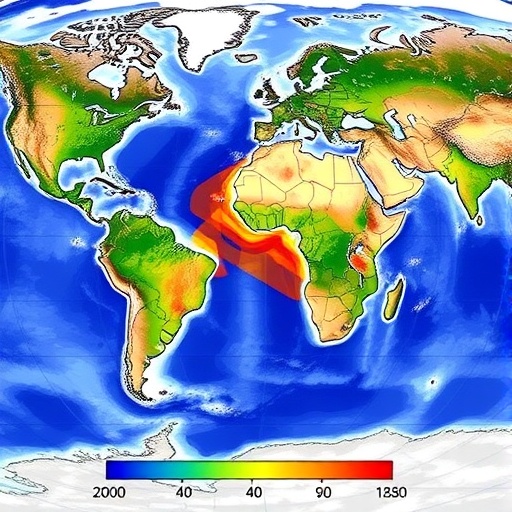
A new study published in Communications Earth & Environment reports that the El Niño–Southern Oscillation (ENSO) leaves a distinct, asymmetric imprint on global water storage—an effect that conventional, symmetric views of climate variability may miss. By focusing on how water stored across Earth’s land, snow, ice, and groundwater responds to ENSO phases, the researchers show that “water gains” and “water losses” do not mirror each other across warm and cool events.

Using a global hydrological framework that assimilates observed constraints, the team quantified how ENSO alters total water storage anomalies on a planetary scale. The analysis reveals that the transition from one ENSO phase to the next is not simply a scaled repetition of the reverse phase. Instead, the magnitude, timing, and spatial distribution of hydrological responses differ between El Niño and La Niña conditions.

The work emphasizes that the hydrological signal is not limited to surface runoff or precipitation alone. It propagates through land-atmosphere processes and storage compartments, creating an integrated fingerprint detectable in the total water budget. Crucially, the researchers identify a directional imbalance: the planet’s storage response during one ENSO phase is stronger or more persistent than the opposite phase, yielding a measurable asymmetry.

Technically, the study evaluates anomalies against a baseline climatology and tracks how storage changes correlate with ENSO indices. By comparing response patterns across events, the authors demonstrate that asymmetric behavior emerges in the coupled system—where atmospheric forcing, soil moisture dynamics, and groundwater contributions interact under differing thermodynamic and circulation regimes.

The result matters because ENSO is one of the most influential sources of seasonal to interannual variability. If water storage anomalies are asymmetric, then forecasting and risk planning for droughts and floods require models that can represent phase-dependent hydrology rather than assuming linear, symmetric reactions.

For climate scientists and water managers, the findings offer a clearer diagnostic pathway: ENSO-linked extremes may be better anticipated by monitoring not only rainfall and temperature anomalies, but also the direction-specific behavior of total storage. In short, the hydrological cycle responds to ENSO with an imbalance—one that could reshape how global water risk is projected during upcoming climate swings.

The study also suggests broader implications for data interpretation. Remote sensing and model intercomparisons that treat ENSO as a symmetric driver may under- or overestimate storage shifts. Incorporating asymmetry could improve attribution of hydrological extremes and refine ensemble predictions.

Finally, the research positions ENSO as more than a statistical pattern: it is a test case for how Earth’s storage system absorbs and releases water under contrasting atmospheric states. The authors’ results make the case for “phase-aware” hydrological modeling—an approach likely to become central as observational records lengthen and forecasting demands intensify.

Subject of Research: El Niño–Southern Oscillation (ENSO) impacts on global hydrological storage, including asymmetry in water gain vs. loss.

Article Title: The hydrological asymmetric signature of El Niño–Southern Oscillation on global water storage.

Article References: Palazzoli, I., Gentine, P. The hydrological asymmetric signature of El Niño–Southern Oscillation on global water storage. Commun Earth Environ (2026). https://doi.org/10.1038/s43247-026-03806-3

Image Credits: AI Generated

DOI: 10.1038/s43247-026-03806-3

Tags: and groundwater storageasymmetric hydrological patterns in ENSO phasesasymmetry in El Niño and La Niña hydrological responsesclimate variability and water resource managementEl Niño impacts on global water storageglobal water storage anomalies and phase differencesiceimplications of asymmetric water storage for climate predictionsinfluence of ENSO on landintegrated hydrologicalland-atmosphere interactions during ENSOplanetary-scale water cycle responses to ENSOquantitative analysis of water storage changes during ENSOsnow
Share26Tweet16
Previous Post

Hybrid Positioning System Promises Reliable Tracking When GPS Fails

Next Post

Machine Learning Predicts Bronchopulmonary Dysplasia Seven Days After Birth Using Respiratory Data

Related Posts

Effects of Deforestation and Reforestation on Soil Biodiversity and Ecosystem Function
Earth Science

Effects of Deforestation and Reforestation on Soil Biodiversity and Ecosystem Function

July 17, 2026
Balancing Metal-Carbon Tradeoffs to Reroute Vehicle Electrification Pathways
Earth Science

Balancing Metal-Carbon Tradeoffs to Reroute Vehicle Electrification Pathways

July 17, 2026
Uncovering Causes Behind Southeast Asia’s Catastrophic Wildfires
Earth Science

Uncovering Causes Behind Southeast Asia’s Catastrophic Wildfires

July 17, 2026
Supraglacial Lake Daily Dynamics Track Hydrological Pulses and Climate Anomalies
Earth Science

Supraglacial Lake Daily Dynamics Track Hydrological Pulses and Climate Anomalies

July 17, 2026
Food Web Reorganization Helps Ecosystems Resist Warming Impacts
Earth Science

Food Web Reorganization Helps Ecosystems Resist Warming Impacts

July 17, 2026
Simple trophic transfer index forecasts spiny lobster fishery dynamics
Earth Science

Simple trophic transfer index forecasts spiny lobster fishery dynamics

July 17, 2026
Next Post
Machine Learning Predicts Bronchopulmonary Dysplasia Seven Days After Birth Using Respiratory Data

Machine Learning Predicts Bronchopulmonary Dysplasia Seven Days After Birth Using Respiratory Data

  • Mothers who receive childcare support from maternal grandparents show more

    Mothers who receive childcare support from maternal grandparents show more parental warmth, finds NTU Singapore study

    27656 shares
    Share 11059 Tweet 6912
  • University of Seville Breaks 120-Year-Old Mystery, Revises a Key Einstein Concept

    1061 shares
    Share 424 Tweet 265
  • Bee body mass, pathogens and local climate influence heat tolerance

    682 shares
    Share 273 Tweet 171
  • Researchers record first-ever images and data of a shark experiencing a boat strike

    546 shares
    Share 218 Tweet 137
  • Groundbreaking Clinical Trial Reveals Lubiprostone Enhances Kidney Function

    531 shares
    Share 212 Tweet 133
Science

Embark on a thrilling journey of discovery with Scienmag.com—your ultimate source for cutting-edge breakthroughs. Immerse yourself in a world where curiosity knows no limits and tomorrow’s possibilities become today’s reality!

RECENT NEWS

  • E-Nose Diagnostics, Rare Disease Research, and AI Medical Education Tools Emerge
  • Study Finds Women’s Neighborhoods Can Influence Heart Health for Decades
  • Republican push fuels rapid rise of antivaccine laws in US states
  • ESA 2026 Annual Meeting to Spotlight Wildlife Ecology in Media Tip Sheet

Categories

  • Agriculture
  • Anthropology
  • Archaeology
  • Athmospheric
  • Biology
  • Biotechnology
  • Blog
  • Bussines
  • Cancer
  • Chemistry
  • Climate
  • Earth Science
  • Editorial Policy
  • Marine
  • Mathematics
  • Medicine
  • Pediatry
  • Policy
  • Psychology & Psychiatry
  • Science Education
  • Social Science
  • Space
  • Technology and Engineering

Subscribe to Blog via Email

Enter your email address to subscribe to this blog and receive notifications of new posts by email.

Join 5,146 other subscribers

© 2025 Scienmag - Science Magazine

Welcome Back!

Login to your account below

Forgotten Password?

Retrieve your password

Please enter your username or email address to reset your password.

Log In
No Result
View All Result
  • HOME
  • SCIENCE NEWS
  • CONTACT US

© 2025 Scienmag - Science Magazine

Discover more from Science

Subscribe now to keep reading and get access to the full archive.

Continue reading
