

Friday, July 17, 2026
Science
No Result
View All Result
  • Login
  • HOME
  • SCIENCE NEWS
  • CONTACT US
  • HOME
  • SCIENCE NEWS
  • CONTACT US
No Result
View All Result
Scienmag
No Result
View All Result
Home Science News Medicine

Extracellular Matrix Stiffness Guides Region-Specific Lung Epithelial Differentiation in Organoids

July 17, 2026
in Medicine
Reading Time: 2 mins read
0
Extracellular Matrix Stiffness Guides Region-Specific Lung Epithelial Differentiation in Organoids

Extracellular Matrix Stiffness Guides Region-Specific Lung Epithelial Differentiation in Organoids

65
SHARES
587
VIEWS
Share on FacebookShare on Twitter
ADVERTISEMENT

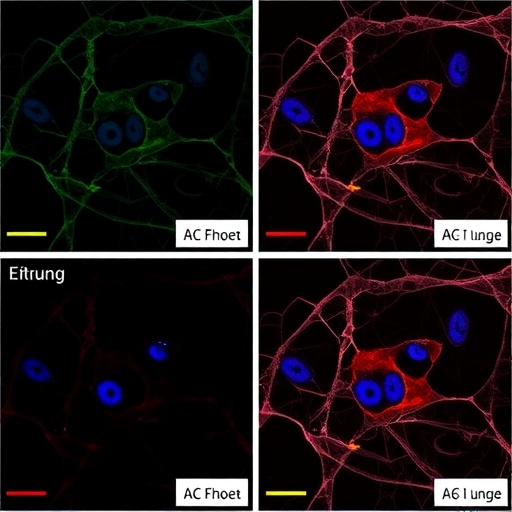
Viral Science News — A new study from researchers including Z. Liao and H. Meng reports that mechanical cues from the extracellular matrix can steer human pluripotent stem cell (hPSC)–derived lung organoids toward distinct epithelial fates. Published in Nature Communications, the work links substrate stiffness to region-specific differentiation, offering a mechanistic explanation for how developing lung tissue may interpret physical properties as biological instructions.

To probe this relationship, the team generated lung organoids from hPSCs and cultured them on matrices engineered to present different elastic moduli. Rather than treating stiffness as a background physical feature, the investigators treated it as an experimental “signal,” asking whether cells translate matrix mechanics into lineage decisions.

Across stiffness conditions, organoids displayed systematic shifts in epithelial composition. Cultures on softer matrices preferentially enriched markers consistent with one lung epithelial program, while stiffer environments supported maturation toward another regionally associated epithelial identity. This pattern suggests that lung differentiation is not solely governed by biochemical factors, but also by the mechanical landscape cells encounter.

The paper further examines how cells convert stiffness into intracellular programs. The authors describe engagement of mechanotransduction pathways commonly associated with cytoskeletal tension and adhesion-mediated signaling. These signals, they argue, modulate transcriptional regulators that bias progenitor cells toward specific epithelial outcomes.

Because organoids can recapitulate aspects of early tissue organization, the authors also assessed spatial organization within developing structures. Mechanical differences were accompanied by changes in tissue architecture and differentiation timing, indicating that stiffness influences not only what fate cells adopt, but also how tissue domains form.

Importantly, the findings imply that organoid platforms can be tuned as “mechanical bioreactors.” By selecting matrix stiffness, researchers may guide organoid-derived lung epithelial cells toward desired regional phenotypes for studies of development, disease modeling, and regenerative approaches.

The study’s central message is that extracellular matrix stiffness acts as an instructive cue, directing regional lung epithelial differentiation. This reframes lung organoid engineering as a design problem that must consider mechanical parameters alongside growth factors and signaling inputs.

References to the study highlight a clear connection between engineered mechanics and measurable epithelial fate outcomes. The DOI provides direct access: 10.1038/s41467-026-75663-9.

Subject of Research: hPSC-derived lung organoids; mechanobiology; lung epithelial differentiation
Article Title: Extracellular matrix stiffness directs region-specific lung epithelial differentiation revealed by hPSC-derived lung organoids.
Article References: Liao, Z., Meng, H., Lv, J. et al. Extracellular matrix stiffness directs region-specific lung epithelial differentiation revealed by hPSC-derived lung organoids. Nat Commun (2026). https://doi.org/10.1038/s41467-026-75663-9
Image Credits: AI Generated
DOI: 10.1038/s41467-026-75663-9

Tags: biomechanical regulation of pluripotent stem cell differentiationcytoskeletal tension in epithelial differentiationengineered matrices for lung tissue engineeringextracellular matrix stiffness in lung organoid differentiationmechanotransduction pathways in lung tissue developmentphysical cues guiding lung tissue patterningphysical-biological signaling in lungregion-specific epithelial identity in lung organoidsregion-specific lung epithelial cell faterole of matrix mechanics in organoid maturationstem cell-derived lung organoidssubstrate elasticity influence on lung epithelial lineage
Share26Tweet16
Previous Post

Repetitive Neuronal Stimulation Reprograms Mature Neurons Into Immature States

Next Post

ASB2 reduces liver fat accumulation, boosting ILC1 balance and anti-tumor immunity

Related Posts

Brain circuits could explain cognitive symptoms in progressive supranuclear palsy
Medicine

Brain circuits could explain cognitive symptoms in progressive supranuclear palsy

July 17, 2026
ASB2 reduces liver fat accumulation, boosting ILC1 balance and anti-tumor immunity
Medicine

ASB2 reduces liver fat accumulation, boosting ILC1 balance and anti-tumor immunity

July 17, 2026
Repetitive Neuronal Stimulation Reprograms Mature Neurons Into Immature States
Medicine

Repetitive Neuronal Stimulation Reprograms Mature Neurons Into Immature States

July 17, 2026
Subjective Well-Being Mediates Link Between Caregiver Ability and Postoperative Resilience
Medicine

Subjective Well-Being Mediates Link Between Caregiver Ability and Postoperative Resilience

July 17, 2026
Japan Study Explores Community Supporters’ Experiences with Team Orange Dementia Program
Medicine

Japan Study Explores Community Supporters’ Experiences with Team Orange Dementia Program

July 17, 2026
COVID-19 Booster Strategies Deliver Long-Lasting Immunity
Medicine

COVID-19 Booster Strategies Deliver Long-Lasting Immunity

July 17, 2026
Next Post
ASB2 reduces liver fat accumulation, boosting ILC1 balance and anti-tumor immunity

ASB2 reduces liver fat accumulation, boosting ILC1 balance and anti-tumor immunity

  • Mothers who receive childcare support from maternal grandparents show more

    Mothers who receive childcare support from maternal grandparents show more parental warmth, finds NTU Singapore study

    27656 shares
    Share 11059 Tweet 6912
  • University of Seville Breaks 120-Year-Old Mystery, Revises a Key Einstein Concept

    1061 shares
    Share 424 Tweet 265
  • Bee body mass, pathogens and local climate influence heat tolerance

    682 shares
    Share 273 Tweet 171
  • Researchers record first-ever images and data of a shark experiencing a boat strike

    546 shares
    Share 218 Tweet 137
  • Groundbreaking Clinical Trial Reveals Lubiprostone Enhances Kidney Function

    531 shares
    Share 212 Tweet 133
Science

Embark on a thrilling journey of discovery with Scienmag.com—your ultimate source for cutting-edge breakthroughs. Immerse yourself in a world where curiosity knows no limits and tomorrow’s possibilities become today’s reality!

RECENT NEWS

  • New perception-based technology brings AR glasses closer to real life
  • New Layered Crystal Enables High-Efficiency Thermoelectric Energy Conversion
  • Brain circuits could explain cognitive symptoms in progressive supranuclear palsy
  • ASB2 reduces liver fat accumulation, boosting ILC1 balance and anti-tumor immunity

Categories

  • Agriculture
  • Anthropology
  • Archaeology
  • Athmospheric
  • Biology
  • Biotechnology
  • Blog
  • Bussines
  • Cancer
  • Chemistry
  • Climate
  • Earth Science
  • Editorial Policy
  • Marine
  • Mathematics
  • Medicine
  • Pediatry
  • Policy
  • Psychology & Psychiatry
  • Science Education
  • Social Science
  • Space
  • Technology and Engineering

Subscribe to Blog via Email

Enter your email address to subscribe to this blog and receive notifications of new posts by email.

Join 5,146 other subscribers

© 2025 Scienmag - Science Magazine

Welcome Back!

Login to your account below

Forgotten Password?

Retrieve your password

Please enter your username or email address to reset your password.

Log In
No Result
View All Result
  • HOME
  • SCIENCE NEWS
  • CONTACT US

© 2025 Scienmag - Science Magazine

Discover more from Science

Subscribe now to keep reading and get access to the full archive.

Continue reading
