

Thursday, July 16, 2026
Science
No Result
View All Result
  • Login
  • HOME
  • SCIENCE NEWS
  • CONTACT US
  • HOME
  • SCIENCE NEWS
  • CONTACT US
No Result
View All Result
Scienmag
No Result
View All Result
Home Science News Psychology & Psychiatry

Separating Human Projection from Machine Cognition Is Key to LLM Understanding

July 16, 2026
in Psychology & Psychiatry
Reading Time: 2 mins read
0
Separating Human Projection from Machine Cognition Is Key to LLM Understanding

Separating Human Projection from Machine Cognition Is Key to LLM Understanding

65
SHARES
587
VIEWS
Share on FacebookShare on Twitter
ADVERTISEMENT

Anthropomorphism has become a defining lens for how people interact with large language models (LLMs) and how researchers test them, often treating these systems as if they share human traits such as morality, personality, social intelligence, and even consciousness. But as models grow more capable, the debate intensifies: do LLMs possess genuine human-like understanding, or are they sophisticated pattern matchers?

Support for “genuine understanding” comes from mechanistic work suggesting that LLMs can build internal representations grounded in perceptual structure, despite operating on text alone. Related analyses also report introspective-like access to internal states and evidence that multi-step planning can occur before generating final responses—for example, when producing structured outputs such as poems.

Skeptics counter with a different diagnostic: brittleness. They argue that small changes—paraphrases that preserve meaning, or irrelevant additions—can trigger sharp accuracy losses. Moreover, LLMs often struggle with logic tasks that lack training-like templates, and chain-of-thought benefits can appear to mix reasoning with memorized fragments from training data.

The article proposes experientialism as a unifying framework to dissolve the dichotomy. Instead of assuming that understanding must mirror either objective reality or unconstrained imagination, experientialism views cognition as arising from interactions between an agent and its environment. Under an extended version of this idea, meaning is constructed by a system’s internal representational machinery while being constrained by the environment it learns from.

This view aligns with Bayesian cognition: an agent’s internal model is separated from the outside world by an interaction boundary (a Markov blanket). Lacking direct access, it must infer hidden causes of sensory-like inputs. Crucially, the internal model’s structure depends both on environmental structure and on the representational capacity of the agent itself.

Applying this to LLMs suggests a comparative but non-identical picture of cognition. For humans, embodied sensorimotor experience supports embodied cognition. For LLMs, the Transformer’s training corpus plays an analogous role, shaping how internal representations are constructed—an insight that reframes the question from “Does it understand?” to “How does it construct meaning under its constraints?”

A key empirical example comes from recent work on temporal cognition. In a similarity-judgment task spanning years from 1525 to 2524, large models reportedly develop a subjective temporal reference point and follow a Weber–Fechner-like scaling pattern. Neural and representational analyses are described as showing logarithmic temporal coding, hierarchical abstraction relative to the reference, and non-linear temporal structure embedded in the training data.

Taken together, the proposal reframes LLMs as “the other mind”: not a lesser version of human cognition, but a different cognitive construction process. The danger, the article warns, is treating model outputs as direct surrogates for human behavioral data without verifying cognitive equivalence.

Instead, it advocates task-based cognitive comparisons that test convergence and divergence directly. As LLMs enter high-stakes domains, machine experientialism argues for non-human-centric cognitive science—understanding how internal reality is built, predicting where divergence will emerge, and intervening to mitigate risks.

Subject of Research: Distinguishing human projection from machine cognition in large language models

Article Title: Understanding large language models demands distinguishing human projection from machine cognition.

Article References: Li, L., Teng, Y., Wang, Y. et al. Understanding large language models demands distinguishing human projection from machine cognition. Commun Psychol 4, 108 (2026). https://doi.org/10.1038/s44271-026-00508-6

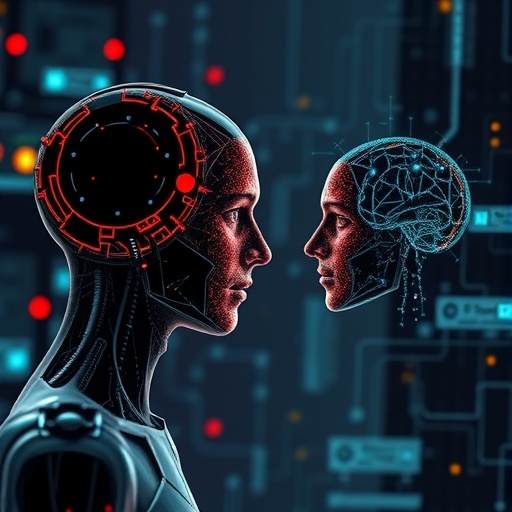
Image Credits: AI Generated

DOI: https://doi.org/10.1038/s44271-026-00508-6

Keywords: anthropomorphism; experientialism; Bayesian cognition; Markov blanket; mechanistic interpretability; temporal cognition; chain-of-thought; cognitive comparison; AI safety alignment; internal representation

Tags: AI cognitionanthropomorphism in AIbrittleness and robustness of language modelschain-of-thought reasoning in AIexperientialism in AI cognitionhuman-like understanding in AIinternal representations in LLMslarge language modelsLLM reasoning and planning capabilitiesmodel interpretability and internal statespattern matching versus genuine understanding
Share26Tweet16
Previous Post

Detected Rocky Exoplanet in Habitable Zone With Atmosphere

Next Post

AI designs functional CRISPR-like nucleases surpassing natural models

Related Posts

Traumatic Experiences Linked to Depression Symptoms in LGBTQ+ People in China
Psychology & Psychiatry

Traumatic Experiences Linked to Depression Symptoms in LGBTQ+ People in China

July 16, 2026
Social Isolation Disrupts Prefrontal Excitatory–Inhibitory Balance, Impairs Novel Social Memory in Male Mice
Psychology & Psychiatry

Social Isolation Disrupts Prefrontal Excitatory–Inhibitory Balance, Impairs Novel Social Memory in Male Mice

July 16, 2026
Reanalysis of Longitudinal Studies on How Intergroup Contact Shapes Attitudes
Psychology & Psychiatry

Reanalysis of Longitudinal Studies on How Intergroup Contact Shapes Attitudes

July 15, 2026
Psilocybin Alters Human Brain Synaptic Plasticity, New Research Finds
Psychology & Psychiatry

Psilocybin Alters Human Brain Synaptic Plasticity, New Research Finds

July 15, 2026
Early-Life Stress Alters Spontaneous Behavior in Cntnap2 Heterozygous Mice
Psychology & Psychiatry

Early-Life Stress Alters Spontaneous Behavior in Cntnap2 Heterozygous Mice

July 15, 2026
COVID-19 fatigue linked to hippocampal immune and metabolic changes
Psychology & Psychiatry

COVID-19 fatigue linked to hippocampal immune and metabolic changes

July 15, 2026
Next Post
AI designs functional CRISPR-like nucleases surpassing natural models

AI designs functional CRISPR-like nucleases surpassing natural models

  • Mothers who receive childcare support from maternal grandparents show more

    Mothers who receive childcare support from maternal grandparents show more parental warmth, finds NTU Singapore study

    27656 shares
    Share 11059 Tweet 6912
  • University of Seville Breaks 120-Year-Old Mystery, Revises a Key Einstein Concept

    1061 shares
    Share 424 Tweet 265
  • Bee body mass, pathogens and local climate influence heat tolerance

    682 shares
    Share 273 Tweet 171
  • Researchers record first-ever images and data of a shark experiencing a boat strike

    546 shares
    Share 218 Tweet 137
  • Groundbreaking Clinical Trial Reveals Lubiprostone Enhances Kidney Function

    531 shares
    Share 212 Tweet 133
Science

Embark on a thrilling journey of discovery with Scienmag.com—your ultimate source for cutting-edge breakthroughs. Immerse yourself in a world where curiosity knows no limits and tomorrow’s possibilities become today’s reality!

RECENT NEWS

  • Perioperative D-dimer to albumin ratio predicts serious complications, mortality after hip fracture
  • Lehigh University Joins Global Consortium to Advance Commercial Space Research
  • Biochar Enables Earthworms to Survive Copper and Glyphosate Pollution
  • Early inflammation signal fuels oral cancer, suggests immunoprevention strategy

Categories

  • Agriculture
  • Anthropology
  • Archaeology
  • Athmospheric
  • Biology
  • Biotechnology
  • Blog
  • Bussines
  • Cancer
  • Chemistry
  • Climate
  • Earth Science
  • Editorial Policy
  • Marine
  • Mathematics
  • Medicine
  • Pediatry
  • Policy
  • Psychology & Psychiatry
  • Science Education
  • Social Science
  • Space
  • Technology and Engineering

Subscribe to Blog via Email

Enter your email address to subscribe to this blog and receive notifications of new posts by email.

Join 5,146 other subscribers

© 2025 Scienmag - Science Magazine

Welcome Back!

Login to your account below

Forgotten Password?

Retrieve your password

Please enter your username or email address to reset your password.

Log In
No Result
View All Result
  • HOME
  • SCIENCE NEWS
  • CONTACT US

© 2025 Scienmag - Science Magazine

Discover more from Science

Subscribe now to keep reading and get access to the full archive.

Continue reading
