


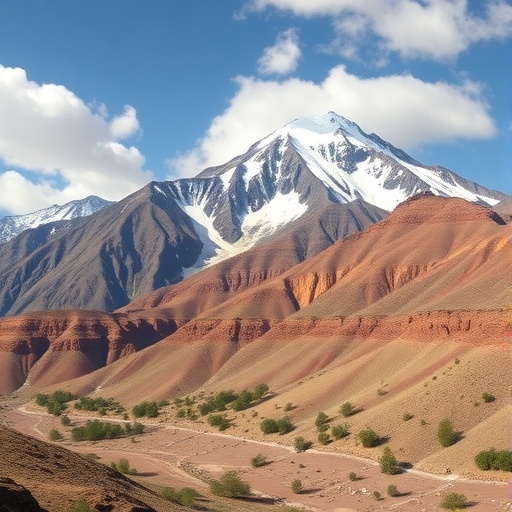
A new study published in Communications Earth & Environment reports that central Tibet’s rugged mountain architecture was not built in a single burst. Instead, it was shaped by long-lived crustal shortening that persisted after a major ocean closed during the Cretaceous period—when the Bangong–Nujiang Ocean shut down and the surrounding plates collided.
The research team, led by Zhang, Liu, Lin, and colleagues, examines how tectonic forces transferred through the region during and after ocean closure. Their central finding is that shortening did not simply end when the ocean vanished. Rather, the continental collision continued to drive deformation well beyond the immediate collision event, helping sustain mountain growth over extended geological time.
To reach this conclusion, the authors combine regional tectonic constraints with structural observations that reflect how stress and strain were distributed through the Tibetan crust. They interpret the evolving patterns of deformation as evidence for sustained compression, including the way different crustal levels responded to continued convergence.
The study frames the Bangong–Nujiang Ocean closure as a pivotal tectonic switch: once the ocean disappeared, the mechanical coupling between continental blocks increased. That change allowed compression to remain effective, promoting ongoing uplift and crustal thickening in central Tibet.
Importantly, the paper links this sustained shortening to the broader development of Tibetan topography. Rather than treating uplift as a short-lived response to a single collisional moment, the results support a scenario in which post-closure tectonics kept feeding the mountain belt for millions of years.
By addressing the timing and persistence of shortening, the work helps refine how geologists explain the thick crust beneath Tibet and the coexistence of active deformation with long-term structural inheritance. The authors suggest that the region’s growth reflects both the closure of an ocean basin and the prolonged geodynamic consequences of that closure.
The findings also carry implications for how future modeling efforts should represent continental collisions. They highlight that plate-tectonic reorganizations can create enduring mechanical conditions, sustaining deformation even after the most dramatic phase of convergence has passed.
With the DOI link and citation tied to the 2026 publication, the study—understood through its title and approach—offers a clear, data-driven narrative: central Tibet’s rise reflects sustained shortening following Cretaceous ocean closure, shaping a mountain system that kept growing long after the ocean was gone.
Cite Scienmag News
Violet Maxwell. (July 16, 2026). Cretaceous Bangong–Nujiang closure sustained Tibetan mountain growth through shortening. Scienmag. https://scienmag.com/cretaceous-bangong-nujiang-closure-sustained-tibetan-mountain-growth-through-shortening/
Violet Maxwell. "Cretaceous Bangong–Nujiang closure sustained Tibetan mountain growth through shortening." Scienmag, 16 July 2026, https://scienmag.com/cretaceous-bangong-nujiang-closure-sustained-tibetan-mountain-growth-through-shortening/. Accessed 3 September 2026.
Violet Maxwell. "Cretaceous Bangong–Nujiang closure sustained Tibetan mountain growth through shortening." Scienmag. July 16, 2026. https://scienmag.com/cretaceous-bangong-nujiang-closure-sustained-tibetan-mountain-growth-through-shortening/


