

Thursday, July 16, 2026
Science
No Result
View All Result
  • Login
  • HOME
  • SCIENCE NEWS
  • CONTACT US
  • HOME
  • SCIENCE NEWS
  • CONTACT US
No Result
View All Result
Scienmag
No Result
View All Result
Home Science News Earth Science

Cretaceous Bangong–Nujiang closure sustained Tibetan mountain growth through shortening

July 16, 2026
in Earth Science
Reading Time: 2 mins read
0
Cretaceous Bangong–Nujiang closure sustained Tibetan mountain growth through shortening

Cretaceous Bangong–Nujiang closure sustained Tibetan mountain growth through shortening

65
SHARES
587
VIEWS
Share on FacebookShare on Twitter
ADVERTISEMENT

A new study published in Communications Earth & Environment reports that central Tibet’s rugged mountain architecture was not built in a single burst. Instead, it was shaped by long-lived crustal shortening that persisted after a major ocean closed during the Cretaceous period—when the Bangong–Nujiang Ocean shut down and the surrounding plates collided.

The research team, led by Zhang, Liu, Lin, and colleagues, examines how tectonic forces transferred through the region during and after ocean closure. Their central finding is that shortening did not simply end when the ocean vanished. Rather, the continental collision continued to drive deformation well beyond the immediate collision event, helping sustain mountain growth over extended geological time.

To reach this conclusion, the authors combine regional tectonic constraints with structural observations that reflect how stress and strain were distributed through the Tibetan crust. They interpret the evolving patterns of deformation as evidence for sustained compression, including the way different crustal levels responded to continued convergence.

The study frames the Bangong–Nujiang Ocean closure as a pivotal tectonic switch: once the ocean disappeared, the mechanical coupling between continental blocks increased. That change allowed compression to remain effective, promoting ongoing uplift and crustal thickening in central Tibet.

Importantly, the paper links this sustained shortening to the broader development of Tibetan topography. Rather than treating uplift as a short-lived response to a single collisional moment, the results support a scenario in which post-closure tectonics kept feeding the mountain belt for millions of years.

By addressing the timing and persistence of shortening, the work helps refine how geologists explain the thick crust beneath Tibet and the coexistence of active deformation with long-term structural inheritance. The authors suggest that the region’s growth reflects both the closure of an ocean basin and the prolonged geodynamic consequences of that closure.

The findings also carry implications for how future modeling efforts should represent continental collisions. They highlight that plate-tectonic reorganizations can create enduring mechanical conditions, sustaining deformation even after the most dramatic phase of convergence has passed.

With the DOI link and citation tied to the 2026 publication, the study—understood through its title and approach—offers a clear, data-driven narrative: central Tibet’s rise reflects sustained shortening following Cretaceous ocean closure, shaping a mountain system that kept growing long after the ocean was gone.

Subject of Research: Tectonics and mountain growth in central Tibet following the Cretaceous closure of the Bangong–Nujiang Ocean

Article Title: Sustained shortening following Cretaceous Bangong–Nujiang Ocean closure shaped central Tibetan mountain growth.

Article References: Zhang, B., Liu, S., Lin, C. et al. Communications Earth & Environment (2026). https://doi.org/10.1038/s43247-026-03830-3

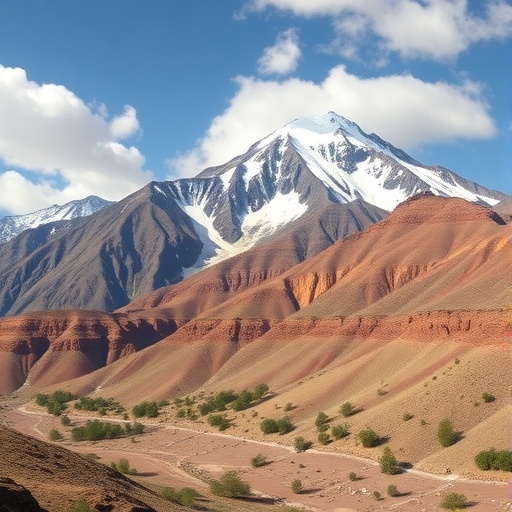
Image Credits: AI Generated

Tags: continental collision and deformationCretaceous Bangong–Nujiang Ocean closurecrustal thickening after ocean closuregeological history of Cretaceous tectonicsimpact of plate convergence on mountain growthlong-lived crustal shorteningrole of mechanical coupling in tectonic processesstructural geology of Tibetan Plateausustained mountain uplift mechanismstectonic evolution of Tibettectonic forces during ocean closureTibetan mountain range formation
Share26Tweet16
Previous Post

Hasanuddin University Study Shows Bacterial Cellulose for High-Performance Energy Storage

Next Post

Queen Odor Mediates Reproductive Suppression in Eusocial Mammals

Related Posts

Wet Harzburgite and Dry Basalt Slabs Maintain Ongoing Seismic Stagnation
Earth Science

Wet Harzburgite and Dry Basalt Slabs Maintain Ongoing Seismic Stagnation

July 16, 2026
Great Barrier Reef Acropora deaths tied to climate swings and human pressures
Earth Science

Great Barrier Reef Acropora deaths tied to climate swings and human pressures

July 16, 2026
Volcanic eruptions leave imprint on coupled reanalysis global overturning circulation
Earth Science

Volcanic eruptions leave imprint on coupled reanalysis global overturning circulation

July 16, 2026
Antibiotic Resistance Gene Detected in Australian Soil
Earth Science

Antibiotic Resistance Gene Detected in Australian Soil

July 16, 2026
Tectonic record reveals early tidal despinning history on Oz Terra, Charon
Earth Science

Tectonic record reveals early tidal despinning history on Oz Terra, Charon

July 15, 2026
T. rex Likely Caused Tooth Marks on Cretaceous Fossil Bones in Wyoming
Earth Science

T. rex Likely Caused Tooth Marks on Cretaceous Fossil Bones in Wyoming

July 15, 2026
Next Post
Queen Odor Mediates Reproductive Suppression in Eusocial Mammals

Queen Odor Mediates Reproductive Suppression in Eusocial Mammals

  • Mothers who receive childcare support from maternal grandparents show more

    Mothers who receive childcare support from maternal grandparents show more parental warmth, finds NTU Singapore study

    27656 shares
    Share 11059 Tweet 6912
  • University of Seville Breaks 120-Year-Old Mystery, Revises a Key Einstein Concept

    1061 shares
    Share 424 Tweet 265
  • Bee body mass, pathogens and local climate influence heat tolerance

    682 shares
    Share 273 Tweet 171
  • Researchers record first-ever images and data of a shark experiencing a boat strike

    546 shares
    Share 218 Tweet 137
  • Groundbreaking Clinical Trial Reveals Lubiprostone Enhances Kidney Function

    531 shares
    Share 212 Tweet 133
Science

Embark on a thrilling journey of discovery with Scienmag.com—your ultimate source for cutting-edge breakthroughs. Immerse yourself in a world where curiosity knows no limits and tomorrow’s possibilities become today’s reality!

RECENT NEWS

  • Microglia Shape Developing Cortical Blood Vessels via PD-1 Signaling
  • Brown fat microRNAs mapping shows secreted signaling network between organs
  • Wet Harzburgite and Dry Basalt Slabs Maintain Ongoing Seismic Stagnation
  • Great Barrier Reef Acropora deaths tied to climate swings and human pressures

Categories

  • Agriculture
  • Anthropology
  • Archaeology
  • Athmospheric
  • Biology
  • Biotechnology
  • Blog
  • Bussines
  • Cancer
  • Chemistry
  • Climate
  • Earth Science
  • Editorial Policy
  • Marine
  • Mathematics
  • Medicine
  • Pediatry
  • Policy
  • Psychology & Psychiatry
  • Science Education
  • Social Science
  • Space
  • Technology and Engineering

Subscribe to Blog via Email

Enter your email address to subscribe to this blog and receive notifications of new posts by email.

Join 5,146 other subscribers

© 2025 Scienmag - Science Magazine

Welcome Back!

Login to your account below

Forgotten Password?

Retrieve your password

Please enter your username or email address to reset your password.

Log In
No Result
View All Result
  • HOME
  • SCIENCE NEWS
  • CONTACT US

© 2025 Scienmag - Science Magazine

Discover more from Science

Subscribe now to keep reading and get access to the full archive.

Continue reading
