


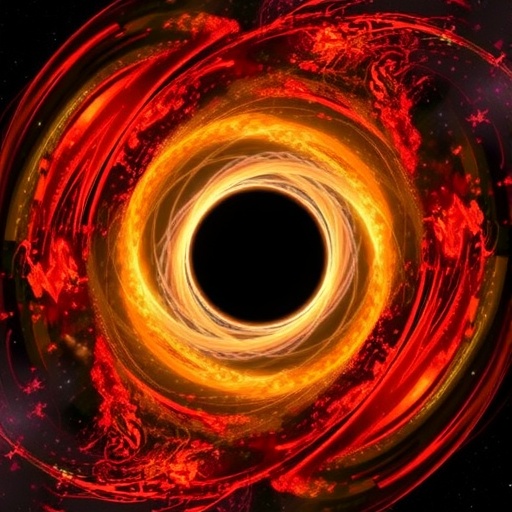
Listening to the “ringing” left behind after black holes collide could soon let scientists test Einstein’s General Relativity in some of the most extreme conditions in the universe. In a major new review, researchers describe how black hole “spectroscopy” is evolving from theory into a practical experimental approach.
When two black holes merge, the newly formed object does not settle instantly. Instead, it enters the ringdown phase, emitting gravitational waves that behave like a set of characteristic vibrations. These signals are called quasinormal modes, and each mode carries information about the black hole’s properties.
By extracting the frequencies and damping rates of these quasinormal modes from gravitational-wave data, scientists can infer the black hole’s mass and its spin. Just as importantly, the observed pattern can be compared against the predictions of General Relativity, providing a stringent test of whether Einstein’s gravity remains valid in the strong-field regime.
Since the first gravitational-wave detection in 2015, the LIGO-Virgo-KAGRA collaboration has recorded hundreds of black hole mergers and identified ringdown features consistent with General Relativity. However, the present generation of detectors limits how many vibration modes can be measured reliably, and therefore how precisely alternative explanations can be checked.
The review highlights that the ringdown signal can contain richer structure than simple single-mode behavior. Researchers have reported multiple overtones, interactions between modes, and dynamical mode excitations that reshape how the “music” of the merger is heard in real observations.
It also emphasizes unusual effects such as exceptional points, where modes can merge in unexpected ways, and “tails” of gravitational-wave emission that can be enhanced in crowded astrophysical environments. Together, these features help researchers model signals more accurately and reduce the risk of overlooking new physics.
Beyond Einstein’s framework, black hole spectroscopy may probe ideas that go beyond the Standard Model of particle physics, including beyond-Einstein gravity theories, the possible influence of dark matter, and quantum-scale effects near the event horizon.
With next-generation observatories—such as the European-led Einstein Telescope, the US Cosmic Explorer, and the space-based LISA mission—researchers expect routine detection of multiple ringdown modes. That capability could transform black holes into precision laboratories for fundamental physics and astrophysical discovery.
ENDS
Keywords
black hole spectroscopy, gravitational waves, ringdown, quasinormal modes, General Relativity, LIGO-Virgo-KAGRA, Einstein Telescope, Cosmic Explorer, LISA, mode interactions
Cite Scienmag News
Grant Pearson. (July 16, 2026). Listening to Black Hole Ringing Reveals Path to Future Gravitational-Wave Astronomy. Scienmag. https://scienmag.com/listening-to-black-hole-ringing-reveals-path-to-future-gravitational-wave-astronomy/
Grant Pearson. "Listening to Black Hole Ringing Reveals Path to Future Gravitational-Wave Astronomy." Scienmag, 16 July 2026, https://scienmag.com/listening-to-black-hole-ringing-reveals-path-to-future-gravitational-wave-astronomy/. Accessed 3 September 2026.
Grant Pearson. "Listening to Black Hole Ringing Reveals Path to Future Gravitational-Wave Astronomy." Scienmag. July 16, 2026. https://scienmag.com/listening-to-black-hole-ringing-reveals-path-to-future-gravitational-wave-astronomy/


