


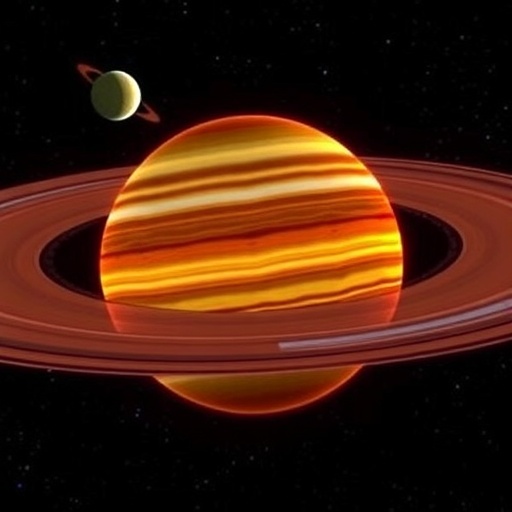
Scientists have produced the most detailed picture yet of the planetary system around Barnard’s Star, the Sun’s closest neighbour after Alpha Centauri, located just under six light-years away. The system—discovered in 2025—contains four sub-Earth planets that are smaller than both Earth and Venus, yet larger than Mars, belonging to a planet type not seen in our own Solar System.
By examining the star’s chemical composition, researchers at the University of Cambridge traced likely mineral building blocks inside the planets. Their analysis points to an unusually magnesium-rich host star, implying that the planets’ interiors could be dominated by magnesium-bearing minerals. On Earth, magnesium largely forms silicate minerals such as olivines, which are important for retaining water through geological processes.
In contrast, the new work indicates that Barnard’s Star planets are likely to form large amounts of periclase, a rare magnesium mineral. Crucially, this mineral is less effective at storing water than Earth’s olivine-rich interiors. The team also found that the planets probably struggle to keep substantial atmospheres, making them even less promising for habitability.
Their hostile conditions stem from proximity. Even the outermost planet orbits roughly ten times closer to its star than Mercury does to the Sun. With low gravitational pull relative to atmospheric escape, stellar radiation and particle winds would strip gases away over time.
Using the system’s evolutionary context, the researchers estimate that any retained atmospheres could persist for at most about two billion years—far shorter than the star system’s estimated 10-billion-year age. That timeline strongly suggests current planetary environments are thin or absent.
Another striking feature is tidal locking. Because these worlds orbit so close, each planet rotates in sync with its orbit, keeping one hemisphere in permanent daylight while the opposite face remains in perpetual night. This would create extreme, persistent temperature contrasts.
Beyond individual planet characteristics, the study explores long-term orbital behaviour. Compact multi-planet systems are often dynamically unstable, risking collisions, infall, or ejection. Here, the researchers report orbital resonance: the inner three planets’ orbital “years” follow a 9:12:16 ratio, helping maintain gravitational balance.
The team concludes that future surveys and missions—such as ESA’s PLATO—could uncover many more small, rocky worlds. While Barnard’s Star planets appear too uninhabitable, the method linking stellar chemistry to planetary composition may sharpen the search for planets with life-friendlier ingredients.
Finally, the paper highlights a broader strategy: even when planets are hostile, their mineral inventories and atmospheric histories can reveal how planetary systems evolve, and why some worlds may retain conditions needed for biology.
Keywords
Barnard’s Star; exoplanets; sub-Earth; periclase; tidal locking; orbital resonance; atmospheric loss; magnesium-rich stars; planetary habitability; PLATO
Cite Scienmag News
Grant Pearson. (July 15, 2026). Astronomers Discover Nearby Planets: Small, Weird, and Completely Uninhabitable. Scienmag. https://scienmag.com/astronomers-discover-nearby-planets-small-weird-and-completely-uninhabitable/
Grant Pearson. "Astronomers Discover Nearby Planets: Small, Weird, and Completely Uninhabitable." Scienmag, 15 July 2026, https://scienmag.com/astronomers-discover-nearby-planets-small-weird-and-completely-uninhabitable/. Accessed 3 September 2026.
Grant Pearson. "Astronomers Discover Nearby Planets: Small, Weird, and Completely Uninhabitable." Scienmag. July 15, 2026. https://scienmag.com/astronomers-discover-nearby-planets-small-weird-and-completely-uninhabitable/


