

Wednesday, July 15, 2026
Science
No Result
View All Result
  • Login
  • HOME
  • SCIENCE NEWS
  • CONTACT US
  • HOME
  • SCIENCE NEWS
  • CONTACT US
No Result
View All Result
Scienmag
No Result
View All Result
Home Science News Archaeology

Precolonial Brazilian Cerrado Villages Grew Maize-Based Polyculture for Centuries

July 15, 2026
in Archaeology
Reading Time: 2 mins read
0
Precolonial Brazilian Cerrado Villages Grew Maize-Based Polyculture for Centuries
65
SHARES
587
VIEWS
Share on FacebookShare on Twitter
ADVERTISEMENT

Precolonial societies in Brazil’s Cerrado—a vast tropical savanna—have long posed a puzzle: did people survive mainly through mobile hunting and gathering, or through intensive, settled maize farming? A new study in Science Advances delivers large-scale, direct evidence that shifts the debate toward a more complex reality of how food systems were organized.

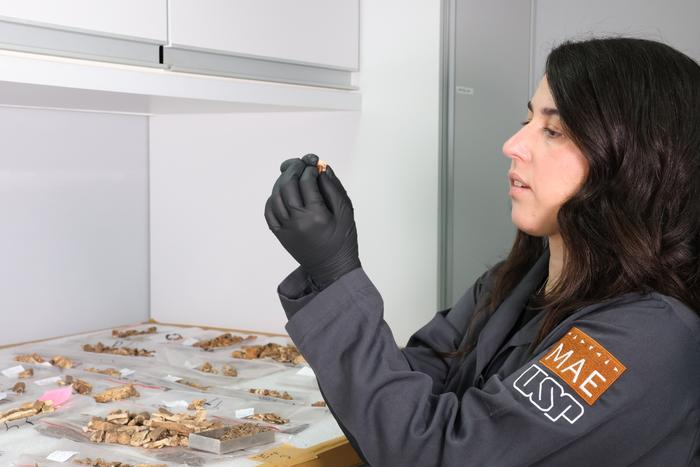
Using stable isotope measurements, researchers traced what people ate across the Late Holocene. They analyzed carbon, nitrogen, and oxygen isotope ratios preserved in human teeth and bone collagen from more than 100 individuals recovered at 37 archaeological sites spanning the Cerrado, Caatinga, and Atlantic Forest biomes.

To build a tightly dated dietary timeline, the team combined isotope data with freshly generated radiocarbon dates from human bone collagen, faunal isotope baselines, archaeobotanical indicators, and palaeoecological records. This multi-proxy approach allowed them to separate dietary signal from environmental background and to compare contemporaneous communities living in broadly similar regions.

The isotopic patterns reveal a striking geographic and cultural split. Populations associated with open-air villages obtained a substantial share of their diets from maize, while groups living in nearby rock shelters consumed markedly more diverse foods and showed little evidence of intensive maize reliance.

Because the two settings overlapped ecologically, the researchers argue that the dietary differences cannot be explained by climate or local resource availability alone. Instead, the contrast points to distinct cultural traditions and economic strategies operating side by side across the landscape.

Crucially, the maize-centered communities did not appear to practice monoculture at an intensive scale. Rather than replacing wild and domesticated diversity, they developed maize-based polyculture systems designed to sustain large villages while maintaining a broad spectrum of cultivated and gathered resources.

“These results challenge broader ideas about how agriculture developed in tropical South America,” the study’s findings suggest, aligning maize cultivation with resilient, diversified production strategies. The work emphasizes how domesticated crops, wild plants, and local ecological knowledge were integrated to buffer communities against ecological variability.

With this evidence, the Cerrado emerges alongside the Amazon as a major center for understanding Indigenous innovation before European colonization. The research also reframes long-term human influence on one of the world’s most biodiverse tropical savannas, highlighting how sustainable land-use practices can shape ecosystems over centuries.

Subject of Research: Precolonial subsistence strategies and maize-based food production in the Brazilian Cerrado
Article Title: Maize-based polyculture, not monoculture, sustained pre-colonial societies in the Brazilian Cerrado
News Publication Date: 15-Jul-2026
Web References: http://dx.doi.org/10.1126/sciadv.aef7066
References: 10.1126/sciadv.aef7066
Image Credits: Mariane Pereira Ferreira

Keywords: stable isotopes, maize, polyculture, archaeology, radiocarbon dating, Indigenous food systems, Cerrado, diet reconstruction, tropical savannas

Tags: archaeological evidence of early food systems in Brazilcultural differences in early Brazilian communitiesdietary reconstruction of ancient Brazilian societiesenvironmental influence on prehistoric food choicesevidence for settled agriculture in premaize-based polyculture in tropical savannamulti-proxy paleoecological research methodsPrecolonial Brazilian Cerrado agricultureprehistoric subsistence strategies in Cerrado and Caatingarole of maize in ancient Brazilian dietssettlement patterns and food reliance in South American prehistorystable isotope analysis of ancient diets
Share26Tweet16
Previous Post

Greenland snow reveals industrial impact through rising atmospheric methane levels

Next Post

Roadless Rule Safeguards Drinking Water for 25 Million Americans, Study Finds

Related Posts

Hasmonean and Qumran calendars combine to solve a Dead Sea
Archaeology

Hasmonean and Qumran calendars combine to solve a Dead Sea Scrolls mystery

July 14, 2026
Medieval Graves Rarely Shared by Close Relatives
Archaeology

Medieval Graves Rarely Shared by Close Relatives

July 10, 2026
Genomic Analysis Reveals Ancestral Connections Among Scythian Elite Burials Across
Archaeology

Genomic Analysis Reveals Ancestral Connections Among Scythian Elite Burials Across the Eurasian Steppe

July 4, 2026
Superworms: The Future of Skeleton Cleaning
Archaeology

Superworms: The Future of Skeleton Cleaning

July 1, 2026
Were Late Pleistocene Clovis People Skilled Big-Game Hunters or Mere
Archaeology

Were Late Pleistocene Clovis People Skilled Big-Game Hunters or Mere Scavengers?

July 1, 2026
Ancient DNA Discovered on Cave Walls Reveals New Insights
Archaeology

Ancient DNA Discovered on Cave Walls Reveals New Insights

June 24, 2026
Next Post
Roadless Rule Safeguards Drinking Water for 25 Million Americans, Study Finds

Roadless Rule Safeguards Drinking Water for 25 Million Americans, Study Finds

  • Mothers who receive childcare support from maternal grandparents show more

    Mothers who receive childcare support from maternal grandparents show more parental warmth, finds NTU Singapore study

    27656 shares
    Share 11059 Tweet 6912
  • University of Seville Breaks 120-Year-Old Mystery, Revises a Key Einstein Concept

    1061 shares
    Share 424 Tweet 265
  • Bee body mass, pathogens and local climate influence heat tolerance

    682 shares
    Share 273 Tweet 171
  • Researchers record first-ever images and data of a shark experiencing a boat strike

    546 shares
    Share 218 Tweet 137
  • Groundbreaking Clinical Trial Reveals Lubiprostone Enhances Kidney Function

    531 shares
    Share 212 Tweet 133
Science

Embark on a thrilling journey of discovery with Scienmag.com—your ultimate source for cutting-edge breakthroughs. Immerse yourself in a world where curiosity knows no limits and tomorrow’s possibilities become today’s reality!

RECENT NEWS

  • Tectonic record reveals early tidal despinning history on Oz Terra, Charon
  • Allergic disease comorbidity shows distinct epidemiological patterns across Taiwan school grades
  • Correction: Positive TKT–c-Myc loop promotes TACE resistance in hepatocellular carcinoma
  • Perseverance rover captures unprecedented record of ancient Mars asteroid impacts

Categories

  • Agriculture
  • Anthropology
  • Archaeology
  • Athmospheric
  • Biology
  • Biotechnology
  • Blog
  • Bussines
  • Cancer
  • Chemistry
  • Climate
  • Earth Science
  • Editorial Policy
  • Marine
  • Mathematics
  • Medicine
  • Pediatry
  • Policy
  • Psychology & Psychiatry
  • Science Education
  • Social Science
  • Space
  • Technology and Engineering

Subscribe to Blog via Email

Enter your email address to subscribe to this blog and receive notifications of new posts by email.

Join 5,146 other subscribers

© 2025 Scienmag - Science Magazine

Welcome Back!

Login to your account below

Forgotten Password?

Retrieve your password

Please enter your username or email address to reset your password.

Log In
No Result
View All Result
  • HOME
  • SCIENCE NEWS
  • CONTACT US

© 2025 Scienmag - Science Magazine

Discover more from Science

Subscribe now to keep reading and get access to the full archive.

Continue reading
