


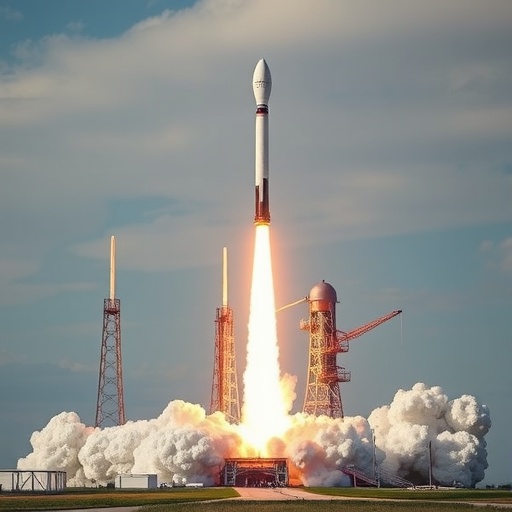
The cost of sending payloads into low Earth orbit is on the verge of a dramatic decline, set to revolutionize the economics of space travel within the next two decades. Recent research led by economists at the University of Cambridge forecasts that launch costs could fall by more than half by 2030 and plunge nearly 93% by 2040. This transformative drop could unlock a wide range of commercial and scientific space activities, from orbital manufacturing to space tourism.
Drawing on the most comprehensive dataset ever assembled — covering 4,405 launches from 1960 to 2025 with over 330 rocket configurations across major spacefaring nations — the study provides a detailed analysis of cost trajectories in space launch technology. Last year, the average cost to reach low Earth orbit stood at about $3,868 per kilogram. This is projected to fall to $1,569 per kilogram by 2030, and potentially as low as $273 per kilogram by 2040.
The underlying mechanism identified is an “experience curve” effect, whereby every doubling of the cumulative payload launches corresponds to a 21.2% reduction in cost per kilogram. This rate of cost decline outpaces even the historic improvements in steamship freight during the Industrial Revolution and rapidly advancing solar photovoltaic technology. The comparison underscores the vast potential for economies of scale and technological innovation in space launch markets.
Interestingly, the research also reveals how geopolitical and economic shifts have influenced launch costs. The Cold War era saw relatively stable prices, but the fall of the Berlin Wall in 1989 marked the start of faster cost reductions. Increased involvement from commercial entities, notably SpaceX—which now accounts for roughly 80% of global annual payload to orbit—has sharply accelerated this trend, altering the space economy from a government-driven sphere into a competitive, market-based frontier.
While declining launch costs hold enormous promise, the study also cautions about risks posed by monopolistic control and rising geopolitical competition. The dominance of a single launch provider could stifle price competition and delay broader industrial growth in orbit. Nonetheless, expanded capacity is expected to nearly double from 4,900 tonnes in 2025 to over 9,100 tonnes by 2030, with projections reaching 32,000 tonnes by 2040.
The implications are vast. Lower costs could enable in-orbit factories producing advanced fiber optics and bioprinted organs, off-planet solar power stations, asteroid mining ventures, and even permanent lunar bases. This technological and economic leap positions space colonization and externalization of polluting industries as feasible ventures within the coming decades. The study concludes that the era of space launch is entering a new phase, where economics, trade, and innovation drive exponential growth and open up unprecedented opportunities for humanity beyond Earth.
Keywords
space launch cost, low Earth orbit, space economy, experience curve, SpaceX, satellite launches, space commercialization, orbital manufacturing, space technology innovation
Cite Scienmag News
Denise Maddox. (July 14, 2026). Space launch costs may drop over 90% by 2040, revolutionizing space market. Scienmag. https://scienmag.com/space-launch-costs-may-drop-over-90-by-2040-revolutionizing-space-market/
Denise Maddox. "Space launch costs may drop over 90% by 2040, revolutionizing space market." Scienmag, 14 July 2026, https://scienmag.com/space-launch-costs-may-drop-over-90-by-2040-revolutionizing-space-market/. Accessed 4 September 2026.
Denise Maddox. "Space launch costs may drop over 90% by 2040, revolutionizing space market." Scienmag. July 14, 2026. https://scienmag.com/space-launch-costs-may-drop-over-90-by-2040-revolutionizing-space-market/


