

Tuesday, July 14, 2026
Science
No Result
View All Result
  • Login
  • HOME
  • SCIENCE NEWS
  • CONTACT US
  • HOME
  • SCIENCE NEWS
  • CONTACT US
No Result
View All Result
Scienmag
No Result
View All Result
Home Science News Technology and Engineering

Robot-Guided Surgery Advances Treatment of Complex Brain Abscesses

July 14, 2026
in Technology and Engineering
Reading Time: 2 mins read
0
Robot-Guided Surgery Advances Treatment of Complex Brain Abscesses

Robot-Guided Surgery Advances Treatment of Complex Brain Abscesses

65
SHARES
587
VIEWS
Share on FacebookShare on Twitter
ADVERTISEMENT

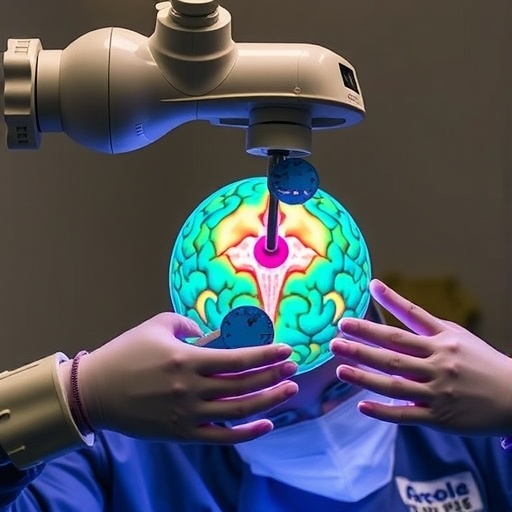
A groundbreaking approach to treating multiple deep brain abscesses has been demonstrated by a Chinese neurosurgical team utilizing advanced robot-guided stereotactic surgery. This innovative technique enabled the successful single-stage evacuation of six intracranial abscesses in a young female patient, marking a significant advancement in minimally invasive neurosurgical interventions for life-threatening brain infections.

The patient, a 21-year-old woman, presented with severe neurological symptoms including fever, headache, vomiting, and declining consciousness. Diagnostic magnetic resonance imaging (MRI) revealed six abscesses distributed across both frontal lobes, and the right temporal and occipital lobes, accompanied by marked cerebral edema and a midline shift, signaling imminent brain herniation. Given the critical multi-focal involvement, traditional open craniotomy would pose substantial risks and require multiple surgeries.

To address these challenges, Professor Jun Wang’s team employed a robot-assisted stereotactic navigation system. This technology integrates preoperative MRI with intraoperative computed tomography to generate a precise three-dimensional brain model. Surgeons planned four carefully calculated trajectories to access and drain all abscess cavities while avoiding eloquent brain regions, vital blood vessels, and ventricular structures. Notably, two trajectories leveraged a “one puncture, two injections” strategy, enabling drainage of two abscesses from a single cortical entry point—minimizing cortical injury and operative time.

Intraoperatively, each abscess was aspirated and irrigated with a gentamicin-saline solution to reduce infectious load locally. Concurrently, broad-spectrum antibiotics were administered and later tailored based on microbial cultures, which identified Streptococcus intermedius as the causative pathogen. The team also implemented a short, controlled dexamethasone regimen to alleviate cerebral edema without compromising the immune response, optimizing the patient’s recovery environment.

The clinical outcomes were remarkable. Fever resolved within 72 hours, neurological status rapidly improved, and follow-up MRI at one month showed complete resolution of abscesses and near-total absorption of abscess walls. Impressively, the patient regained full neurological function, maintaining a Karnofsky Performance Status of 100, with no recurrence observed at six- and twelve-month evaluations.

This case illustrates the transformative potential of robotic precision in neurosurgery for complex infectious cases. By enabling multi-target evacuation in a single minimally invasive procedure, this technology can dramatically reduce surgical trauma and expedite recovery times. While this report focuses on a single patient, it sets a precedent for future integration of robotics with multidisciplinary neurocritical care in treating multifocal intracranial infections.

Professor Wang emphasizes that this approach represents a paradigm shift, combining cutting-edge imaging, robotic navigation, and tailored pharmacologic management to tackle deeply seated brain abscesses effectively. Larger clinical studies are anticipated to validate the broad applicability of this strategy.

As robotic assistance and imaging modalities evolve, their integration promises to redefine emergency neurosurgical care, offering patients safer, faster, and more effective treatments for previously formidable brain infections.


Subject of Research: People
Article Title: Robot-guided stereotactic single‐stage evacuation of six intracranial abscesses: a rare case report with literature review
News Publication Date: 27-May-2026
References: DOI: 10.1186/s41016-026-00436-8
Image Credits: Professor Jun Wang from Department of Neurosurgery at the First Hospital of China Medical University, China

Keywords

Neuroscience, Clinical neuroscience, Neurology, Neurological disorders, Robotics

Tags: advanced imaging in brain abscess treatmentinnovative approaches to complex brain infectionsminimally invasive neurosurgical techniquesMRI and CT integration for surgical planningneuro-navigation systems in neurosurgeryneuroanatomy preservationprecision targeting in neurosurgical proceduresreducing surgical risks with robotic assistancerobot-assisted neurosurgery for intracranial infectionsrobot-guided stereotactic surgery for brain abscessessingle-stage evacuation of multiple brain abscessestreatment of deep brain abscesses
Share26Tweet16
Previous Post

Sensitive SWCNT Pyroelectric Phototransistors for Broadband Infrared Detection at Room Temperature

Next Post

How Supermassive Black Holes Sustain Their Growth

Related Posts

Europe advances integrated charging and energy systems for optimal V2G deployment
Technology and Engineering

Europe advances integrated charging and energy systems for optimal V2G deployment

July 14, 2026
Engineering Principles Advance Battery Electrolyte Design for Better Performance
Technology and Engineering

Engineering Principles Advance Battery Electrolyte Design for Better Performance

July 14, 2026
Nonlinear Dynamics of Cube Net Cage in Jacket Foundation at Different Depths
Technology and Engineering

Nonlinear Dynamics of Cube Net Cage in Jacket Foundation at Different Depths

July 14, 2026
Flexible EV charging boosts cost efficiency in EU energy systems
Technology and Engineering

Flexible EV charging boosts cost efficiency in EU energy systems

July 14, 2026
New Catalysts Boost Sustainable Aviation Fuel Production from Butyl Butyrate
Technology and Engineering

New Catalysts Boost Sustainable Aviation Fuel Production from Butyl Butyrate

July 14, 2026
Tri-layer substrates enable stress-free fabrication of stretchable integrated systems
Technology and Engineering

Tri-layer substrates enable stress-free fabrication of stretchable integrated systems

July 14, 2026
Next Post
How Supermassive Black Holes Sustain Their Growth

How Supermassive Black Holes Sustain Their Growth

  • Mothers who receive childcare support from maternal grandparents show more

    Mothers who receive childcare support from maternal grandparents show more parental warmth, finds NTU Singapore study

    27656 shares
    Share 11059 Tweet 6912
  • University of Seville Breaks 120-Year-Old Mystery, Revises a Key Einstein Concept

    1061 shares
    Share 424 Tweet 265
  • Bee body mass, pathogens and local climate influence heat tolerance

    682 shares
    Share 273 Tweet 171
  • Researchers record first-ever images and data of a shark experiencing a boat strike

    546 shares
    Share 218 Tweet 137
  • Groundbreaking Clinical Trial Reveals Lubiprostone Enhances Kidney Function

    531 shares
    Share 212 Tweet 133
Science

Embark on a thrilling journey of discovery with Scienmag.com—your ultimate source for cutting-edge breakthroughs. Immerse yourself in a world where curiosity knows no limits and tomorrow’s possibilities become today’s reality!

RECENT NEWS

  • Seasonal Cycle Balances Tropical Rain-Band Asymmetry
  • Detecting Exclusionary Nationalism in Prewar Japan Through Language Analysis
  • Europe advances integrated charging and energy systems for optimal V2G deployment
  • Magnetic Fields and Colliding Ejecta in Precessing SS 433 Jets

Categories

  • Agriculture
  • Anthropology
  • Archaeology
  • Athmospheric
  • Biology
  • Biotechnology
  • Blog
  • Bussines
  • Cancer
  • Chemistry
  • Climate
  • Earth Science
  • Editorial Policy
  • Marine
  • Mathematics
  • Medicine
  • Pediatry
  • Policy
  • Psychology & Psychiatry
  • Science Education
  • Social Science
  • Space
  • Technology and Engineering

Subscribe to Blog via Email

Enter your email address to subscribe to this blog and receive notifications of new posts by email.

Join 5,146 other subscribers

© 2025 Scienmag - Science Magazine

Welcome Back!

Login to your account below

Forgotten Password?

Retrieve your password

Please enter your username or email address to reset your password.

Log In
No Result
View All Result
  • HOME
  • SCIENCE NEWS
  • CONTACT US

© 2025 Scienmag - Science Magazine

Discover more from Science

Subscribe now to keep reading and get access to the full archive.

Continue reading
