


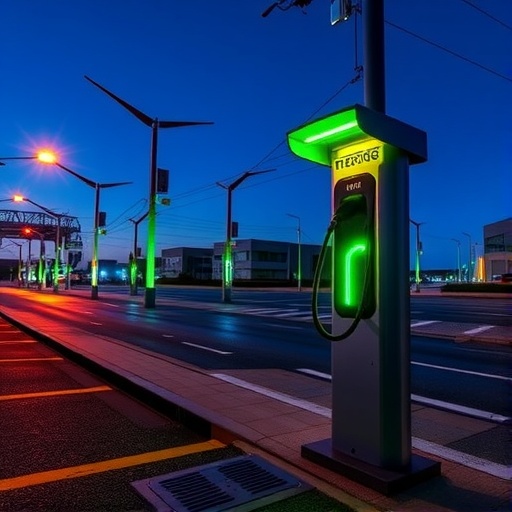
As Europe accelerates its transition towards electric vehicles (EVs), new research highlights the critical importance of flexible charging infrastructure tailored to emerging smart charging technologies. A recent study published in Nature Energy presents a novel approach, explicitly integrating charging infrastructure costs into a comprehensive European energy system model to evaluate the impact of unidirectional smart charging (V1G) and bidirectional vehicle-to-grid (V2G) technologies on system optimization and cost-efficiency.
Current European policies adopt uniform benchmarks for EV charging infrastructure, treating all vehicles and regions homogenously. This new research challenges that convention by considering the nuanced capabilities of V1G, which allows controlled charging to align with grid demands, and V2G, which enables vehicles to discharge energy back into the grid. By modeling these flexible charging schemes, the study reveals substantial system-wide benefits that conventional frameworks overlook.
The findings indicate that V1G technology captures the lion’s share of cost savings, reducing annual system expenses by €19 to €42 billion, translating to about 2.2-4.5% in overall savings. This unidirectional smart charging significantly lowers infrastructure requirements by optimizing charging times without demanding costly grid reinforcements. Conversely, V2G—while offering more dynamic grid interaction—yields more modest direct cost savings up to €2.5 billion per year but unlocks significant additional revenue streams estimated at €6.4 billion annually through balancing market participation, which helps stabilize fluctuations in renewable energy supply.
Interestingly, the study underscores that V2G deployment is especially advantageous in solar-heavy energy systems constrained by limited grid expansion. In these scenarios, where combined wind and solar generation is less abundant, the bidirectional export of electricity from EVs can alleviate grid stress and enhance overall energy reliability.
Moreover, the research highlights the stark heterogeneity in charging requirements across European countries, reflecting differences in utilization patterns and regional energy portfolios. This variability indicates risks associated with one-size-fits-all European Union infrastructure targets. Such uniform benchmarks might lead to overbuilding in regions with less demand or underutilizing the flexibility potential in areas where smart charging could effectively reduce infrastructure costs and improve grid integration.
The integration of charging infrastructure planning with broader energy system optimization marks a significant advance in electric mobility strategies. By allowing V1G and V2G to compete within a cost-minimizing framework, policymakers can tailor infrastructure investments more precisely, balancing costs with grid flexibility and renewable energy utilization.
This study’s comprehensive model reveals the multifaceted value of smart charging beyond merely meeting vehicle energy needs. The shift towards dynamic and coordinated charging paradigms promises to support a more resilient, cost-effective, and sustainable European energy system as EV penetration continues to rise.
With smart charging technologies at the forefront, the research provides critical insights for energy planners and governments aiming to design next-generation charging networks that unlock the full grid-balancing capabilities of EVs. As Europe races toward decarbonization goals, embracing this layered, context-sensitive approach could accelerate the adoption of electric vehicles while safeguarding grid reliability and containing costs.
The findings pave the way for more flexible regulatory frameworks that incentivize smart charging solutions, pushing beyond static infrastructure targets and moving towards an adaptive, data-driven model of transport electrification.
Cite Scienmag News
Denise Maddox. (July 14, 2026). Europe advances integrated charging and energy systems for optimal V2G deployment. Scienmag. https://scienmag.com/europe-advances-integrated-charging-and-energy-systems-for-optimal-v2g-deployment/
Denise Maddox. "Europe advances integrated charging and energy systems for optimal V2G deployment." Scienmag, 14 July 2026, https://scienmag.com/europe-advances-integrated-charging-and-energy-systems-for-optimal-v2g-deployment/. Accessed 7 September 2026.
Denise Maddox. "Europe advances integrated charging and energy systems for optimal V2G deployment." Scienmag. July 14, 2026. https://scienmag.com/europe-advances-integrated-charging-and-energy-systems-for-optimal-v2g-deployment/


