

Tuesday, July 14, 2026
Science
No Result
View All Result
  • Login
  • HOME
  • SCIENCE NEWS
  • CONTACT US
  • HOME
  • SCIENCE NEWS
  • CONTACT US
No Result
View All Result
Scienmag
No Result
View All Result
Home Science News Medicine

New Dual-Compartment Platform Monitors Biochemistry in Human Liver Perfusion

July 14, 2026
in Medicine
Reading Time: 2 mins read
0
New Dual-Compartment Platform Monitors Biochemistry in Human Liver Perfusion

New Dual-Compartment Platform Monitors Biochemistry in Human Liver Perfusion

65
SHARES
587
VIEWS
Share on FacebookShare on Twitter
ADVERTISEMENT

In a groundbreaking advance for organ transplantation, researchers have developed a dual-compartment biochemical monitoring platform that significantly enhances human liver perfusion assessment during clinical procedures. This innovative technology represents a pivotal leap in preserving liver function outside the body, potentially increasing the success rates of liver transplants and patient outcomes.

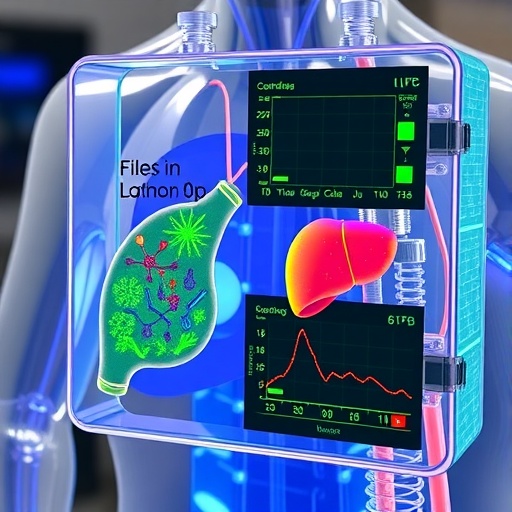
The platform operates by continuously sampling and analyzing critical biochemical markers in two separate compartments of the liver perfusion system—namely the vascular and extravascular spaces. This dual-compartment approach allows for unprecedented real-time monitoring of the liver’s metabolic state and cellular integrity during ex vivo perfusion. Unlike traditional single-compartment systems, which offer limited insight into the complex biochemical interactions within the liver, this device captures a comprehensive biochemical profile, enabling clinicians to make more informed decisions about organ viability.

At the heart of this technology is a miniaturized, multiplexed sensor array capable of detecting a spectrum of biochemical parameters such as glucose, lactate, electrolytes, and key enzymes indicative of cellular distress or recovery. The sensors interface with an automated data acquisition unit that processes the information and presents it through an intuitive clinical dashboard. This setup facilitates timely interventions that can optimize perfusion conditions, such as adjusting oxygen delivery or nutrient supply, ensuring the organ remains in an optimal state for transplantation.

The research team deployed this platform in a clinical setting involving human liver perfusions and demonstrated its ability to track metabolic changes accurately throughout the perfusion period. The detailed biochemical data correlated strongly with conventional markers of liver health and predicted post-transplant function more reliably than prior methods. Crucially, this enables the extension of preservation times and may allow for the utilization of marginal organs previously deemed unsuitable for transplantation.

Importantly, the device’s design emphasizes sterility, biocompatibility, and ease of integration into existing clinical workflows. Its compact footprint and real-time data transmission capabilities make it suitable for routine clinical use, lending itself to broad adoption across transplant centers worldwide. Additionally, the dual-compartment strategy may be adapted to other organ systems, opening avenues for improved preservation techniques beyond hepatology.

This advancement emerges against a backdrop of growing demands for donor organs and the pressing need to minimize ischemia-reperfusion injury—a major cause of graft failure. By providing continuous biochemical feedback, the platform offers a novel means to intervene dynamically during preservation, potentially mitigating damage and enhancing graft survival.

Future directions for this technology include refining sensor sensitivity, expanding the panel of monitored biomarkers, and integrating artificial intelligence algorithms for predictive analytics. Such improvements could further personalize organ preservation and transplantation strategies, marking a new era in transplant medicine.

This dual-compartment biochemical monitoring platform not only exemplifies the power of cutting-edge engineering applied to clinical challenges but also embodies the collaborative spirit driving innovation at the intersection of biotechnology and medicine. Its clinical deployment heralds a future where organ transplantation is safer, more efficient, and more successful.


Subject of Research: Human liver perfusion and biochemical monitoring technology

Article Title: A clinically deployed dual-compartment biochemical monitoring platform for human liver perfusion

Article References:
Zhou, K., Kim, M., Liu, CW. et al. A clinically deployed dual-compartment biochemical monitoring platform for human liver perfusion. Nat Commun 17, 5627 (2026). https://doi.org/10.1038/s41467-026-74799-y

Image Credits: AI Generated

DOI: https://doi.org/10.1038/s41467-026-74799-y

Tags: advanced liver perfusion systems with real-time dataand improving transplantation outcomesautomated data processing forclinical applications of real-time biochemical monitoring in liver transplantationcontinuous biochemical marker analysis in organ transplantationdual-compartment liver perfusion monitoring technologyex vivo liver preservation and assessmentimproving liver transplant success rates through biochemical monitoringinnovative organ preservation device with dual-compartment analysisliver tissue health during preservationmultiplexed biosensor arrays for organ viabilityreal-time biochemical monitoring in human liver perfusion systems
Share26Tweet16
Previous Post

Transcatheter PDA Closure Effects on Kidney Function in Tiny Preemies

Next Post

Oxytocin Triggers Socially Induced Cataplexy Episodes

Related Posts

Macrophage Itaconate Suppresses Heat Production in Fat Tissue
Medicine

Macrophage Itaconate Suppresses Heat Production in Fat Tissue

July 14, 2026
Oxytocin Triggers Socially Induced Cataplexy Episodes
Medicine

Oxytocin Triggers Socially Induced Cataplexy Episodes

July 14, 2026
Transcatheter PDA Closure Effects on Kidney Function in Tiny Preemies
Medicine

Transcatheter PDA Closure Effects on Kidney Function in Tiny Preemies

July 14, 2026
Osteoclasts Trigger DCC Loop Causing Chronic Low Back Pain in Mice
Medicine

Osteoclasts Trigger DCC Loop Causing Chronic Low Back Pain in Mice

July 14, 2026
Ethics Framework Proposed for Perioperative-Neonatal Care in Open Fetal Surgery
Medicine

Ethics Framework Proposed for Perioperative-Neonatal Care in Open Fetal Surgery

July 14, 2026
Single-cell analysis identifies keratinocyte groups driving inflammation in dermatitis
Medicine

Single-cell analysis identifies keratinocyte groups driving inflammation in dermatitis

July 14, 2026
Next Post
Oxytocin Triggers Socially Induced Cataplexy Episodes

Oxytocin Triggers Socially Induced Cataplexy Episodes

  • Mothers who receive childcare support from maternal grandparents show more

    Mothers who receive childcare support from maternal grandparents show more parental warmth, finds NTU Singapore study

    27656 shares
    Share 11059 Tweet 6912
  • University of Seville Breaks 120-Year-Old Mystery, Revises a Key Einstein Concept

    1061 shares
    Share 424 Tweet 265
  • Bee body mass, pathogens and local climate influence heat tolerance

    682 shares
    Share 273 Tweet 171
  • Researchers record first-ever images and data of a shark experiencing a boat strike

    546 shares
    Share 218 Tweet 137
  • Groundbreaking Clinical Trial Reveals Lubiprostone Enhances Kidney Function

    531 shares
    Share 212 Tweet 133
Science

Embark on a thrilling journey of discovery with Scienmag.com—your ultimate source for cutting-edge breakthroughs. Immerse yourself in a world where curiosity knows no limits and tomorrow’s possibilities become today’s reality!

RECENT NEWS

  • Space launch costs may drop over 90% by 2040, revolutionizing space market
  • New Tick-Borne Viruses Evade Human Immune System Defense Mechanisms
  • China’s water quality improvements impact agricultural productivity negatively
  • Vacuum-Deposited Perovskite Solar Cells Enhanced by Controlled Crystallization

Categories

  • Agriculture
  • Anthropology
  • Archaeology
  • Athmospheric
  • Biology
  • Biotechnology
  • Blog
  • Bussines
  • Cancer
  • Chemistry
  • Climate
  • Earth Science
  • Editorial Policy
  • Marine
  • Mathematics
  • Medicine
  • Pediatry
  • Policy
  • Psychology & Psychiatry
  • Science Education
  • Social Science
  • Space
  • Technology and Engineering

Subscribe to Blog via Email

Enter your email address to subscribe to this blog and receive notifications of new posts by email.

Join 5,146 other subscribers

© 2025 Scienmag - Science Magazine

Welcome Back!

Login to your account below

Forgotten Password?

Retrieve your password

Please enter your username or email address to reset your password.

Log In
No Result
View All Result
  • HOME
  • SCIENCE NEWS
  • CONTACT US

© 2025 Scienmag - Science Magazine

Discover more from Science

Subscribe now to keep reading and get access to the full archive.

Continue reading
