

Saturday, September 5, 2026
Science
No Result
View All Result
  • Login
  • HOME
  • SCIENCE NEWS
  • CONTACT US
  • HOME
  • SCIENCE NEWS
  • CONTACT US
No Result
View All Result
Scienmag
No Result
View All Result
Home Science News Earth Science

Major Earthquakes Impact Sea-Level Predictions in Southeast Asia, NTU Study Finds

July 14, 2026
in Earth Science
Violet Maxwell
By Violet Maxwell Scienmag Editorial Profile - Natural Hazards
Reading Time: 2 mins read
0
Major Earthquakes Impact Sea-Level Predictions in Southeast Asia, NTU Study Finds

Major Earthquakes Impact Sea-Level Predictions in Southeast Asia, NTU Study Finds

65
SHARES
587
VIEWS
Share on FacebookShare on Twitter
ADVERTISEMENT

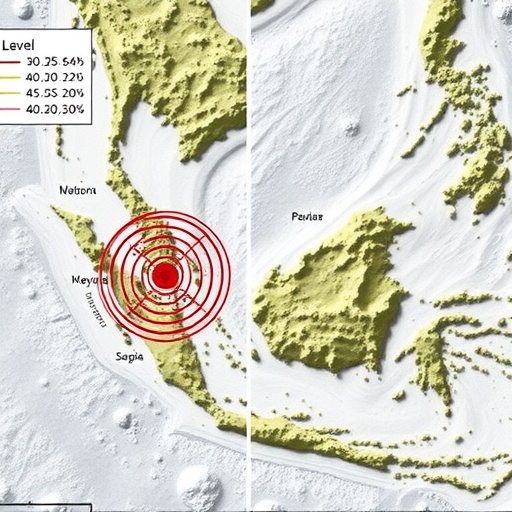
A groundbreaking study by researchers at Nanyang Technological University, Singapore (NTU Singapore), reveals that major earthquakes in Southeast Asia significantly impact regional sea-level projections by inducing long-term land subsidence. This discovery challenges current sea-level rise models, which primarily account for climate-driven factors like ice sheet melting and ocean warming, but often overlook geological processes beneath the Earth’s surface.

The research focuses on the Sumatran backarc region—an area situated behind Sumatra’s volcanic arc—where a hot and mechanically weak layer of the upper mantle, despite being solid rock, exhibits a capacity for slow, viscous flow. This weak layer deforms gradually after significant seismic events, leading to continued sinking of the overlying landmass for years, extending even decades post-earthquake.

Utilizing over twenty years of geodetic data from locations across Singapore, Malaysia, and Thailand, the research team traced ongoing ground displacements linked to seismic events such as the 2004 Sumatra-Andaman earthquake and the 2012 Wharton Basin earthquakes. Remarkably, these land movements were detected more than 600 kilometers from the quake epicenters, implying that the asthenosphere—a partially molten region of the upper mantle beneath the crust—is mechanically weak enough to accommodate post-seismic deformation at vast distances.

Computer simulations calibrated against GPS-derived ground movement validated that only a rheologically weak upper mantle could produce the measured patterns of postseismic subsidence. This slow deformation process, referred to as postseismic viscoelastic relaxation, steadily depresses the land surface, contributing to localized relative sea level rise beyond what is predicted by oceanic and ice mass changes alone.

Prof. Emma Hill, Chair of the Asian School of the Environment and Interim Director of the Earth Observatory of Singapore, emphasizes that integrating such deep Earth processes into sea-level rise forecasts is crucial. “Recognizing the contribution of post-earthquake land subsidence offers a more comprehensive understanding of coastal flood risks, particularly for vulnerable low-lying urban centers in Southeast Asia,” she states.

Lead author Dr. Grace Ng highlights the persistence of postseismic deformation mechanisms, explaining that earthquakes do not merely cause instantaneous shaking but trigger a slow, prolonged adjustment deep within the Earth. This finding suggests that geophysical models must extend beyond immediate post-event analyses to incorporate multi-decadal land movement forecasts for accurate risk assessments.

By recognizing the dual influence of oceanic changes and tectonic land motion, this research provides vital insights for improving coastal infrastructure planning and flood defense strategies. Coastal communities in Southeast Asia could leverage these refined models to anticipate and mitigate the compounded effects of climate change and tectonic subsidence, ensuring resilient adaptation measures.

This study also opens avenues for reevaluating similar subduction zones worldwide, where dynamic post-earthquake mantle flow might play an underappreciated role in shaping regional relative sea-level trends. As sea-level rise continues to threaten global coastlines, the inclusion of such geological factors represents a critical step towards holistic and accurate environmental forecasting.

Subject of Research: Earth Science

Article Title: Major Earthquakes Impact Sea-Level Predictions in Southeast Asia, NTU Study Finds

Article References: Original research article

Image Credits: AI Generated

DOI: Not provided

Keywords: asthenosphere's role in land subsidence, Earthquake-induced land subsidence, geodetic data sea-level modeling, geological processes influencing sea-level rise, long-term effects of seismic events on sea levels, NTU Singapore earthquake research, post-seismic land sinking, seismic activity and regional climate change, seismic impact on regional sea levels, Southeast Asia sea-level predictions, Sumatra-Andaman earthquake land deformation, upper mantle viscous flow

Cite Scienmag News

Violet Maxwell. (July 14, 2026). Major Earthquakes Impact Sea-Level Predictions in Southeast Asia, NTU Study Finds. Scienmag. https://scienmag.com/major-earthquakes-impact-sea-level-predictions-in-southeast-asia-ntu-study-finds/


Violet Maxwell. "Major Earthquakes Impact Sea-Level Predictions in Southeast Asia, NTU Study Finds." Scienmag, 14 July 2026, https://scienmag.com/major-earthquakes-impact-sea-level-predictions-in-southeast-asia-ntu-study-finds/. Accessed 5 September 2026.

Violet Maxwell. "Major Earthquakes Impact Sea-Level Predictions in Southeast Asia, NTU Study Finds." Scienmag. July 14, 2026. https://scienmag.com/major-earthquakes-impact-sea-level-predictions-in-southeast-asia-ntu-study-finds/

Tags: asthenosphere's role in land subsidenceEarthquake-induced land subsidencegeodetic data sea-level modelinggeological processes influencing sea-level riselong-term effects of seismic events on sea levelsNTU Singapore earthquake researchpost-seismic land sinkingseismic activity and regional climate changeseismic impact on regional sea levelsSoutheast Asia sea-level predictionsSumatra-Andaman earthquake land deformationupper mantle viscous flow
Share26Tweet16
Previous Post

Vaping or smoking cuts young people’s fitness by 15%

Next Post

PRIME-6G Aims to Revolutionize Connected Factory Technology

Related Posts

GSA opposes shrinking Bears Ears and Grand Staircase-Escalante monuments
Earth Science

GSA opposes shrinking Bears Ears and Grand Staircase-Escalante monuments

September 5, 2026
Yolk-shell zeolite nanoreactors resist poisons to cut NOx emissions
Earth Science

Yolk-shell zeolite nanoreactors resist poisons to cut NOx emissions

September 5, 2026
How multiple factors drive BTEX migration in saturated porous media
Earth Science

How multiple factors drive BTEX migration in saturated porous media

September 5, 2026
Post-wildfire flash floods and debris flows drive rising US losses
Earth Science

Post-wildfire flash floods and debris flows drive rising US losses

September 5, 2026
What shapes where juvenile parrotfish graze on Atlantic reefs
Earth Science

What shapes where juvenile parrotfish graze on Atlantic reefs

September 5, 2026
Two dryland trees respond differently to summer rainfall pulses in Rajasthan
Earth Science

Two dryland trees respond differently to summer rainfall pulses in Rajasthan

September 5, 2026
Next Post
PRIME-6G Aims to Revolutionize Connected Factory Technology

PRIME-6G Aims to Revolutionize Connected Factory Technology

  • Mothers who receive childcare support from maternal grandparents show more optimized

    Mothers who receive childcare support from maternal grandparents show more parental warmth, finds NTU Singapore study

    27656 shares
    Share 11059 Tweet 6912
  • University of Seville Breaks 120-Year-Old Mystery, Revises a Key Einstein Concept

    1061 shares
    Share 424 Tweet 265
  • Bee body mass, pathogens and local climate influence heat tolerance

    682 shares
    Share 273 Tweet 171
  • Researchers record first-ever images and data of a shark experiencing a boat strike

    546 shares
    Share 218 Tweet 137
  • Groundbreaking Clinical Trial Reveals Lubiprostone Enhances Kidney Function

    531 shares
    Share 212 Tweet 133
Science

Embark on a thrilling journey of discovery with Scienmag.com—your ultimate source for cutting-edge breakthroughs. Immerse yourself in a world where curiosity knows no limits and tomorrow’s possibilities become today’s reality!

RECENT NEWS

  • Graphene research reveals evidence of unconventional superconductivity
  • New grant funds study of California’s traditional health care practices
  • Black spruce decline: climate change and pests transform North American forests
  • Parkinson’s disease may cost China 473 billion yuan by 2040

Categories

  • Agriculture
  • Anthropology
  • Archaeology
  • Athmospheric
  • Biology
  • Biotechnology
  • Blog
  • Bussines
  • Cancer
  • Chemistry
  • Climate
  • Earth Science
  • Editorial Policy
  • Marine
  • Mathematics
  • Medicine
  • Pediatry
  • Policy
  • Psychology & Psychiatry
  • Science Education
  • Social Science
  • Space
  • Technology and Engineering

Subscribe to Blog via Email

Enter your email address to subscribe to this blog and receive notifications of new posts by email.

Join 5,151 other subscribers

© 2025 Scienmag - Science Magazine

Welcome Back!

Login to your account below

Forgotten Password?

Retrieve your password

Please enter your username or email address to reset your password.

Log In
No Result
View All Result
  • HOME
  • SCIENCE NEWS
  • CONTACT US

© 2025 Scienmag - Science Magazine

Discover more from Science

Subscribe now to keep reading and get access to the full archive.

Continue reading