


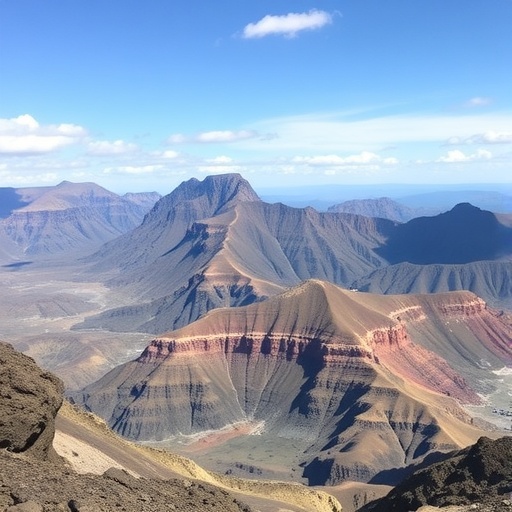
A groundbreaking new study reveals how volcanic activity instigated a profound shift in the Earth’s carbon cycle and oxygen levels during the Mesoproterozoic era, some 1.6 to 1 billion years ago. Published in Communications Earth & Environment, the research provides compelling evidence that ancient volcanism played a pivotal role in reshaping the planet’s atmospheric and oceanic chemistry, setting the stage for major evolutionary milestones.
By analyzing geochemical signatures embedded in sedimentary rock formations dating back to the Mesoproterozoic, researchers uncovered fluctuations in carbon isotopes that align closely with episodes of intense volcanic activity. These volcanic events released substantial quantities of greenhouse gases and nutrients into the environment, disturbing the long-term carbon cycle and triggering changes in oxygen production and distribution.
The Mesoproterozoic has often been regarded as a relatively stable period in Earth’s history, sandwiched between the Great Oxidation Event and the rise of complex multicellular life. However, this new evidence challenges that view, suggesting dynamic environmental shifts driven by geological forces were occurring beneath the surface. The influx of volcanic gases not only enriched the atmosphere with carbon dioxide but also altered ocean chemistry, potentially enhancing primary productivity.
One of the key findings is the link between volcanism and pulses in oxygen levels, which may have modulated the availability of oxygen in both the atmosphere and oceans. These oxygen fluctuations had profound implications for microbial ecosystems, including the early evolution of eukaryotes. The study proposes that volcanically induced shifts in redox conditions helped create ecological niches that fostered biological innovation.
Technically, the research team employed state-of-the-art isotopic analysis and sophisticated geochemical modeling to reconstruct the ancient interactions between volcanic emissions and biogeochemical cycles. Their approach allowed them to parse out subtle variations in the isotopic composition of carbon in carbonates and organic matter, revealing patterns consistent with episodic volcanic forcing.
This revelation sheds new light on the interplay between Earth’s interior geological processes and surface environmental conditions. The findings imply that internal Earth dynamics, such as tectonic activity, could exert significant control over global biogeochemical cycles far beyond what was previously appreciated.
As the field pushes forward, this research opens pathways for reevaluating other intervals in Earth’s deep history where volcanism might have been a critical driver of environmental and evolutionary change. Understanding how ancient carbon and oxygen cycles responded to volcanic perturbations is crucial for decoding the complex feedbacks that govern Earth’s habitability over geological time scales.
In sum, the study reshapes our understanding of the Mesoproterozoic era by highlighting the central role of volcanism in steering the carbon cycle and oxygen dynamics, laying groundwork for the eventual rise of complex lifeforms. It underscores the intricate connections between volcanic activity and life on Earth, providing a fresh perspective on the forces that shaped our planet’s early environment.
Jiang, Z., Cai, C., Dou, L. et al. Volcanism driven shift in the Mesoproterozoic carbon cycle and oxygen dynamics.
Commun Earth Environ (2026). https://doi.org/10.1038/s43247-026-03798-0
Cite Scienmag News
Violet Maxwell. (July 11, 2026). Volcanism Alters Carbon Cycle and Oxygen Levels in Mesoproterozoic Era. Scienmag. https://scienmag.com/volcanism-alters-carbon-cycle-and-oxygen-levels-in-mesoproterozoic-era/
Violet Maxwell. "Volcanism Alters Carbon Cycle and Oxygen Levels in Mesoproterozoic Era." Scienmag, 11 July 2026, https://scienmag.com/volcanism-alters-carbon-cycle-and-oxygen-levels-in-mesoproterozoic-era/. Accessed 3 September 2026.
Violet Maxwell. "Volcanism Alters Carbon Cycle and Oxygen Levels in Mesoproterozoic Era." Scienmag. July 11, 2026. https://scienmag.com/volcanism-alters-carbon-cycle-and-oxygen-levels-in-mesoproterozoic-era/


