


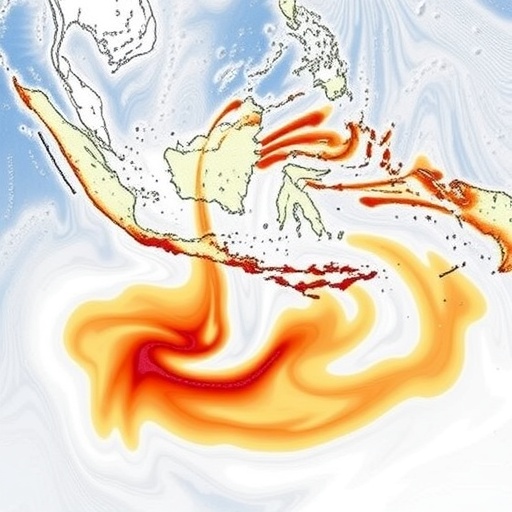
A newly published study reveals a striking connection between the accelerated circulation of Southern Hemisphere ocean gyres and the increased heat transport through the Indonesian Throughflow, a crucial ocean current system for global climate regulation. This research, led by Guo, Li, Cheng, and colleagues, offers fresh insights into how changes in ocean dynamics in one region can have profound impacts across vast distances, reshaping heat distribution patterns between the Pacific and Indian Oceans.
The Indonesian Throughflow (ITF) serves as a major conduit whereby warm water from the western Pacific Ocean flows into the eastern Indian Ocean. This process is essential for balancing the Earth’s heat budget and influences climate phenomena on regional and global scales. The study highlights a significant increase in heat transport via the ITF, a shift intimately tied to the intensification of Southern Hemisphere circulation gyres—large-scale oceanic vortices that drive the movement of surface and subsurface waters.
Utilizing a combination of advanced oceanographic models and observational data, the research team traced how the spin-up, or acceleration, of these gyres has altered the strength and volume of the ITF. Increased gyre circulation enhances the pressure gradients and wind patterns that funnel warm Pacific waters through the complex Indonesian archipelago. As a result, heat exchange across ocean basins has intensified, which may have cascading effects on weather patterns, marine ecosystems, and climate variability across the Indo-Pacific region.
This novel linkage underscores the complexity of ocean-atmosphere interactions and the interdependence of Earth’s ocean currents. The authors suggest that intensified gyre activity could be a response to shifts in wind stress driven by broader climate change processes, including altered Southern Hemisphere westerly winds. Hence, the findings pinpoint a dynamic feedback mechanism wherein atmospheric changes accelerate ocean gyres, thereby modulating oceanic heat transport pathways.
Beyond regional impacts, this enhanced heat flux through the ITF could influence the Indian Ocean Dipole, monsoon systems, and even sea surface temperature patterns as far afield as East Africa and Australia. Such ripple effects underscore the interconnectedness of oceanic and atmospheric systems, emphasizing the need for integrated climate models that factor in these complex circulatory changes.
The researchers highlight the urgency of monitoring these evolving ocean circulation patterns, given their potential to amplify climate extremes. Understanding how the Indonesian Throughflow system responds to Southern Hemisphere gyre activity also offers a valuable window into future climate scenarios, particularly in a warming world where small shifts in heat transport could have outsized environmental consequences.
By decoding this oceanic interplay, the study adds a crucial piece to the puzzle of Earth’s climate system, revealing how regional oceanic accelerations propagate influential changes across ocean basins. This breakthrough opens avenues for improved climate prediction models and a better grasp of how anthropogenic forces may be reshaping ocean heat dynamics at a planetary scale.
In linking the spin-up of Southern Hemisphere circulation gyres with increased heat transport through the Indonesian Throughflow, the study illuminates a vital mechanism through which ocean currents mediate climate variability. As research progresses, this knowledge could prove instrumental in adapting to—and mitigating—the multifaceted impacts of global climate change.
Cite Scienmag News
Violet Maxwell. (July 10, 2026). Indonesian Throughflow Heat Boost Fuels Southern Hemisphere Circulation Gyres. Scienmag. https://scienmag.com/indonesian-throughflow-heat-boost-fuels-southern-hemisphere-circulation-gyres/
Violet Maxwell. "Indonesian Throughflow Heat Boost Fuels Southern Hemisphere Circulation Gyres." Scienmag, 10 July 2026, https://scienmag.com/indonesian-throughflow-heat-boost-fuels-southern-hemisphere-circulation-gyres/. Accessed 4 September 2026.
Violet Maxwell. "Indonesian Throughflow Heat Boost Fuels Southern Hemisphere Circulation Gyres." Scienmag. July 10, 2026. https://scienmag.com/indonesian-throughflow-heat-boost-fuels-southern-hemisphere-circulation-gyres/


