

Thursday, July 9, 2026
Science
No Result
View All Result
  • Login
  • HOME
  • SCIENCE NEWS
  • CONTACT US
  • HOME
  • SCIENCE NEWS
  • CONTACT US
No Result
View All Result
Scienmag
No Result
View All Result
Home Science News Marine

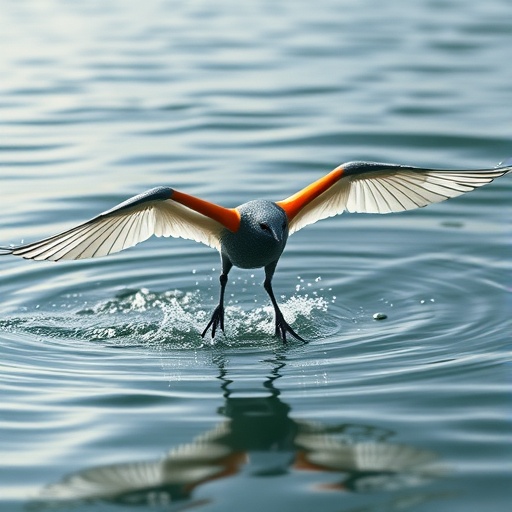
Flapping-wing robot reveals how birds transition between air and water

July 9, 2026
in Marine
Reading Time: 2 mins read
0
Flapping-wing robot reveals how birds transition between air and water

Flapping-wing robot reveals how birds transition between air and water

65
SHARES
587
VIEWS
Share on FacebookShare on Twitter
ADVERTISEMENT

A groundbreaking flapping-wing robot capable of both flying in air and swimming underwater is transforming scientific understanding of how diving birds navigate two vastly different environments. The study, led by Raphael Zufferey and colleagues, highlights new design principles that may revolutionize not only biological research but also the development of versatile aquatic-aerial robots for environmental monitoring.

About 100 bird species uniquely employ their wings to propel themselves efficiently both through air and underwater. Although these birds maintain a broadly similar wing-flapping motion in both media, they adapt by slowing wingbeats and decreasing wing surface area beneath the surface. Given that water is approximately 1,000 times denser than air, the physics of effective locomotion diverge significantly between the two. This disparity demands distinct forces and wing kinematics to optimize propulsion and lift in each. However, investigating these dual-environment dynamics in live birds is challenging, and computational models grapple with capturing the intricate fluid-structure interactions during transitions between water and air.

The robotic platform designed by Zufferey et al. offers a compelling solution by physically embodying the principles governing biological flapping-wing locomotion. The 250-gram untethered robot integrates a sleek fuselage, dual flexible membrane wings, and a movable tail, all in a waterproof chassis equipped with onboard electronics. This configuration allows remote modulation of wing-flapping frequency and tail angles, enabling controlled experimentation on how variations in wing size, flexibility, and motion affect performance in both aerial and aquatic settings as well as during seamless transitions.

Intriguingly, the researchers discovered that complex wing-folding mechanisms—long assumed essential for birds’ dual-function wings—are not critical. Instead, attaining an optimal balance of wing flexibility, size, and beating frequency suffices to achieve comparable propulsion and flight dynamics. Smaller wings, observed in certain diving birds, were found to enhance underwater speed but did not yield greater swimming efficiency, implying that wing reduction may primarily improve maneuverability and prey capture rather than conserve metabolic energy.

Wings possessing intermediate flexibility delivered the greatest overall efficacy. They enabled robust underwater thrust while still generating adequate lift to support flight, embodying a key functional compromise. The team also uncovered that aquatic takeoff powered solely by wing motion, without leg assistance, is feasible albeit energy-intensive. Notably, due to flying requiring significantly less power expenditure compared to swimming, the robot demonstrated greater efficiency in exiting the water to fly over longer distances rather than remaining submerged.

This pioneering robotic model not only sheds light on the evolutionary and physiological adaptations of aerial-aquatic animals but also establishes a versatile platform for future studies in limnology, oceanography, marine ecosystem assessment, and coastal management. By bridging the gap between biological observation and precise physical experimentation, the work unlocks new vistas for understanding—and emulating—the remarkable versatility of nature’s flying swimmers.

Subject of Research: Flapping-wing locomotion in aerial-aquatic environments
Article Title: Leaping out of the water: Aerial-aquatic locomotion with flapping wings
News Publication Date: 9-Jul-2026
Web References: 10.1126/science.aeb6744
Keywords: flapping-wing robot, aerial locomotion, aquatic propulsion, wing flexibility, biomechanical adaptation, diving birds, biomimetic robots, dual-environment locomotion

Tags: advancements in biomimetic drone technologybio-inspired aquatic-aerial robotsbio-inspired robotics for environmental monitoringbird wing propulsion in water and airchallenges of dual-environment bird flightFlapping-wing robot for dual-environment locomotionfluid-structure interaction in biomimetic roboticsinnovative principles in flapping-wing robot developmentphysics of wing flapping in different mediarobotic modeling of diving bird mechanicstransition dynamics between water and air in roboticsversatile underwater and aerial robot design
Share26Tweet16
Previous Post

How Mice Survive Extreme Environments Revealed by Researchers

Next Post

Genetic Adaptations Enable Survival of Earth’s Highest-Dwelling Mammal

Related Posts

New Marine Network Enhances Environmental Protections and Shipping Rules
Marine

New Marine Network Enhances Environmental Protections and Shipping Rules

July 9, 2026
Climate Change Causes Marine Animals to Shrink in Size
Marine

Climate Change Causes Marine Animals to Shrink in Size

July 9, 2026
Scientists Reveal the Mysteries Behind Basking Shark’s Strange Skin
Marine

Scientists Reveal the Mysteries Behind Basking Shark’s Strange Skin

July 9, 2026
International Team Warns Science Alone Can’t Save Coral Reefs
Marine

International Team Warns Science Alone Can’t Save Coral Reefs

July 8, 2026
Geoengineering Potential to Mitigate Extreme El Niño Events Explored
Marine

Geoengineering Potential to Mitigate Extreme El Niño Events Explored

July 8, 2026
South Australia’s algal bloom is the most toxic microalga recorded.
Marine

South Australia’s algal bloom is the most toxic microalga recorded.

July 6, 2026
Next Post
Genetic Adaptations Enable Survival of Earth’s Highest-Dwelling Mammal

Genetic Adaptations Enable Survival of Earth's Highest-Dwelling Mammal

  • Mothers who receive childcare support from maternal grandparents show more

    Mothers who receive childcare support from maternal grandparents show more parental warmth, finds NTU Singapore study

    27656 shares
    Share 11059 Tweet 6912
  • University of Seville Breaks 120-Year-Old Mystery, Revises a Key Einstein Concept

    1061 shares
    Share 424 Tweet 265
  • Bee body mass, pathogens and local climate influence heat tolerance

    682 shares
    Share 273 Tweet 171
  • Researchers record first-ever images and data of a shark experiencing a boat strike

    546 shares
    Share 218 Tweet 137
  • Groundbreaking Clinical Trial Reveals Lubiprostone Enhances Kidney Function

    531 shares
    Share 212 Tweet 133
Science

Embark on a thrilling journey of discovery with Scienmag.com—your ultimate source for cutting-edge breakthroughs. Immerse yourself in a world where curiosity knows no limits and tomorrow’s possibilities become today’s reality!

RECENT NEWS

  • BU Medical Student Awarded Prestigious Radiation Oncology Fellowship
  • Biochar Enhances Rice Straw for Improving Salty Soil Farming
  • Iran Fails on Environment While Persecuting Activists, New Book Reveals
  • Balancing Pollinator Protection and Climate Change Efforts

Categories

  • Agriculture
  • Anthropology
  • Archaeology
  • Athmospheric
  • Biology
  • Biotechnology
  • Blog
  • Bussines
  • Cancer
  • Chemistry
  • Climate
  • Earth Science
  • Editorial Policy
  • Marine
  • Mathematics
  • Medicine
  • Pediatry
  • Policy
  • Psychology & Psychiatry
  • Science Education
  • Social Science
  • Space
  • Technology and Engineering

Subscribe to Blog via Email

Enter your email address to subscribe to this blog and receive notifications of new posts by email.

Join 5,146 other subscribers

© 2025 Scienmag - Science Magazine

Welcome Back!

Login to your account below

Forgotten Password?

Retrieve your password

Please enter your username or email address to reset your password.

Log In
No Result
View All Result
  • HOME
  • SCIENCE NEWS
  • CONTACT US

© 2025 Scienmag - Science Magazine

Discover more from Science

Subscribe now to keep reading and get access to the full archive.

Continue reading
