


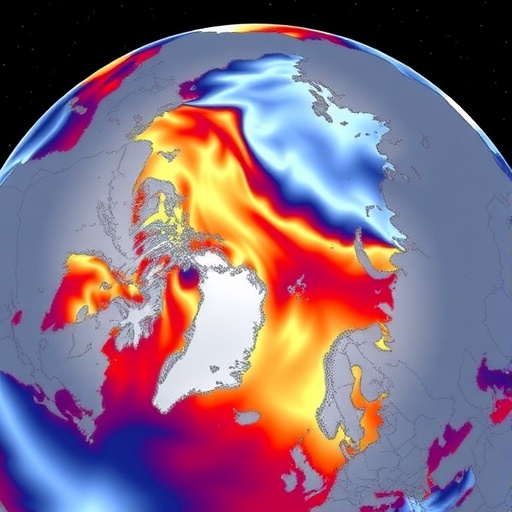
A groundbreaking study sheds new light on the dynamics of Arctic surface momentum, revealing that the region exhibits distinct regime transitions that are both persistent and predictable. This discovery, detailed in a recent publication by Liu and Liang, marks a significant advancement in our understanding of Arctic climate mechanisms and could enhance forecasting models for this sensitive and rapidly changing environment.
Arctic surface momentum balance plays a crucial role in determining the movement and behavior of the atmosphere and sea ice. Until now, the complex interactions governing momentum exchanges between the atmosphere and surface have been poorly understood, especially regarding their temporal variability and stability. Liu and Liang’s research provides compelling evidence that Arctic surface momentum states do not fluctuate randomly but instead transition between well-defined dynamical regimes.
Using high-resolution observational data combined with sophisticated dynamical systems analysis, the researchers identified persistent states characterized by unique momentum balance properties. These regimes influence wind patterns, sea ice drift, and atmospheric circulation, underlining their importance for regional climate variability. The stability of these states implies that such regimes can be anticipated before they give way to another, opening new pathways for predictive modeling.
The study outlines how shifts between these regimes impact Arctic weather and climate patterns, including alterations in momentum fluxes that drive sea ice deformation and atmospheric heat transport. Understanding these transitions is paramount for improving seasonal forecasts and climate models, which have struggled to capture rapid Arctic changes accurately.
Moreover, the predictability of these dynamical regimes suggests that certain Arctic weather phenomena may have longer lead times than previously thought. This insight holds promise for sectors reliant on Arctic forecasting, from shipping and resource extraction to indigenous communities and ecological management.
Technically, the authors applied nonlinear time series analysis techniques to dissect complex momentum data, teasing apart the underlying dynamics that govern regime stability and transitions. The interplay between atmospheric turbulence, surface roughness variability, and thermodynamic conditions emerged as critical factors sustaining these dynamical states.
This research arrives at a crucial juncture, as the Arctic faces unprecedented transformations due to anthropogenic warming. By illuminating the mechanisms behind these momentum regimes, Liu and Liang equip scientists and policymakers with a deeper understanding necessary to anticipate and adapt to emergent Arctic climate realities.
Ultimately, these findings suggest a more predictable Arctic environment than previously recognized, albeit one that still requires careful monitoring as climate change continues to accelerate. The potential to forecast regime shifts could revolutionize how climate impacts in polar regions are managed and mitigated—truly a scientific breakthrough with practical global significance.
Cite Scienmag News
Russell Cooper. (July 8, 2026). Arctic Surface Momentum Shifts Reveal Predictable and Persistent Dynamic States. Scienmag. https://scienmag.com/arctic-surface-momentum-shifts-reveal-predictable-and-persistent-dynamic-states/
Russell Cooper. "Arctic Surface Momentum Shifts Reveal Predictable and Persistent Dynamic States." Scienmag, 8 July 2026, https://scienmag.com/arctic-surface-momentum-shifts-reveal-predictable-and-persistent-dynamic-states/. Accessed 3 September 2026.
Russell Cooper. "Arctic Surface Momentum Shifts Reveal Predictable and Persistent Dynamic States." Scienmag. July 8, 2026. https://scienmag.com/arctic-surface-momentum-shifts-reveal-predictable-and-persistent-dynamic-states/


