


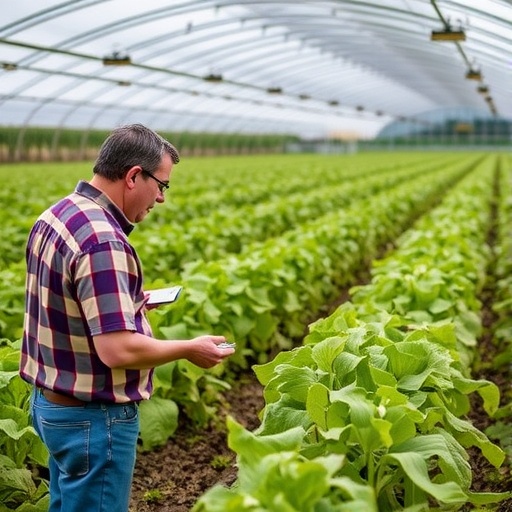
Farmers are on the cusp of a technological revolution, thanks to cutting-edge research from the University of Missouri that harnesses artificial intelligence to optimize planting practices. This breakthrough challenges the traditional, uniform seeding approaches that have long dominated agriculture, revealing that tailoring seeding rates according to precise, location-specific field data can significantly boost productivity and sustainability.
At the core of this innovation is variable-rate seeding (VRS), a technique that eschews one-size-fits-all planting in favor of dynamic adjustments based on the unique conditions found in different parts of a single field. By integrating AI-driven models with geospatial and historical yield data, researchers have created intelligent systems that enable planters to modulate seed density in real time, optimizing resource use and economic returns.
Jasmine Neupane, assistant professor of agricultural systems technology at Mizzou’s College of Agriculture, Food and Natural Resources, highlights the variability often invisible to the naked eye. “Fields might look homogenous from a distance, but soil quality, moisture content, and susceptibility to erosion can vary drastically even within short distances,” she explains. These factors profoundly influence the potential yield and resource requirements of every plot.
The AI model developed by Neupane and her collaborators was trained using comprehensive datasets including soil samples, topographical elevation, and multiple years of yield records gathered from two distinct Ohio farms. This multifaceted data input enables the system to identify agronomic and economic optima for seeding rates, ensuring that investment in seeds and agrochemicals is targeted where it will have the most beneficial impact.
Their findings reveal that for corn, a staple crop with relatively stable responses, VRS supported by AI provides consistent, predictable improvements. The model accurately distinguishes zones within fields where increased seeding enhances yields versus areas where it is economically unwise to apply extra seeds. This precision agriculture technique promises immediate practical benefits for corn farmers aiming to maximize productivity while minimizing waste.
Soybean cultivation presented a more complex picture. Soybeans demonstrate phenotypic plasticity, adapting their growth based on environmental variables such as rainfall and temperature. This resilience complicates predictions, as weather fluctuations often exert a stronger influence on yield than seeding density adjustments alone. Consequently, the AI recommendations for soybeans require further refinement before they can be fully trusted for commercial deployment.
Looking forward, Neupane aims to expand research efforts this summer to incorporate data from Mizzou’s Digital Agriculture Research and Extension Center. Inspired by the agricultural challenges she witnessed growing up in Nepal, she envisions AI as a democratizing force that can empower farmers worldwide—especially those with limited land and resources—to manage their fields with unprecedented strategic insight.
This research represents a significant stride towards precision farming that aligns agronomic decisions with economic and environmental sustainability goals. By enabling nuanced management of crop inputs through artificial intelligence and geospatial analytics, it sets the stage for smarter, more resilient agricultural systems.
The study, titled “Leveraging machine learning and geospatial analysis to determine agronomic and economic optima for variable-rate seeding in corn and soybean,” has been published in the Agronomy Journal.
Cite Scienmag News
Alan Morgan. (July 8, 2026). Mizzou Researchers Harness AI to Revolutionize Farming Practices. Scienmag. https://scienmag.com/mizzou-researchers-harness-ai-to-revolutionize-farming-practices/
Alan Morgan. "Mizzou Researchers Harness AI to Revolutionize Farming Practices." Scienmag, 8 July 2026, https://scienmag.com/mizzou-researchers-harness-ai-to-revolutionize-farming-practices/. Accessed 3 September 2026.
Alan Morgan. "Mizzou Researchers Harness AI to Revolutionize Farming Practices." Scienmag. July 8, 2026. https://scienmag.com/mizzou-researchers-harness-ai-to-revolutionize-farming-practices/


