


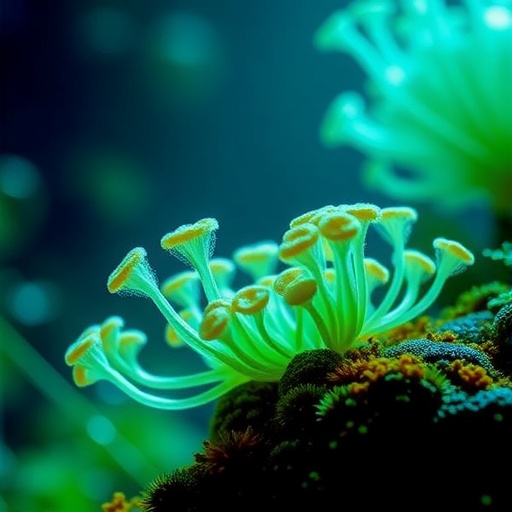
Collodaria, the glassy ocean drifters that build elaborate silica skeletons and host microscopic algae, are challenging a familiar assumption about life in the open sea. A study by Viktoria Nikitashina and Georg Pohnert, published in Nature Communications, shows that these photosymbiotic holobionts do not rely on a single nutritional strategy. Instead, their metabolism appears to be divided between carbon captured by photosynthesis and organic compounds absorbed directly from seawater—a flexible arrangement that may help them survive in nutrient-poor parts of the ocean.
Collodaria belong to the Rhizaria, a diverse group of planktonic organisms whose members include radiolarians and other amoeboid protists. Many collodarian species live as colonies, with numerous individual cells embedded in a gelatinous matrix and surrounded by striking mineral structures. Inside or alongside the host cells are photosynthetic dinoflagellates, microscopic partners that convert light, carbon dioxide and inorganic nutrients into organic matter. The partnership resembles that of corals and their algal symbionts, but it operates in the constantly moving and chemically variable environment of the pelagic ocean.
The new research focuses on what happens when light-driven carbon fixation is not enough. Photosynthesis can provide energy during the day, but it depends on sunlight and requires access to nutrients such as nitrogen and phosphorus. In the open ocean, these resources are often unevenly distributed. Collodaria may therefore supplement photosynthesis through osmotrophy, the uptake of dissolved organic molecules across cell membranes. This strategy allows organisms to exploit carbon compounds already present in seawater, including molecules released by other organisms or produced during the breakdown of biological material.
The key concept is metabolic partitioning: photosynthesis and osmotrophy are not necessarily competing alternatives, but complementary pathways assigned to different members of the holobiont. The algal symbionts can use light to manufacture fixed carbon, while the host may absorb dissolved organic substances from its surroundings. Those compounds can then support respiration, growth, cellular maintenance or the production of the colony’s protective framework. At the same time, photosynthetic products may move in the opposite direction, from the symbionts to the host. The result is a biologically integrated system in which carbon flows through several compartments rather than remaining within a single cell.
According to the study, the distinction between host and symbiont metabolism is therefore more complicated than a simple exchange of “food” for “shelter.” The holobiont functions as a distributed metabolic network. The algal partners contribute the products of photosynthetic carbon fixation, while the host retains the ability to acquire external dissolved nutrients and carbon. This arrangement may reduce pressure on the symbionts and give the colony access to resources that photosynthesis alone cannot provide. It also means that the nutritional identity of Collodaria cannot be captured by labels such as purely phototrophic or purely heterotrophic.
The findings are especially important because dissolved organic matter is often treated as an invisible resource in ocean ecosystems. Although it does not form a visible food particle, it represents a large and chemically diverse pool of carbon. Osmotrophy allows microorganisms to draw on this pool molecule by molecule. For a drifting colony exposed to changing light levels, water masses and nutrient concentrations, the ability to absorb dissolved compounds could provide a crucial buffer. During bright, nutrient-available conditions, photosynthesis may dominate carbon acquisition; in darker or more chemically favorable conditions, uptake from seawater may become more significant.
This flexibility could help explain why photosymbiotic plankton occupy such a wide range of marine habitats. Collodaria are found in warm and temperate waters and can contribute to the vertical transport of organic and inorganic material as their colonies grow, sink or are consumed. Their silica structures also make them part of the ocean’s mineral cycle. By linking light capture, dissolved organic matter and mineral production in one living unit, they connect processes that are often studied separately. A change in the balance between these pathways could influence both the physiology of the colony and the movement of carbon through the water column.
The study also highlights why holobionts must be studied as systems rather than as isolated species. Measurements made only on the algal symbiont might suggest that the partnership is powered mainly by photosynthesis. Observations focused only on the host could miss the scale of carbon supplied by the algae. Metabolic analyses that trace resources through the entire association are better suited to revealing how compounds are acquired, transformed and exchanged. The work by Nikitashina and Pohnert places this internal division of labor at the center of the ecological story, showing that the survival of the partnership depends on more than the presence of photosynthetic cells.
The broader message is that ocean productivity may be more flexible—and more difficult to measure—than conventional models assume. Climate-driven changes in light penetration, stratification, nutrient delivery and dissolved organic matter could alter the relative importance of photosynthesis and osmotrophy in Collodaria. If these organisms adjust their metabolism as conditions shift, they may remain resilient in environments where other plankton struggle. But the same flexibility could also change how much carbon they retain, export or release. By revealing the metabolic cooperation hidden inside a drifting silica colony, the study offers a new view of marine symbiosis: not as a static partnership, but as a dynamic biochemical strategy built for an unpredictable ocean.
Cite Scienmag News
Violet Maxwell. (August 19, 2026). Study reveals how Collodaria holobionts divide metabolism between photosynthesis and osmotrophy. Scienmag. https://scienmag.com/study-reveals-how-collodaria-holobionts-divide-metabolism-between-photosynthesis-and-osmotrophy/
Violet Maxwell. "Study reveals how Collodaria holobionts divide metabolism between photosynthesis and osmotrophy." Scienmag, 19 August 2026, https://scienmag.com/study-reveals-how-collodaria-holobionts-divide-metabolism-between-photosynthesis-and-osmotrophy/. Accessed 4 September 2026.
Violet Maxwell. "Study reveals how Collodaria holobionts divide metabolism between photosynthesis and osmotrophy." Scienmag. August 19, 2026. https://scienmag.com/study-reveals-how-collodaria-holobionts-divide-metabolism-between-photosynthesis-and-osmotrophy/


