


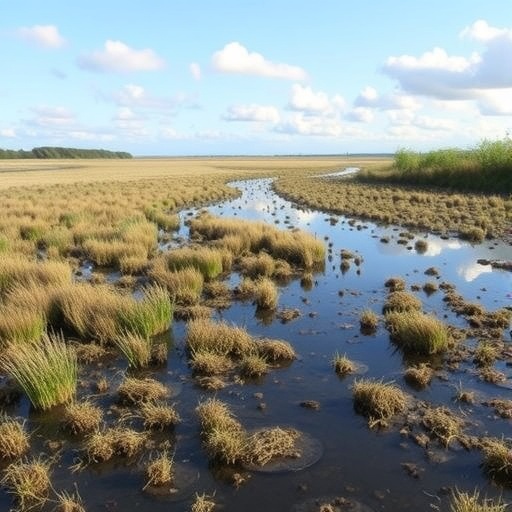
Coastal wetlands are often cast as helpless victims of rising seas, doomed to drown in place if they cannot migrate inland. But a startling new study reveals that these landscapes are capable of a dramatic and self-propelled metamorphosis, flipping from a saltmarsh teeming with cordgrass and samphire into a freshwater reedland that buries carbon at a prodigious rate. The secret, according to an international team of researchers, is a hydrological switch — a subtle but relentless shift in the movement and chemistry of groundwater that rewires the entire ecosystem.
The work, led by Athanasia Valsamidou and published in Communications Earth & Environment, focused on coastal wetlands in the Netherlands where patches of common reed (Phragmites australis) have mysteriously invaded saltmarshes over recent decades. Instead of a gradual, linear progression from salty to fresh conditions, the team documented a binary, almost electrical flip: once a critical threshold of freshwater input is crossed, the system snaps from a saline, tidal flat into a peat-forming reedland that actively engineers its own hydrology to lock out the sea.
At the heart of this transformation is the behaviour of a freshwater lens, the lens-shaped body of rainwater and upland seepage that floats atop denser, saline groundwater because of the density difference. In a healthy saltmarsh, regular tidal inundation suppresses this lens, keeping porewater salinities high and favouring halophytic vegetation. The researchers discovered that if the freshwater supply to the marsh increases — through heavier rainfall, altered drainage, or the realignment of coastal defences — the lens thickens. Once it grows sufficiently buoyant and extensive, it physically pushes the saltwater interface downwards and outwards. This is the hydrological switch: a self-reinforcing process where a small change in freshwater volume triggers a large-scale reorganisation of the subsurface flow field.
The ecological consequences are immediate and irreversible over human timescales. As porewater salinity plummets below the tolerance threshold of saltmarsh plants, they die off en masse, opening space for Phragmites seeds and rhizomes to colonise. The reed, a formidable ecosystem engineer, then accelerates the freshwater takeover. Its dense root mat clogs the soil surface, slowing tidal infiltration and promoting ponding of rainwater. Its towering stems shade out competitors and pump oxygen into the sediment, fuelling microbial decomposition that releases nutrients and further cements the freshwater state. The end product is no longer a marsh but a fen-like reedland that accumulates peat — a carbon-dense, organic soil that can grow vertically, potentially keeping pace with rising sea levels in ways a mineral saltmarsh cannot.
Crucially, the team used a combination of long-term field monitoring, geophysical surveys, and reactive transport modelling to reconstruct the tipping point. They tracked the evolution of porewater chemistry across multiple sites and identified a sharp salinity front migrating seaward at rates of several metres per year. The models showed that once the freshwater lens reached a critical thickness of approximately 1.5 to 2 metres, the saline water beneath it was no longer able to re-enter the root zone by capillary rise or tidal pumping. The lens had effectively decoupled the surface ecosystem from the sea, severing the salt supply line forever.
This finding turns conventional coastal management narratives on their head. Many restoration projects aim to maintain or re-establish saltmarshes for their flood defence and biodiversity value. But in regions where freshwater inputs are increasing — a scenario predicted for many temperate coasts under climate change — the hydrological switch could make such efforts futile. The saltmarsh may be destined to transform into a peaty reedland, whether we want it to or not. The silver lining, however, is immense: reedlands are among the most efficient carbon sinks on the planet, accreting peat at rates that can outpace even the most pessimistic sea-level projections, providing a natural form of coastal resilience.
The study’s authors caution that the switch is not instantaneous; it can unfold over decades as the freshwater lens builds, and it requires a specific combination of hydrogeological conditions, including a low-gradient coastal plain and a reliable year-round freshwater source. Yet where these conditions exist, the process may already be reshaping coastlines from the Baltic to the Gulf of Mexico without being fully recognised. The iconic image of the reed-choked swamp, often dismissed as a degraded landscape, may in fact represent a highly adaptive, carbon-sequestering state that coastal ecosystems have been quietly shifting towards for centuries.
Perhaps the most profound implication is for global carbon budgets. If a significant fraction of the world’s saltmarshes — currently estimated to cover 5.5 million hectares — were to undergo this hydrological switch, the resulting spike in peat formation could sequester additional gigatonnes of atmospheric carbon dioxide. The research hints that restoring natural freshwater flows to drained coastal lowlands could deliberately flip degraded salt pans into carbon-farming reedlands, merging climate mitigation with coastal adaptation. It is a vision of a living coastline that not only retreats from the sea but rises to meet it.
Cite Scienmag News
Violet Maxwell. (July 8, 2026). Hydrological switch converts saltmarsh to peat-forming reedland. Scienmag. https://scienmag.com/hydrological-switch-converts-saltmarsh-to-peat-forming-reedland/
Violet Maxwell. "Hydrological switch converts saltmarsh to peat-forming reedland." Scienmag, 8 July 2026, https://scienmag.com/hydrological-switch-converts-saltmarsh-to-peat-forming-reedland/. Accessed 4 September 2026.
Violet Maxwell. "Hydrological switch converts saltmarsh to peat-forming reedland." Scienmag. July 8, 2026. https://scienmag.com/hydrological-switch-converts-saltmarsh-to-peat-forming-reedland/


