

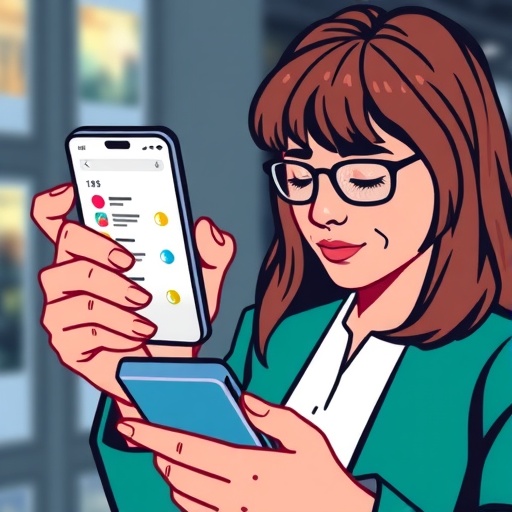
Your smartphone already knows where you go, what you buy, and how you sleep. Now, a groundbreaking study reveals it can also capture the invisible architecture of severe mental illness as it unfolds in daily life, painting the most granular picture yet of conditions like schizophrenia, bipolar disorder, and major depression outside the clinic walls. Researchers equipped hundreds of individuals with serious psychiatric diagnoses with a simple smartphone app that pinged them multiple times a day, asking about their mood, thoughts, and perceptions in the moment. The resulting dataset—a dense, longitudinal stream of real-world experience—unlocks patterns that could fundamentally reshape how we diagnose, monitor, and treat these disorders.
The work, published in Translational Psychiatry, leverages ecological momentary assessment to move beyond the traditional snapshot of a clinical interview. In a typical psychiatric evaluation, a patient is asked to recall and summarize weeks of complex inner experience in a single sitting, a method notoriously vulnerable to memory biases, recency effects, and the unnaturally sterile environment of the doctor’s office. By contrast, this study collected over 60,000 momentary surveys from participants going about their ordinary routines, capturing symptoms as they ebbed and flowed during arguments, commutes, lonely afternoons, and moments of quiet joy.
The analytical engine driving the insights is a class of statistical models known as dynamic structural equation modeling, adapted for intensive longitudinal data. Rather than treating diagnoses as rigid silos, the team mapped how transdiagnostic symptom dimensions—such as anxious apprehension, anhedonia, perceptual dysregulation, and cognitive disorganization—co-vary and predict one another within individuals over time. This approach acknowledges a truth clinicians have long sensed: a person with bipolar depression and one with major depressive disorder may share more phenomenological DNA in a given hour than two people with the same diagnosis but different life contexts.
One of the most striking findings is the extent of short-term volatility in symptoms that remain completely invisible to standard assessments. A participant might report near-normal mood at a morning survey, severe paranoia at lunch, and a return to baseline by evening. This high-frequency fluctuation, the authors argue, is not merely noise but a signal of underlying instability in neural systems governing affective regulation and reality testing. The smartphone surveys captured these micro-relapses and rapid cycles with a temporal resolution that dwarfs the weekly or monthly check-ins typical of outpatient care.
The study also uncovered characteristic temporal cascades: for example, a morning spike in rumination significantly elevated the probability of an evening spike in persecutory ideation, but only when social context was rated as stressful. Such contingent relationships reveal how environmental triggers interact with endogenous vulnerability factors to produce the experience of psychosis or despair. This kind of contextualized dynamic network could one day form the basis of personalized early-warning algorithms, buzzing a patient or their care team when an individual’s pattern signals an impending crisis.
Crucially, the research embraced a dimensional, transdiagnostic framework codified in the Hierarchical Taxonomy of Psychopathology (HiTOP). Instead of recruiting participants based on DSM categories alone, the team selected individuals who shared broad-spectrum liability for serious mental illness, then let the data reveal natural clusters of symptom co-occurrence. The results provide strong ecological validity for the idea that the boundaries we draw around schizophrenia, schizoaffective disorder, and bipolar I are permeable, with patients frequently straddling these artificial lines depending on the hour or day. This has profound implications for drug development, which has been hamstrung by clinical trials that silo patients according to labels that may poorly reflect underlying biology.
The technological backbone of the project is remarkably unexotic—an app that presents Likert-scale questions and slider bars, requiring minimal digital literacy. Compliance rates were high, debunking the paternalistic myth that individuals with severe mental illness are too disorganized or paranoid to engage meaningfully with mobile health tools. In fact, participants reported that the self-monitoring itself had a therapeutic effect, enhancing insight and reducing the feeling of being passively victimized by their symptoms. This fusion of data collection and digital phenotyping with a subtle interventionist dimension points toward a future where the measurement tool is also a treatment component, seamlessly integrated into daily life.
Beyond the immediate clinical implications, the study models a new kind of science where the laboratory is the lived experience of participants. It captures the wild, uncontrolled messiness of real existence—caffeine, traffic, broken sleep, social rejection—and treats it not as a confound to be eliminated but as the very substrate of psychopathology. The resulting dataset is open-source, inviting computational neuroscientists and statisticians to hunt for hidden Markov states, early warning signals of phase transitions, and other complex signatures borrowed from ecology and physics. The potential to identify generalized indicators of system collapse in mental health, akin to the flickering that precedes a stock market crash or an epileptic seizure, is tantalizingly within reach.
Critics will note that self-report captures only the conscious, articulable surface of mental life and misses the profound role of autonomic, neuroendocrine, and motivational processes that operate below awareness. The researchers acknowledge this limitation and advocate for multimodal sensor fusion, where passive data streams—geolocation, speech prosody, screen interaction patterns—are married to active survey responses to create a dense physiological and behavioral fabric. Already, pilot work is underway integrating the platform with wearable electrodermal and actigraphy sensors.
The vision is audacious: a continuous, privacy-respecting diagnostic system that learns the rhythms of an individual’s mind and sounds an alarm not when they meet some arbitrary population threshold, but when their own signature begins to warp into a shape that historically preceded suffering. In an era when mental health resources are stretched to breaking, this kind of scalable, empirically grounded digital triage could mean the difference between a prevented episode and a devastating hospitalization. The humble daily survey, it turns out, might hold the key to unlocking the darkest corners of the psyche, one ping at a time.
Subject of Research: Ecological momentary assessment of transdiagnostic clinical symptoms using daily smartphone surveys in individuals with serious mental illness.
Article Title: Ecological assessment of transdiagnostic clinical symptoms in serious mental illness with daily smartphone surveys.
Article References:
Chung, Y., Gillis, B.W., Rahimi-Eichi, H. et al. Ecological assessment of transdiagnostic clinical symptoms in serious mental illness with daily smartphone surveys. Transl Psychiatry (2026). https://doi.org/10.1038/s41398-026-04218-9
Image Credits: AI Generated
DOI: https://doi.org/10.1038/s41398-026-04218-9
Keywords: ecological momentary assessment, transdiagnostic, serious mental illness, smartphone surveys, digital phenotyping, dynamic symptom networks, hierarchical taxonomy of psychopathology, real-world monitoring, psychosis, mood disorders


