

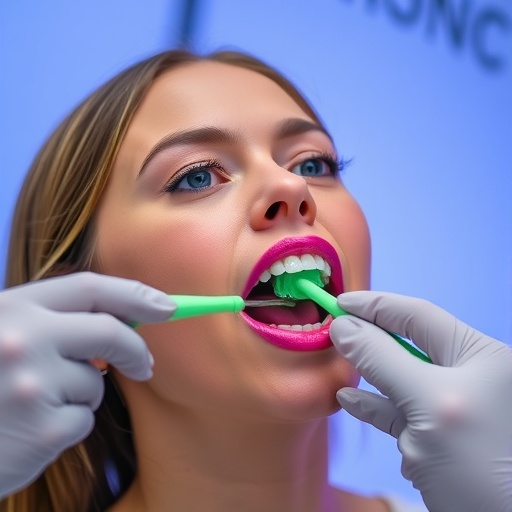
A cheap, non-invasive brush test can detect oral cancer in under an hour and could spare more than 90 percent of patients from painful, often unnecessary scalpel biopsies, according to a landmark study published in Biomarker Research. Building on years of molecular diagnostics work, the test — called qMIDS-V3 — requires only a quick swab of the inside of the mouth and delivers a result while the patient is still in the clinic, a step change for a disease where late diagnosis remains a global killer.
Oral squamous cell carcinoma is one of the fastest-rising causes of early death worldwide, with over 650,000 new cases each year. In the United Kingdom alone, more than 10,000 people were diagnosed last year and 3,637 died. The tragedy behind these numbers is that survival is strongly tied to stage at detection, yet over half of all mouth cancers are caught only at stage IV, when the tumour is at its most advanced and treatment options are limited and disfiguring. The main barrier to earlier discovery is not a lack of suspicious lesions — it is the diagnostic bottleneck that follows. Most patients who present with an oral potentially malignant disorder have a benign condition, but distinguishing the few that will progress to carcinoma is impossible by visual inspection alone. Consequently, the default clinical response is a scalpel biopsy, an invasive procedure that cuts out a piece of tongue, gum or cheek tissue. The biopsy can be exquisitely painful, risks infection, and in certain sites such as the gum may damage underlying tooth and bone. Unsurprisingly, both patients and clinicians are reluctant to repeat it, making systematic surveillance of high-risk individuals difficult.
The new brush test sidesteps this problem entirely. Instead of a tissue excision, a clinician simply rotates a small brush against the suspicious patch to collect exfoliated surface cells. The sample is then analysed using a real-time PCR-based assay that measures the expression of a small panel of genes whose dysregulation is a hallmark of malignant transformation. The core of the molecular signature centres on the genes INHBA and S100A16; their coordinated dysregulation reflects the profound rewiring of cell signalling and structural integrity that occurs as an oral epithelial cell becomes cancerous. The algorithm converts the gene-expression profile into a straightforward risk score, effectively stratifying lesions into low-risk and high-risk categories within one hour.
The international research team, led by Professor Muy-Teck Teh from Queen Mary University of London’s Centre for Oral Immunobiology & Regenerative Medicine, validated qMIDS-V3 in the largest study of its kind, processing more than 1,000 samples from 545 patients across the UK, India and China. The work is the culmination of a development pipeline that began with a microbiopsy-based assay, qMIDS-V2, which required a tiny 1-millimetre tissue core and had already proven robust across diverse populations. What startled the investigators was that the completely non-invasive brush swab version performed at a level highly comparable to its tissue-based predecessor. “We were genuinely astonished,” Teh said. “The biological signal captured by these four genes is sufficiently strong and consistent that it can be detected even from the superficial exfoliated cells collected by a brush biopsy.” The finding implies that patients may no longer need even a minimally invasive procedure to benefit from molecularly guided triage.
The clinical implications are immediate and far-reaching. A ten-year audit in the UK revealed a 450 percent surge in two-week-wait referrals for suspected oral cancer, accompanied by a 50 percent drop in the cancer detection rate. Between 92.5 and 99.5 percent of those referred patients were cancer-free, and the overwhelming majority remained so at five-year follow-up. Implementing qMIDS-V3 as a first-line triage tool in primary care or dental settings could dramatically reduce the number of unnecessary referrals and eliminate thousands of avoidable biopsies every year, easing not only patient suffering but also financial strain on health systems.
Equally important is the test’s role in long-term surveillance. Because it is non-invasive and repeatable, qMIDS-V3 for the first time makes it practical to serially monitor patients with persistent pre-malignant lesions that carry an unpredictable risk of malignant transformation. Detecting early molecular changes during a routine follow-up could flag a developing cancer months or even years before it becomes clinically apparent, when curative treatment is still possible. Teh emphasised that with the right commercial partner, the inexpensive test could be deployed in clinics within two years.
The test is protected by patents filed by Queen Mary Innovation Ltd, and the university is actively seeking a commercial partner to drive regulatory approval and manufacturing scale-up. While further health-economic and prospective clinical utility studies will be needed, the biological performance data leave little doubt that a new front is opening in the fight against oral cancer — one where a simple brush could replace the blade.
Subject of Research: People
Article Title: INHBA–S10A16 dysregulation enables a non-invasive molecular stratification platform for rapid detection of oral squamous cell carcinoma: results from a large diagnostic case-control study
News Publication Date: 6 July 2026
Web References: https://link.springer.com/article/10.1186/s40364-026-00963-7
References: Teh, MT., Patil, R., Tekade, S.A. et al. Biomarker Research (2026). DOI: 10.1186/s40364-026-00963-7; Global Burden of Disease Cancer Collaboration. Lancet (2025). DOI: 10.1016/S0140-6736(25)01635-6
Image Credits: Credit: Teh, MT., Patil, R., Tekade, S.A. et al.
Keywords: Oral cancer, Brush biopsy, qMIDS-V3, Non-invasive diagnostics, Gene expression dysregulation, INHBA, S100A16, Oral squamous cell carcinoma, Molecular triage, Point-of-care testing


