

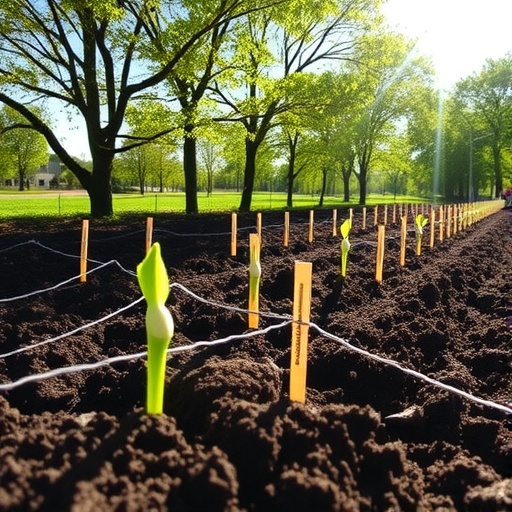
Turning agricultural waste into a powerful tool for healing degraded soils just became a lot more feasible, thanks to an unlikely ally: sunlight. A new study reveals that exposing hydrochar—a charcoal-like material made from biomass—to simulated solar radiation dramatically boosts its ability to revitalize depleted farmland, offering a low-energy pathway to tackle two pressing global challenges at once. The research, published in Carbon Research, zeroes in on the molecular dance between sunlight-treated carbon materials and soil microbes, uncovering a synergy that could reshape sustainable agriculture.
The team, led by Professor Yanfang Feng at the Jiangsu Academy of Agricultural Sciences, began with a messy but abundant duo: pig manure and mandarin peels. Using hydrothermal carbonization, a process that pressure-cooks wet biomass into a carbon-rich solid, they produced hydrochars at two distinct temperatures—180 °C and 260 °C—to vary their chemical structure. The materials were then placed under artificial solar lamps for 200 hours, with intermittent wetting to mimic real-world field conditions, so that photochemical reactions could remodel their surfaces. The goal was to understand how sunlight, a free and abundant energy source, could replace energy-intensive chemical modifications typically used to enhance soil amendments.
A suite of advanced analytical techniques revealed profound transformations. Fourier-transform infrared spectroscopy (FTIR) and X-ray photoelectron spectroscopy (XPS) showed that solar aging encouraged the formation of micropores and rearranged oxygen-containing functional groups like carbonyl (C=O) and ether (C–O) linkages. Meanwhile, three-dimensional excitation-emission matrix (3D-EEM) fluorescence spectroscopy and ultrahigh-resolution electrospray ionization Fourier-transform ion cyclotron resonance mass spectrometry (ESI-FT-ICR MS) dissected the dissolved organic matter (DOM) leaching from the chars. Although the total amount of DOM dropped after aging, its molecular complexity soared. The proportion of low-molecular-weight, bioavailable compounds—especially protein-like substances—increased by 1.2% to 5.5%, essentially predigesting the carbon for hungry soil microbes.
To test real-world impact, the researchers mixed these aged hydrochars into paddy soil microcosms and tracked the ecosystems for 45 days. The results were striking: soil organic carbon content surged by 53.3% to 110.0%, while total nitrogen climbed 14.2% to 28.5%. These numbers signal not just an injection of nutrients, but a fundamental upgrade in the soil’s ability to store carbon and support plant life. Crucially, the amendments did not merely dump compounds into the dirt; they reshaped the microbial community. Beneficial genera such as Geobacter, known for its role in iron reduction and organic matter breakdown, and Bacillus, a workhorse of nutrient cycling, became significantly more abundant. Metagenomic analysis further indicated that genes involved in carbon, nitrogen, and phosphorus metabolism were upregulated, effectively turning the soil into a more metabolically active and resilient system.
One initially puzzling finding was a decline in ammonium nitrogen (NH₄⁺-N) levels in the treated soils. The researchers clarified that this is not a loss of fertility, but evidence of accelerated nitrogen transformation. Rather than sitting as ammonium, the nitrogen was being channeled through microbial pathways into more stable organic forms, reducing losses from volatilization or leaching. This regulated shift points to a smarter nitrogen cycle—one that holds nutrients tighter and feeds plants more efficiently.
The mechanisms hinge on the interplay between carbon structures and microbial preferences. Solar aging partially oxidizes hydrochar surfaces, creating pore spaces and oxygen-rich functional groups that can sorb nutrients while also releasing small, easily degradable organic fragments. These fragments prime native microbes, selectively enriching those that can capitalize on the labile carbon and, in turn, drive the transformations of nitrogen and phosphorus. The process essentially engineers a microbial consortium optimized for soil health, using nothing but sunlight to activate the char.
Professor Feng emphasizes that this approach offers a route to genuinely circular agriculture. “By understanding the molecular interplay between solar-aged hydrochar and soil microbiota, we can develop sustainable solutions that not only remediate soils but also contribute to carbon sequestration and advance precision agriculture,” she said. The study currently focuses on flooded rice systems, where anaerobic conditions dominate, but the principles may translate to other environments. The next steps involve field-scale validation across different climates and soil types, as well as fine-tuning the duration and intensity of solar exposure to maximize benefits.
If scaled, the technology could transform problematic waste streams—manure, fruit peels, crop residues—into standardized soil restoratives using little more than the power of the sun. This low-energy, bioreceptive material could help rehabilitate the roughly one-third of the planet’s soils considered degraded, while simultaneously locking carbon underground. The work stands as a compelling example of how rethinking waste and leveraging natural photochemistry can address interlinked crises of food security and climate change.
Subject of Research: Impact of solar radiation aging on hydrochar properties and its subsequent effect on soil remediation and microbial communities in paddy soils.
Article Title: Solar radiation aging enhances hydrochar’s soil remediation potential by altering dissolved organic matter and microbial communities
News Publication Date: 3-Jul-2026
Web References: http://dx.doi.org/10.1007/s44246-026-00277-1
References: He, L., Ji, Y., Li, D., Wang, Y., Lyu, H., Wang, B., Chen, B., Liu, X., Chen, C., Guo, B., Li, N., & Feng, Y. (2026). Solar radiation aging enhances hydrochar’s soil remediation potential by altering dissolved organic matter and microbial communities. Carbon Research. DOI: 10.1007/s44246-026-00277-1
Image Credits: Lili He, Yahui Ji, Detian Li, Yuying Wang, Haohao Lyu, Bingyu Wang, Bingfa Chen, Xiangyu Liu, Chengrong Chen, Bin Guo, Neng Li & Yanfang Feng
Keywords: hydrochar, solar radiation aging, soil remediation, dissolved organic matter, microbial communities, carbon sequestration, paddy soil, pig manure, mandarin peels, photochemical reactions, Geobacter, Bacillus, nitrogen cycling, sustainable agriculture


