

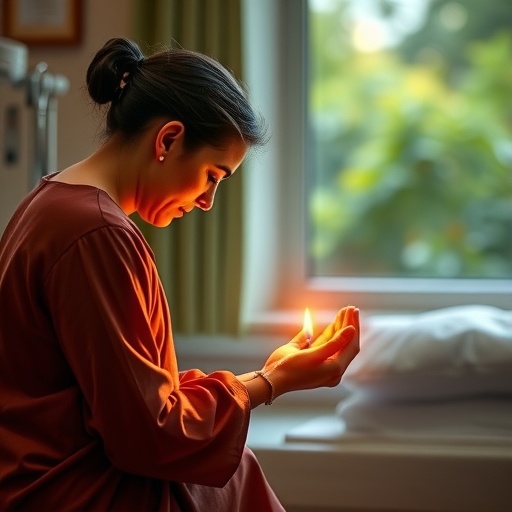
In the relentless rhythm of beeping monitors and hurried rounds, a profound but easily overlooked phenomenon is emerging as a powerful antidote to clinician burnout and eroded patient trust. Researchers have termed these fleeting episodes “sacred moments”—brief experiences of deep connection, awe, or a sensation that time itself stands still—and a new evidence-based conceptual model, published in the Journal of General Internal Medicine, provides the first systematic framework for understanding how they work and why they matter. Led by scientists at Lawson Research Institute, the research arm of St. Joseph’s Health Care London, the work marks a pivotal step in bringing the spiritual and existential dimensions of medicine back into focus.
The model identifies specific conditions that allow such moments to arise within the high-pressure choreography of health care. Emotional presence—when a clinician is fully attuned to a patient beyond the clinical task—emerges as a foundational requirement. Supportive leadership that validates reflective practice and institutional structures that carve out time for intentional pause also proved critical. These factors, the researchers argue, can be deliberately cultivated rather than left to chance, transforming sacred moments from rare serendipities into reproducible elements of whole-person care. St. Joseph’s itself became the first Canadian hospital to join the Sacred Moments Initiative led by the University of Michigan, a collaboration that fed directly into the new publication and signaled a growing international commitment to addressing clinician well-being through meaning-centered approaches.
The quantitative case is striking. A survey of 629 physicians revealed that 67.7 percent had experienced a sacred moment with a patient, and of those, 76 percent reported feeling less burned out as a direct result. Yet fewer than five percent ever shared that experience with a colleague. This gap between the profound private impact and the near-total absence of communal processing represents a missed opportunity of enormous scale. The data suggest that sacred moments are not merely subjective pleasantries but psychologically protective events that can measurably reduce the emotional exhaustion driving the health care workforce crisis.
Cross-cultural evidence adds further weight. In a parallel study exploring the concept in Japanese health care settings, researchers found that once the notion of a sacred moment was explained, the majority of clinicians and patients recognized having encountered it during medical visits. The finding underscores that the phenomenon is not an artifact of Western spiritual idioms but a cross-culturally valid aspect of human interaction in times of vulnerability. It speaks to a universal grammar of healing that transcends technology and technique.
Neurologically and psychologically, sacred moments appear to interrupt the brain’s default mode of task-focused, future-planning cognition and pivot attention fully into the present. This temporal shift—accompanied by feelings of awe and small-self perspective—downregulates stress circuits and boosts oxytocin signaling, strengthening the relational bond between patient and provider. In a clinical landscape where depersonalized care has become a recognized contributor to patient mistrust, these moments act as relational circuit breakers, restoring the sense of mutual humanity. The conceptual model published by Lawson researchers maps these mechanisms, linking the immediate experience to downstream outcomes such as greater meaning in work, improved emotional health, and increased satisfaction with care.
“These small, deeply connecting experiences have a profound impact that serve as a reminder of the spiritual and existential dimensions of care that many clinicians value, but become quickly lost in the demands of the hospital setting,” said Dr. Serena Wong, a psychologist at St. Joseph’s and first author of the report. Wong emphasizes that while many health care workers describe their profession as a calling, the systemic pressures often take a toll physically, emotionally, and spiritually. Sacred moments, she argues, can help reconnect providers with that original sense of purpose, especially when leaders and peers actively support such reflection. Her own clinical observations confirm that moments of awe and deep connection in therapy can transform patients, fostering healing, hope, and resilience.
To move from theory to practice, the research highlights an innovative intervention called Sacred Moment Rounds. Co-led by spiritual care professionals and trained clinicians, these structured sessions create a psychologically safe space where staff can share their experiences of connection, countering the isolation that the survey statistics reveal. The rounds are not about debriefing clinical cases but about acknowledging the transcendent moments that happen in the margins of care. St. Joseph’s has already begun implementing this model, embedding it within a broader commitment to caring for body, mind, and spirit. Dale Nikkel, Manager of Spiritual Care and co-author of the paper, noted that being the first Canadian hospital to join the initiative reflects a choice to lead with compassion and nourish spiritual health as a core institutional value.
The implications extend beyond individual well-being. With burnout rates across health systems at historic highs, patients increasingly encounter providers who are present in body but absent in spirit. Sacred moments offer a counterforce, not by adding another task to the clinician’s day, but by revealing the restorative power already latent in authentic human encounter. The research does not position sacred moments as a cure-all, but as a vital invitation to return the heart and soul to a profession that desperately needs them. As health care continues to grapple with technological acceleration and workforce fragility, paying attention to the briefest of human connections may turn out to be one of the most sophisticated interventions available.
Subject of Research: People
Article Title: Sacred Moments in Healthcare: An evidence-based conceptual model
News Publication Date: July 7, 2026
Web References: https://link.springer.com/article/10.1007/s11606-026-10240-w ; https://www.sacredmomentsinitiative.org/
References: Wong et al., “Sacred Moments in Healthcare: An evidence-based conceptual model,” Journal of General Internal Medicine, 4 June 2026, DOI: 10.1007/s11606-026-10240-w; Ameling et al., 2025 survey of 629 physicians; Japanese healthcare study: PubMed ID 41758323
Image Credits: Not available
Keywords: sacred moments, clinician burnout, patient trust, spiritual care, whole-person care, healthcare, emotional presence, awe, depersonalization, meaning in work


