


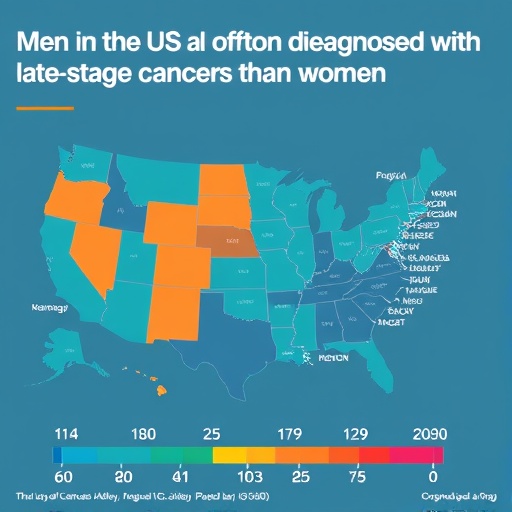
In a sweeping analysis of over 2.4 million cancer cases across the United States, researchers have uncovered a stark and persistent pattern: men are significantly more likely than women to be diagnosed at advanced stages for the vast majority of nonreproductive solid cancers. The study, which mined data from the National Cancer Institute’s Surveillance, Epidemiology, and End Results (SEER) 21 database between 2015 and 2022, examined 30 distinct cancer types that affect both sexes, stripping away the confounding variable of reproductive organs to focus purely on tumors that arise in tissues from the brain to the bladder. The findings, published in the American Association for Cancer Research journal Cancer Epidemiology, Biomarkers & Prevention, paint a troubling picture of sex-based disparities that ripple from initial symptom presentation all the way to the likelihood of survival. For 20 of those 30 malignancies, men carried a heavier burden of regional or distant spread at the moment their disease was first identified, a disadvantage that translates directly into poorer prognoses and higher mortality rates.
The investigation, led by Beth Maclin, a postdoctoral fellow in the Division of Cancer Epidemiology and Genetics at the NCI, constructed a meticulous statistical framework to isolate the effect of sex on stage at diagnosis. The team categorized each case using the SEER historic staging system: localized disease confined entirely to the primary site; regional disease that had infiltrated adjacent lymph nodes or structures; and distant disease, synonymous with metastatic spread to remote organs or far-flung lymph node basins. By collapsing regional and distant classifications into a “later-stage” composite, the researchers then performed multivariable logistic regression models, adjusting for age at diagnosis and year of detection to ensure that temporal shifts in screening technologies or diagnostic criteria did not skew the results. This rigorous approach allowed them to compute adjusted odds ratios that quantified the excess risk men face, revealing numbers that are far from subtle.
When peeling back the layers of the data, the magnitude of the disparity for certain cancers leaps off the page with an almost visceral impact. For malignancies of the head and neck and endocrine system, the odds that a man would be diagnosed with regional rather than localized disease were dramatically elevated. Men were 151 percent more likely to present with regional tongue cancer, 93 percent more likely with regional salivary gland cancer, 80 percent more likely with regional oropharyngeal cancer, and 74 percent more likely with regional thyroid cancer compared to women. The gastrointestinal tract mirrored this trend, with men facing a 67 percent greater likelihood of a regional-stage stomach cancer diagnosis. These are not marginal fluctuations within statistical noise; they are gaping chasms that suggest fundamentally different trajectories of detection and disease progression between the sexes.
The landscape of metastatic, or distant-stage, disease further amplifies the male disadvantage, and the same cluster of anatomical sites dominates the list. Men exhibited 134 percent greater odds of receiving a diagnosis of distant tongue cancer, an alarming statistic that implies tumors of the oral cavity are being identified in men only after they have seeded to the lungs or bones. The thyroid gland, long considered a cancer with an excellent prognosis when caught early, revealed a 128 percent increased likelihood of distant metastases at diagnosis in men. Salivary gland tumors, already rare and diagnostically challenging, showed a 97 percent hike in distant-stage diagnosis in males, while stomach cancer metastatic at first clinical presentation was 56 percent more common in men. Even melanoma, a cancer visible on the skin’s surface and therefore theoretically amenable to early self-detection, demonstrated a 50 percent higher chance of being discovered only after it had disseminated to internal organs in male patients. These numbers collectively underscore a systemic failure in secondary prevention—the interception of cancer before it escapes its tissue of origin—that disproportionately affects one half of the population.
Interestingly, the male predisposition toward later-stage diagnosis was not universal; a small clutch of cancers bucked the trend, and these exceptions offer important clues about the interplay of anatomy, symptom perception, and screening practices. For carcinomas of the larynx and bladder, men were actually less likely than women to be diagnosed at a regional stage compared to a localized stage—40 percent less likely for laryngeal cancer and 20 percent less likely for bladder cancer. The pattern held for distant-stage diagnoses as well, where men with bladder cancer, anal cancer, and liver cancer were 31 percent, 16 percent, and 13 percent less likely, respectively, to receive a metastatic-stage label at first diagnosis. The laryngeal cancer finding is particularly intriguing because early symptoms such as persistent hoarseness are often dismissed in women as less ominous, potentially delaying their workup, whereas the same complaint in a male patient—especially one with a smoking history—may trigger a more urgent laryngoscopy and earlier detection. Bladder cancer’s sex reversal may be anchored in the fact that hematuria, or blood in the urine, is frequently attributed to benign causes like urinary tract infections in women, a cognitive bias that inadvertently allows tumors to progress to deeper layers of the bladder wall before urological referral.
The stability of these sex-based disparities across racial and ethnic groups, as well as across county-level median household income brackets, is a testament to the deeply entrenched nature of whatever forces are driving the phenomenon. The researchers stratified the dataset by race and ethnicity and by socioeconomic proxies and found that the same directional patterns persisted, suggesting that the male disadvantage is not merely a proxy for unequal access to care or differential exposures that track with social determinants of health. While absolute risks certainly vary across populations—for instance, the incidence of stomach cancer is higher in Asian and Hispanic communities, and melanoma is more common in non-Hispanic White individuals—the relative odds of late-stage diagnosis in men versus women remained stubbornly consistent. This homogeneity hints at biological or behavioral mechanisms that operate broadly, cutting across the demographic mosaic of the country.
What, then, lies at the root of this pervasive male vulnerability? Maclin and her colleagues were careful to outline a constellation of plausible explanations that do not point to a single smoking gun but rather to a tangled web of behavioral, structural, and perhaps biological factors. The most immediate suspect is the differential uptake of cancer screening. For malignancies where screening modalities exist and are recommended—such as colorectal cancer with colonoscopy or skin cancer with dermatologic surveillance—men have historically lagged behind women in participation rates, a pattern that can be traced to lower health literacy, aversion to preventative medical encounters, or logistical barriers that interact with gendered work and family roles. A missed screening window means a neoplasm has more time to silently traverse the local-to-regional-to-distant continuum, and by the time symptoms become undeniable, the window for curative resection may have already slammed shut.
Beyond the screening gap, there is a well-documented divergence in health care-seeking behaviors that unfolds across the lifespan. From adolescence through old age, men visit primary care physicians, dentists, and specialists at lower frequencies than women, a tendency that robs clinicians of the opportunity to triage early, vague complaints that might be the first whisper of an underlying malignancy. Women, in contrast, are socialized to engage with the health care system not only for their own reproductive health needs—contraception, cervical cancer screening, pregnancy, menopause—but also often as the designated health managers for their families, a role that normalizes periodic medical contact. This regular interface creates a conduit for incidental detection of nonreproductive cancers; a thyroid nodule palpated during an annual exam, an oropharyngeal lesion noticed during a dental cleaning, or a suspicious skin lesion remarked upon during a visit for an unrelated issue all become opportunities for early diagnosis that men disproportionately miss.
Clinician perception and cognitive biases form yet another layer of the explanatory model. The same report of unintentional weight loss, persistent fatigue, or a new palpable mass may be met with a different index of suspicion depending on the patient’s sex, particularly in a clinical encounter compressed into a fifteen-minute window. There is evidence from qualitative studies that women’s pain and somatic complaints are more readily attributed to psychosomatic or functional disorders, but for certain malignancies, the opposite dynamic may hold: men may be less likely to be perceived as anxious hypochondriacs when they report constitutional symptoms, and yet the data on later-stage diagnosis suggests that men’s symptoms are not being investigated early enough to catch tumors while they remain localized. The interplay is complex, and Maclin emphasized that the way clinicians interpret symptoms in males and females could lead to divergent diagnostic pathways, with some patients receiving prompt cross-sectional imaging and biopsies while others are offered watchful waiting or empirical treatment for benign mimics.
Biological factors, though not the primary focus of this epidemiological analysis, cannot be entirely dismissed as contributors. Sex hormones, immune surveillance differences modulated by X and Y chromosomes, and variations in the tumor microenvironment have all been shown to influence cancer progression in experimental models. For instance, estrogen signaling has been linked to enhanced immune-mediated tumor suppression in some contexts, and the loss of certain X-linked tumor suppressor genes that escape X-inactivation could offer women a genetic buffer that slows the pace of disease evolution before a tumor becomes clinically detectable. These intrinsic differences could mean that even if men and women were to present for medical attention at identical points along their disease trajectory, the underlying biology might ensure that a man’s tumor has already reached a more aggressive, less differentiated, and more disseminated state. The study’s design, however, cannot disentangle whether the observed stage differences arise from delays in detection, differences in tumor growth kinetics, or a combination of both.
The dataset itself, while extraordinarily rich, is not without its blind spots, and the authors were transparent about the limitations that temper the interpretation of their results. The SEER historic staging system, which classifies tumors into localized, regional, and distant categories, is inherently a coarser instrument than the tumor-node-metastasis (TNM) classification scheme used in contemporary clinical oncology, and it lacks the granularity of T, N, and M subcategories that provide detailed information on the depth of invasion and the number of involved nodes. This bluntness could obscure subtle stage shifts that might have added nuance to the sex-based comparisons. Moreover, critical variables that influence access to timely diagnosis—such as health insurance coverage, distance to an academic cancer center, or the exact sequence of clinical encounters leading to a biopsy—were absent from the SEER registry, leaving a residual shadow of unmeasured confounding. Additionally, a non-trivial portion of cases—exceeding ten percent for malignancies of the lip, esophagus, stomach, liver, pleura, bone and joints, and the eye and orbit—had missing staging data, and the exclusion of these records could, if the missingness was systematically related to sex, bias the estimates in unpredictable directions. The study also deliberately excluded sex-specific cancers such as prostate, breast, ovarian, and testicular tumors, meaning the narrative it weaves is confined to organs shared by both sexes, a design choice that clarifies the research question but cannot speak to the broader landscape of all solid tumors.
Despite these caveats, the clinical and public health implications of the findings are immediate and actionable. The sheer consistency of the male disadvantage across such a diverse array of organs argues forcefully for targeted interventions that recalibrate the trajectory of cancer detection in men. Primary care providers could adopt sex-stratified risk thresholds when evaluating common presenting symptoms, triggering faster specialist referrals for male patients with, say, persistent dysphagia—a potential flag for esophageal or oropharyngeal malignancy—rather than initially treating it as gastrointestinal reflux. Public health campaigns, long accustomed to delivering messages about mammograms and Pap smears, could be creatively retooled to resonate with male audiences, employing platforms and spokespersons that bypass the traditional barriers of stoicism and medical avoidance. Workplace wellness programs, barbershop health initiatives, and digital health tools that embed symptom checkers into apps men already use could all act as bridges to earlier clinical contact.
The study also serves as an uncomfortable mirror reflecting how societal scripts around masculinity may be literally shortening men’s lives. The gendered expectation that men should be self-reliant, robust, and impervious to bodily concerns translates into a collective cultural refrain of “toughing it out” when faced with a persistent cough, a skin lesion that won’t heal, or an enlarging neck mass. Each month that elapses between the first twinge of abnormality and the decision to seek medical advice is a month in which a localized cancer can transform into a formidable, disseminated adversary. Maclin distilled the core message into a simple, universal prescription that sidesteps the complexity of the statistical modeling: everyone should visit a doctor regularly, and no one should postpone a medical consultation when they notice a change in their body. That counsel, while ageless, carries a particular urgency for the millions of men who are statistically pitted against a biological clock they may not even hear ticking.
The researchers underscored that closing the sex gap in cancer stage at diagnosis could yield dividends not only in survival but also in the reduction of treatment-associated morbidity. Early-stage cancers are far more amenable to minimally invasive surgical techniques, de-escalated radiation fields, and organ-preserving strategies that avoid the radical resections and high-intensity chemotherapy regimens required for advanced disease. The human cost—measured in lost years of active life, severed work trajectories, and shattered family tranquility—could be mitigated if the distribution of stages could be shifted leftward on the localized-to-metastatic spectrum for men. Future studies will need to parse the relative contributions of screening access, biological aggressiveness, and the duration of the patient interval and the diagnostic interval, employing linked datasets that merge SEER records with claims data, patient surveys, and genomic information, to pinpoint exactly where in the chain of events the sex disparity crystallizes and what specific lever can most efficiently reverse it. Until then, the dramatic numbers emerging from this analysis stand as both a warning and a call to action, demanding that the oncology community, primary care physicians, and the public alike confront the reality that cancer, for men, arrives later and hits harder.
Cite Scienmag News
Nathaniel Bowman. (July 6, 2026). Men in the US more often diagnosed with late-stage cancers than women. Scienmag. https://scienmag.com/men-in-the-us-more-often-diagnosed-with-late-stage-cancers-than-women/
Nathaniel Bowman. "Men in the US more often diagnosed with late-stage cancers than women." Scienmag, 6 July 2026, https://scienmag.com/men-in-the-us-more-often-diagnosed-with-late-stage-cancers-than-women/. Accessed 4 September 2026.
Nathaniel Bowman. "Men in the US more often diagnosed with late-stage cancers than women." Scienmag. July 6, 2026. https://scienmag.com/men-in-the-us-more-often-diagnosed-with-late-stage-cancers-than-women/


