


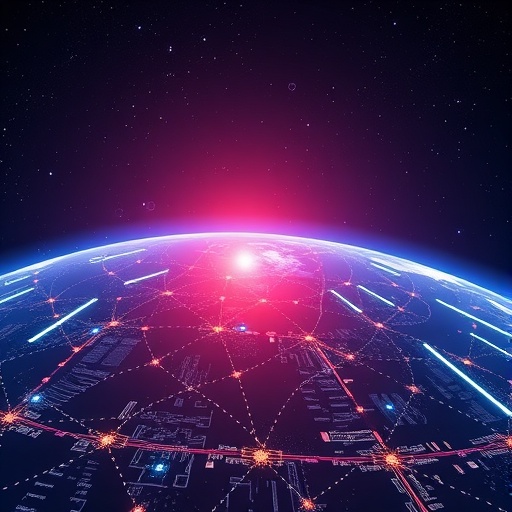
As the world’s orbital highways grow increasingly congested with a projected one hundred thousand satellites swirling overhead by the end of this decade, a fundamental problem has quietly escalated from a logistical headache into an existential operational crisis: how can mere human teams possibly manage the torrent of telemetry, the endless scheduling windows, and the delicate choreography of vast constellations without buckling under the complexity? Ground control rooms, once the domain of a handful of dedicated engineers nursing a single precious spacecraft through the void, are staring down a future where a single operator might be responsible for hundreds or even thousands of space-borne assets, each demanding constant attention, maneuvering through increasingly cluttered orbital shells, and generating petabytes of sensor data that must be parsed, analyzed, and acted upon in near real-time. This looming bottleneck threatens not just the profitability of the burgeoning commercial space industry but the very safety and sustainability of the orbital environment itself, setting the stage for a radical rethinking of how humanity interfaces with its celestial machinery.
It is precisely this challenge that has drawn together two unlikely partners from opposite ends of the Asia-Pacific technological sphere into a high-stakes collaboration aimed at weaving artificial intelligence directly into the neural fabric of satellite operations. Nanyang Technological University, Singapore, home to the nation’s pioneering Satellite Research Centre, and Fusic Co., Ltd., a Japanese software powerhouse specializing in cloud computing and machine learning systems, have formally agreed to jointly explore the development of AI-enabled ground systems capable of taming the coming chaos of mega-constellations. Their Memorandum of Understanding, inked on the sixth of July at the SPACETIDE 2026 business conference in Tokyo, represents far more than a bilateral research agreement; it is a strategic bet that the fusion of Singapore’s deep spaceflight heritage with Japan’s world-class software engineering culture can produce autonomous systems sophisticated enough to act as digital co-pilots for the overwhelmed human teams of tomorrow, all unfolding against the diplomatic backdrop of sixty years of formal relations between the two island nations.
To truly appreciate the magnitude of what this partnership seeks to accomplish, one must first understand the sheer physics and information-theory constraints that bind classical satellite operations to a model that simply cannot scale. Traditional ground operations are built around a relatively small number of contact windows when a satellite passes within range of a ground station, moments during which operators must upload command sequences, download stored data, assess the health of dozens or hundreds of onboard subsystems, and make split-second decisions about anomaly resolution before the spacecraft slips back into the silent void. Each of these passes requires meticulous preparation, with human schedulers allocating antenna time across multiple missions, balancing the urgent needs of one satellite against the routine housekeeping of another, all while factoring in weather interference, equipment maintenance, and the unyielding celestial mechanics that dictate when and where a spacecraft will appear above the local horizon. For a fleet of a dozen satellites, this already presents a complex optimization problem; for a constellation numbering in the thousands, it becomes a combinatorial nightmare that outstrips the cognitive capacity of even the most experienced human team, leading inevitably to scheduling conflicts, missed opportunities, and the terrifying prospect of losing a spacecraft simply because an alert was buried in an unread log file.
The collaborative framework outlined by NTU and Fusic proposes to attack this problem on multiple fronts simultaneously, deploying a layered architecture of artificial intelligence tools that range from relatively straightforward machine learning classifiers to, eventually, specialized autonomous software agents capable of executing bounded tasks under strict human supervision. At the most immediate and practical level, the research will investigate how AI can assist with mission scheduling and ground-station allocation, essentially transforming the operational planning process from a manual, spreadsheet-driven exercise into an intelligent optimization engine that can dynamically reassign resources as conditions change, perhaps rerouting a data dump to a different antenna in real-time when the primary station experiences unexpected interference, or reprioritizing satellite contacts when onboard sensors detect an anomaly that requires immediate engineering attention. This scheduling intelligence would not replace human judgment but would instead present operators with a continuously updated, AI-curated set of optimal choices, dramatically compressing the decision cycle and ensuring that human cognitive bandwidth is reserved for the genuinely novel situations that machines cannot yet handle.
Digging deeper into the technical substrate of the collaboration, the partners intend to explore how AI can fundamentally reshape the early detection and diagnosis of technical problems aboard increasingly complex spacecraft, a domain where the traditional approach of threshold-based alerts has proven woefully inadequate for modern systems. Contemporary satellites generate rivers of telemetry data covering everything from battery charge-discharge curves and reaction wheel bearing temperatures to the subtle degradation patterns of solar array efficiency over years of radiation exposure, and within this data lie faint, early-warning signatures of impending failures that are often invisible to human operators scanning dashboard displays but are readily detectable by machine learning models trained on historical anomaly datasets. A trained neural network, for instance, might notice that a particular thruster valve requires an extra four milliseconds to respond to a firing command compared to its baseline performance established months earlier, a microscopic drift that would never trigger a traditional red-line alert but which correlates strongly with a failure mode seen on similar propulsion systems, giving ground teams precious days or weeks to develop mitigation strategies before a critical maneuver becomes impossible.
Beyond the immediate operational benefits, the NTU-Fusic initiative envisions a future where specialized AI agents, operating under a carefully designed governance framework, take on increasing responsibility for routine tasks that currently consume enormous amounts of skilled engineering time. Such agents might autonomously prepare sets of command sequences for standard orbit maintenance burns, verify that those sequences conform to all known flight rules and constraints, coordinate the necessary communications windows across multiple ground stations, and present a complete, human-readable summary of their actions to a mission director who retains final approval authority and can interrogate the AI’s reasoning at any point. This concept of explainable autonomy is central to the research agenda, as the partners recognize that no satellite operator will entrust a multimillion-dollar asset to a black-box algorithm whose decision-making process is opaque; instead, the goal is to build systems that leave clear, auditable records of how and why any given recommendation was made, creating a chain of accountability that extends from the silicon logic gates all the way to the human being who ultimately signs off on every command radiated into space.
The space situational awareness dimension of the collaboration adds yet another layer of urgency and technical sophistication to the research program, as the projected hundred-thousand-satellite environment will demand a quantum leap in how operators track, predict, and respond to the movements of both cooperative and non-cooperative objects in orbit. Current conjunction assessment processes rely heavily on data from the United States Space Force and other governmental tracking networks, which provide warnings when two objects are predicted to pass uncomfortably close to one another, but these warnings are often delivered with significant uncertainty and require human analysts to manually evaluate risk and decide whether to expend precious propellant on an avoidance maneuver. An AI-augmented system could potentially ingest tracking data from multiple sources, including commercial space surveillance networks, and autonomously generate probabilistic collision forecasts that account for atmospheric drag uncertainties, solar radiation pressure effects, and the notorious challenges of modeling gravitational perturbations in low Earth orbit, providing operators with a much richer understanding of when they truly need to move their spacecraft and when a predicted conjunction is likely to dissolve into a safe miss distance without costly intervention.
The partnership brings together two institutions with remarkably complementary technical pedigrees that make the ambitious scope of this research program credible rather than merely aspirational. NTU’s Satellite Research Centre, known colloquially as SaRC, has been the cradle of Singapore’s space ambitions since before the city-state had any realistic claim to being a spacefaring nation, having designed, built, tested, and operated a total of thirteen satellites starting with X-SAT in 2011, the first locally developed spacecraft to carry a Singaporean flag into orbit. This end-to-end experience, spanning the brutal realities of space environmental testing, the white-knuckle tension of launch campaigns, and the patient years of in-orbit operations, has imbued the SaRC team with a visceral, battle-tested understanding of what actually happens to spacecraft hardware and software when exposed to the thermal extremes, radiation fluxes, and mechanical shocks of the space environment, knowledge that is absolutely essential for designing ground systems that can correctly interpret the often-noisy and sometimes contradictory signals arriving from a distressed satellite.
Complementing this spaceflight heritage is Fusic’s deep expertise in the kind of modern software engineering practices that have revolutionized terrestrial industries but have only begun to penetrate the conservative world of satellite operations. Headquartered in Fukuoka, Japan, the company has built sophisticated systems leveraging cloud computing infrastructure, advanced artificial intelligence and machine learning frameworks, and Internet of Things architectures that are designed to ingest, process, and extract insights from massive streams of real-time data generated by distributed sensor networks, a technical description that applies equally well to a constellation of Earth observation satellites as it does to a smart factory or a connected city deployment. Fusic’s engineers bring to the table a fluency with the tools of contemporary AI development, including deep learning frameworks, reinforcement learning algorithms that can discover optimal operational strategies through simulation, and generative AI models that might one day assist operators by drafting preliminary anomaly reports or translating complex telemetry anomalies into natural-language summaries accessible to engineering managers who are not necessarily experts in every subsystem aboard a given spacecraft.
The geopolitical and diplomatic context surrounding the announcement adds significant weight to what might otherwise be dismissed as just another university-industry research agreement in an era when such partnerships are announced with numbing frequency. The signing took place at SPACETIDE 2026, a premier space business conference in Tokyo that has become the Asia-Pacific region’s most important gathering for the commercial space industry, and the NTU-Fusic agreement was explicitly positioned alongside two other significant Singapore-Japan space collaborations announced at the same venue. A Memorandum of Cooperation between the National Space Agency of Singapore and the Japan Aerospace Exploration Agency signals an intention to align the two nations’ governmental space activities more closely, while a parallel Memorandum of Understanding between the Association of Aerospace Industries (Singapore) and the Society of Japanese Aerospace Companies points toward a broader industrial ecosystem convergence. Taken together, these three agreements paint a picture of a rapidly deepening space partnership between Singapore and Japan that has been catalyzed by the elevation of their bilateral relationship to a Strategic Partnership in March 2026, with both governments explicitly identifying artificial intelligence, automation, deep technology, and secure digital systems as priority areas for cooperation.
The technical requirements that the research program must navigate extend well beyond the core artificial intelligence challenges into domains that will test the partnership’s ability to deliver systems that are not merely clever but also trustworthy, secure, and compliant with the increasingly complex regulatory frameworks governing space activities. Any AI system that plays a role in satellite command and control must be hardened against cyberattacks that could attempt to poison the training data, manipulate the model’s outputs through adversarial inputs, or simply deny access to critical AI services during time-sensitive orbital operations. The partners have explicitly acknowledged that their research will need to consider system resilience, meaning that the AI tools must gracefully degrade rather than catastrophically fail if they encounter situations far outside their training distributions, a scenario that is essentially guaranteed in the dynamic and chaotic orbital environment where novel anomalies, unprecedented conjunctions, and unanticipated spacecraft behaviors are the norm rather than the exception. Regulatory compliance adds yet another dimension of complexity, as any AI system that influences satellite operations must operate within the legal frameworks established by national regulators and international bodies like the International Telecommunication Union, which governs spectrum allocation and orbital slot assignments through treaties that predate the era of autonomous spacecraft operations by decades.
The longer-term vision articulated by the researchers extends toward a distributed intelligence architecture in which multiple specialized AI agents, each with its own narrow domain of expertise, collaborate to support different aspects of constellation operations while human operators maintain oversight of safety-critical decisions, regulatory compliance, and the strategic mission assurance functions that ultimately determine whether a satellite fleet delivers value to its stakeholders. One agent might specialize in power system management, continuously optimizing the charging and discharging cycles of batteries across an entire constellation to maximize their operational lifetimes while accounting for the varying eclipse durations experienced by satellites in different orbital planes. Another might focus on propulsion system optimization, calculating the most fuel-efficient sequences of station-keeping maneuvers to maintain the precise orbital spacing required for a constellation’s coverage patterns while preserving enough propellant reserves for end-of-life disposal burns. A third might serve as a communications traffic manager, dynamically routing data flows across inter-satellite laser links and ground station passes to ensure that the most time-sensitive information reaches terrestrial users with minimal latency. Human mission directors would interact with this ecosystem of specialized agents through a unified interface that abstracts away much of the underlying complexity while preserving the ability to drill down into any specific recommendation and understand the full chain of reasoning that produced it.
The potential commercial implications of success in this research program are substantial enough to attract attention from satellite operators far beyond the immediate orbits of Singapore and Japan, as the entire global space industry is grappling with the same fundamental scalability challenges that the NTU-Fusic collaboration seeks to address. Companies operating large communications constellations in low Earth orbit, Earth observation fleets that must coordinate complex imaging campaigns across dozens of satellites, and emerging space logistics providers that aim to service, refuel, and repair spacecraft on orbit all share a desperate need for ground automation that can manage complexity at scales that currently require ever-expanding teams of expensive and hard-to-recruit satellite engineers. Technologies developed through this partnership could eventually support commercial satellite operators across Singapore, Japan, and the broader Asian market, a region that has seen explosive growth in space activity but which has historically lagged behind the United States and Europe in the development of indigenous operational software capabilities.
The scientific and engineering community will be watching closely as the partners begin to test their software concepts using realistic mission scenarios derived from NTU’s operational experience, with future NTU satellite missions potentially providing orbital platforms for validating selected technologies under genuine spaceflight conditions. This pathway to flight validation is a crucial differentiator for the research program, as the history of artificial intelligence applications in space is littered with algorithms that performed brilliantly in simulation but proved brittle or unreliable when confronted with the messy, unpredictable reality of actual orbital operations. By grounding the research in the concrete operational data and mission experience that SaRC has accumulated over more than a decade of flying real satellites, the partners hope to avoid the trap of solving theoretical problems while ignoring the practical constraints that ultimately determine whether an AI system earns the trust of the human operators who must rely on it.
The emergence of this collaboration also reflects a broader transformation in how spacefaring entities are thinking about the relationship between human intelligence and machine intelligence in the control of critical infrastructure that happens to be hurtling through the vacuum of space at seventeen thousand miles per hour. The early decades of the space age were characterized by a fierce, almost ideological commitment to human-in-the-loop control, born of the painful lessons learned from early mission failures and the understandable reluctance to cede any decision-making authority to the primitive computers of the era. But as terrestrial industries from aviation to medicine to financial trading have demonstrated over the past decade, a carefully designed partnership between human experts and AI systems can routinely outperform either humans or machines working alone, combining the pattern-recognition speed and tireless vigilance of algorithms with the contextual understanding, ethical judgment, and creative problem-solving capabilities that remain uniquely human attributes. The NTU-Fusic collaboration is, at its core, an effort to discover what that optimal human-machine partnership looks like for the specific, unforgiving domain of satellite operations, where mistakes are measured not in dollars lost but in the permanent addition of debris clouds to an orbital environment already teetering on the edge of a runaway cascade of collisions that could lock humanity out of entire regions of near-Earth space for generations.
Cite Scienmag News
Courtney Benton. (July 6, 2026). NTU Singapore and Fusic Join Forces to Create AI ‘Mission Control’ for Next-Gen Satellite Constellations. Scienmag. https://scienmag.com/ntu-singapore-and-fusic-join-forces-to-create-ai-mission-control-for-next-gen-satellite-constellations/
Courtney Benton. "NTU Singapore and Fusic Join Forces to Create AI ‘Mission Control’ for Next-Gen Satellite Constellations." Scienmag, 6 July 2026, https://scienmag.com/ntu-singapore-and-fusic-join-forces-to-create-ai-mission-control-for-next-gen-satellite-constellations/. Accessed 3 September 2026.
Courtney Benton. "NTU Singapore and Fusic Join Forces to Create AI ‘Mission Control’ for Next-Gen Satellite Constellations." Scienmag. July 6, 2026. https://scienmag.com/ntu-singapore-and-fusic-join-forces-to-create-ai-mission-control-for-next-gen-satellite-constellations/


