


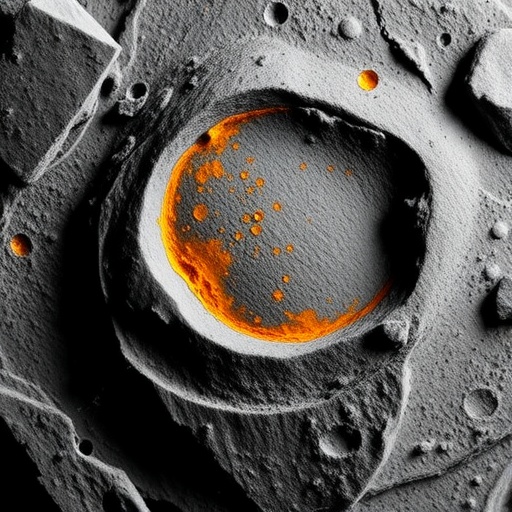
Curtin University researchers have made a breakthrough in understanding Earth’s earliest violent encounters by precisely dating the oldest known impact crater found on our planet. Located in the Pilbara region of Western Australia, the North Pole Dome has long intrigued scientists with its ambiguous geological history. Recent advances in mineral dating technology have finally provided clarity on the age of this enigmatic structure, revealing it to be approximately three billion years old. This discovery not only redefines the timeline of Earth’s impact record but also deepens our comprehension of how meteorite strikes influenced terrestrial evolution during the Archean eon.
The North Pole Dome sits within one of Earth’s most ancient and well-preserved rock formations, a site that has been the subject of intense debate for decades among geologists and planetary scientists. While previous studies suggested that the dome’s unique geological features could be the remnants of an asteroid impact, the precise timing of the event had eluded definitive confirmation. The collaborative investigation, conducted by Curtin University’s School of Earth and Planetary Sciences alongside the Geological Survey of Western Australia, employed cutting-edge mineral chronometry methods to resolve these uncertainties.
Central to this research is the analysis of zircon crystals — resilient minerals renowned for their ability to encapsulate geological time through complex isotopic systems. Within the North Pole Dome rocks, researchers identified zircons exhibiting unusual morphologies characterized by branching skeletal structures. These altered forms are interpreted as having been shaped by intense shock metamorphism resulting from the impact event. By applying high-precision isotopic dating techniques to these impact-modified zircon crystals, scientists were able to isolate the exact moment when these structures were transformed, dating it to roughly three billion years ago.
In order to enhance the robustness of their results, the team also investigated apatite minerals within the same rock formations. Apatite’s isotopic systems can record thermal events associated with fluid fluxes, which often accompany shock metamorphism and subsequent hydrothermal alteration following an impact. Remarkably, the apatite dating mirrored the zircon results, confirming the timing and providing independent evidence for the impact’s occurrence. The concordance of these two mineral chronometers underscores the reliability of the findings and affirms that the North Pole Dome represents a genuine impact structure rather than an artifact of tectonic or volcanic processes.
The ability to disentangle the complex geological history of rocks that are billions of years old is a monumental challenge. Over such vast timescales, subsequent deformation, metamorphism, and chemical alteration typically obliterate or obscure the original signatures of ancient impact events. The North Pole Dome study succeeds in distinguishing the “mineral clock” associated with the meteorite impact from the overprinting effects of later geological activity. This feat was achieved through precise mineral selection and sophisticated analytical protocols capable of resolving intricate isotopic signatures in microscopic domains within the crystals.
This discovery profoundly shifts the record of terrestrial impacts, pushing back the confirmed dates of Earth’s earliest acknowledged impact craters. Prior to this, identifying and securely dating impact structures from the Archean eon remained elusive due to the planet’s dynamic geological processes that continuously recycle and modify the crust. The North Pole Dome, therefore, stands as the only recognized Archean impact structure so far dated with such certainty, providing invaluable insights into the environmental and geological conditions that prevailed during a primordial phase of planetary development.
From a broader planetary evolution perspective, meteorite impacts during the Archean period were likely pivotal in shaping the early Earth environment. These high-energy events contributed to crustal reworking, induced hydrothermal circulation, and may have influenced the distribution and availability of key elements necessary for the emergence of life. Understanding the timing and magnitude of such impacts helps reconstruct Earth’s formative years, including how the earliest continental crust stabilized and how surface conditions evolved in response to extraterrestrial bombardment.
Lead researcher Professor Chris Kirkland emphasizes that the research not only clarifies a long-standing debate regarding the North Pole Dome but also showcases the power of modern geochronological tools to peer deep into Earth’s past. The identification of impact-modified zircon crystals with distinct morphological characteristics represents a novel avenue for detecting ancient impact events in similarly complex and altered terrains worldwide. As geochronology continues to advance, more primordial impact signatures may be uncovered, expanding our understanding of the planet’s early history and the cosmic forces that shaped it.
Furthermore, the significance of this collaboration between Curtin University and the Geological Survey of Western Australia cannot be overstated. Combining expertise in earth sciences with state-of-the-art analytical capabilities exemplifies the interdisciplinary approach required to tackle profound questions about Earth’s origin and evolution. This partnership highlights the critical role of academic and government scientific institutions working hand in hand to unlock the geological narratives recorded in Earth’s oldest rocks.
As the oldest well-dated impact crater, the North Pole Dome offers a rare geological window into the Archean eon, a period marked by the formation of Earth’s earliest continents and the incipient stages of life. Impact events like this would have exerted strong influence on the physical and chemical environment, perhaps even stimulating processes that set the stage for biological innovation. Continued exploration and analysis of ancient impact sites promise to enrich scientific models of early Earth conditions and planetary habitability throughout geological time.
With these findings newly published in the journal Geology, this study sets a benchmark for future research on ancient impact structures. The utilization of dual mineral chronometers—zircon and apatite—provides a replicable framework for dating other ambiguous geological settings. This methodological advancement enhances confidence in distinguishing ancient impacts from tectonic or volcanic phenomena, which may present superficially similar rock transformations but differ fundamentally in origin and environmental consequences.
Ultimately, the elucidation of the North Pole Dome’s age marks a significant milestone in the field of geosciences, melding intricate mineralogical detective work with profound planetary implications. It sheds light on the turbulent early days of Earth’s surface evolution and affords scientists a clearer timeline for when some of the most dramatic cosmic events sculpted the planet’s geology. As research continues, the North Pole Dome will no doubt serve as a vital reference point for unraveling Earth’s deep-time narrative of meteoritical impacts.
News Publication Date: 23-Jun-2026
Web References: http://dx.doi.org/10.1130/G54866.1
References: Kirkland, C.L., et al. “How old is the North Pole Dome impact, Western Australia?” Geology, 2026.
Cite Scienmag News
Violet Maxwell. (June 24, 2026). Precise Dating Reveals Earth’s Oldest Known Asteroid Impact at 3 Billion Years Ago. Scienmag. https://scienmag.com/precise-dating-reveals-earths-oldest-known-asteroid-impact-at-3-billion-years-ago/
Violet Maxwell. "Precise Dating Reveals Earth’s Oldest Known Asteroid Impact at 3 Billion Years Ago." Scienmag, 24 June 2026, https://scienmag.com/precise-dating-reveals-earths-oldest-known-asteroid-impact-at-3-billion-years-ago/. Accessed 4 September 2026.
Violet Maxwell. "Precise Dating Reveals Earth’s Oldest Known Asteroid Impact at 3 Billion Years Ago." Scienmag. June 24, 2026. https://scienmag.com/precise-dating-reveals-earths-oldest-known-asteroid-impact-at-3-billion-years-ago/


