


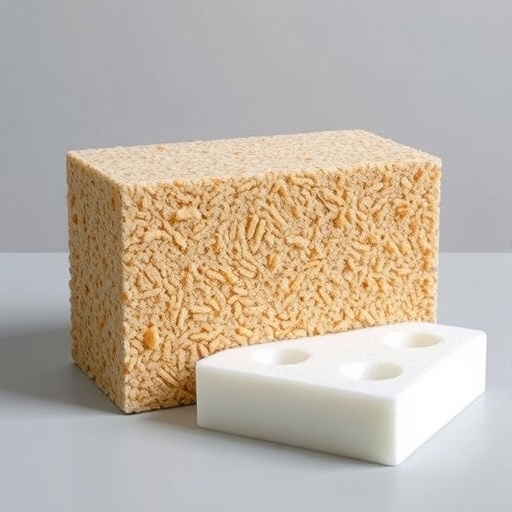
A groundbreaking advancement in sustainable materials science has emerged from an unconventional source: sawdust. A research team, led by Todd Emrick and Isha Farook, has successfully developed innovative foams derived from processed sawdust, combined with cellulose binders and citric acid cross-linkers, as a promising sustainable alternative to traditional polystyrene foams commonly used in packaging and insulation. This novel approach not only utilizes an abundant wood waste material but also offers comparable mechanical properties to polystyrene, with added environmental benefits.
Polystyrene, a ubiquitous material found in packing peanuts and various cushioning applications, is synthesized from fossil fuels and presents significant environmental challenges due to its non-biodegradability and reliance on petrochemical resources. Seeking an eco-friendly substitute, the research team turned to sawdust, a byproduct of lumber production traditionally regarded as waste, to engineer bio-based foams with potential to revolutionize packaging and building materials industries. The process involved refining sawdust into fine and coarse particles, which were then blended with different cellulose-based binders to create foam prototypes exhibiting either rigidity or flexibility.
The sawdust used in the experiments was combined with cellulose binders such as carboxymethyl cellulose and hydroxypropyl cellulose. These polymers serve as primary agents to form the foam matrix, governing the mechanical stiffness and elasticity of the final products. Carboxymethyl cellulose yielded foams that outperformed polystyrene in stiffness, whereas hydroxypropyl cellulose produced softer, more flexible foams. By manipulating the cellulose binder types, the researchers demonstrated the ability to tailor the foam properties according to the intended application.
To fabricate these foams, the team adopted a sophisticated freeze-drying technique. The sawdust-cellulose mixtures were poured into molds and subjected to freezing, followed by freeze drying to eliminate moisture without collapsing the foam structure. This method preserved the porous, lightweight architecture essential for cushioning applications. A subsequent heat-drying stage activated citric acid cross-linkers, creating chemical bonds within the foam network to enhance structural integrity and durability.
Notably, the team experimented with both fine processed wood powder and unprocessed mill waste sawdust in their formulations. Surprisingly, the mechanical properties, including strength and impact resistance, remained consistent regardless of the sawdust processing level. This finding underscores the versatility and robustness of the foam compositions, potentially simplifying sourcing by accommodating a range of sawdust qualities.
Water resistance, a critical attribute for packaging materials, was addressed by applying a thin beeswax coating to certain foam samples. This natural wax layer effectively enhanced moisture repellency, maintaining performance in high humidity environments without adversely affecting the mechanical characteristics. Such biobased coatings align with the sustainable ethos of the project and further extend the functional range of the foams.
Chemical stability assessments revealed that the sawdust-cellulose foams resisted dissolution in solvents like acetone, a feat polystyrene cannot match. Additionally, during water absorption and release cycles, the foams maintained their structure, demonstrating resilience critical for real-world handling and storage. These stability features suggest that the new materials could reliably replace polystyrene in numerous applications where chemical exposure or moisture is a concern.
Mechanical testing involving impact resistance demonstrated compelling performance advantages. When subjected to the drop of a 10-pound weight, the sawdust-based foams absorbed and dispersed energy more effectively than polystyrene samples of equivalent thickness, with the weight bouncing 21% less distance. This improved energy dissipation points to superior protective qualities, marking the foams as viable candidates for high-performance packaging, particularly in electronics and fragile goods transport.
The environmental implications of this research are significant. By repurposing sawdust waste, the project not only diverts material from landfills but also reduces dependence on fossil fuel-derived polymers. The creation of biobased foams capable of matching or exceeding polystyrene’s performance characteristics represents an important step toward circular economy models within materials science.
Looking ahead, the research team acknowledges the need for long-term stability studies to fully validate the durability of the foams across extended periods and diverse environmental conditions. Current evaluations over weeks to months indicate promising liquid stability, critical for transportation and storage scenarios where packaging materials may encounter accidental spills or varying humidity.
Beyond packaging, potential applications for these foams may extend into construction materials, where lightweight, rigid, and insulating properties are highly prized. Given the tunable nature of the material’s stiffness and resilience, future research could explore custom formulations balancing mechanical strength and flexibility to meet specific industrial demands.
The innovation described stems not only from novel chemistry but also from a sustainable philosophy prioritizing waste reuse over chemical inventory expansion. Access to sawdust from local farms and sawmills was instrumental, reflecting a community-oriented approach that underscores the practical viability of scaling this technology.
This research was supported by funding from the U.S. Department of Energy, highlighting official commitment to advancing sustainable polymer technologies. Collaboration with industry suppliers such as Hadley Millworks facilitated access to sawdust waste crucial for experimental progress.
In conclusion, the development of sawdust-based foams introduces a versatile, environmentally friendly alternative to polystyrene. By combining abundant biomass resources with smart chemical engineering, this work paves the way for next-generation packaging and building materials that reduce ecological footprints while maintaining high-performance standards.
News Publication Date: 20-May-2026
Web References:
http://dx.doi.org/10.1021/acsapm.6c00854
References:
Adapted from ACS Applied Polymer Materials 2026, DOI: 10.1021/acsapm.6c00854
Keywords
Physical sciences, Chemistry, Polymers, Sustainable materials, Biobased foam, Sawdust, Packaging materials, Polystyrene alternatives, Cellulose binders, Cross-linking, Freeze drying, Beeswax coating
Cite Scienmag News
Neil Sanderson. (June 23, 2026). Sawdust-Based Foam Emerges as Eco-Friendly Alternative to Polystyrene. Scienmag. https://scienmag.com/sawdust-based-foam-emerges-as-eco-friendly-alternative-to-polystyrene/
Neil Sanderson. "Sawdust-Based Foam Emerges as Eco-Friendly Alternative to Polystyrene." Scienmag, 23 June 2026, https://scienmag.com/sawdust-based-foam-emerges-as-eco-friendly-alternative-to-polystyrene/. Accessed 4 September 2026.
Neil Sanderson. "Sawdust-Based Foam Emerges as Eco-Friendly Alternative to Polystyrene." Scienmag. June 23, 2026. https://scienmag.com/sawdust-based-foam-emerges-as-eco-friendly-alternative-to-polystyrene/


