


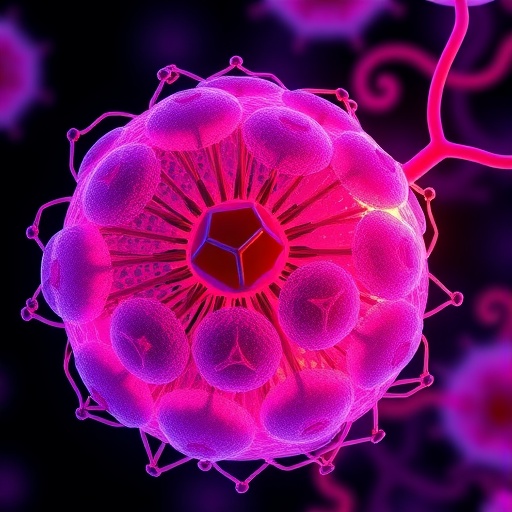
In a groundbreaking study that challenges long-standing assumptions about photosynthetic energy transfer, researchers have unveiled a novel mechanism by which carotenoids, the vibrant pigments responsible for the red and orange hues in many photosynthetic bacteria, mediate energy transfer to bacteriochlorophyll through a process known as singlet fission. The research, conducted by Wang, S., Sutherland, G.A., Pidgeon, J.P., and their collaborators, and recently published in Nature Chemistry, marks a pivotal advancement in our understanding of the fundamental photophysics within purple photosynthetic bacteria.
Singlet fission is an intriguing quantum phenomenon typically associated with the splitting of a singlet exciton into a pair of triplet excitons, effectively doubling the number of excited states from a single photon absorption event. Historically, this process has garnered considerable interest in the context of organic photovoltaics, where enhancing energy conversion efficiencies is paramount. The novel revelation that singlet fission also plays a critical role in natural photosynthetic systems not only broadens the horizon of this phenomenon but also opens new avenues for bio-inspired energy harvesting technologies.
The study concentrates on purple photosynthetic bacteria, organisms that employ intricate pigment-protein complexes to harvest solar energy with remarkable efficiency. Central to this exceptionally coordinated light-harvesting system are carotenoids and bacteriochlorophyll molecules. While carotenoids have long been known to absorb light and protect the photosynthetic apparatus from photodamage, the precise mechanism by which they transfer excitation energy to bacteriochlorophyll has eluded a comprehensive understanding. This research compellingly establishes that singlet fission is the mediating process facilitating this energy transfer, thereby reconciling prior ambiguities.
Utilizing state-of-the-art ultrafast spectroscopy techniques alongside advanced quantum chemical calculations, the team meticulously traced the energy flow between carotenoids and bacteriochlorophyll within intact bacterial membranes. The temporal resolution afforded by femtosecond transient absorption spectroscopy enabled them to capture the rapid formation of triplet states indicative of singlet fission, a signature phenomenon hitherto not associated with carotenoid excitation. These experimental observations were substantiated by multi-scale computational models revealing that carotenoid aggregates within the bacterial photosynthetic complexes possess the right electronic and geometric configurations to facilitate singlet fission efficiently.
This mechanistic insight into energy transfer dynamics was further corroborated by comparative analyses of mutant bacterial strains deficient in certain carotenoid molecules. Absence or alteration of these pigments led to marked reductions in triplet formation and overall photosynthetic efficiency, underscoring the biological relevance and indispensability of singlet fission-mediated transfer. Notably, the work also highlights how this naturally occurring quantum process contributes to the photoprotection of the photosynthetic apparatus by dissipating excess energy through controlled triplet exciton formation.
At the molecular scale, the study delineates how the extended conjugated systems of carotenoids engage in a highly cooperative interaction that facilitates the splitting of singlet excitons. The resulting triplet excitons provide a conduit for transferring excitation energy to bacteriochlorophyll molecules, which then drive the photochemical reactions vital for energy conversion. This paradigm diverges strikingly from classical Förster resonance energy transfer models that have been predominantly employed to describe pigment-pigment interactions, signaling a conceptual shift in how we perceive intra-complex energy migration.
The implication of discovering singlet fission in photosynthetic energy transfer transcends academic curiosity; it signals potential breakthroughs in designing artificial photosynthetic systems and next-generation solar energy devices. Mimicking such naturally evolved quantum strategies could dramatically enhance the efficiency of solar energy capture and conversion in synthetic materials, carving pathways toward sustainable and high-performance energy technologies.
Furthermore, this research elegantly underscores the interplay between quantum mechanics and biological function, asserting that life has harnessed sophisticated quantum effects long before they were formally recognized in condensed matter physics and materials science. By extending knowledge of photoinduced charge separation mechanisms, the findings pave the way for interdisciplinary explorations bridging quantum biology, photophysics, and materials engineering.
The research community has greeted this discovery with enthusiasm, noting that it invites a reevaluation of canonical models of photosynthesis that have traditionally ignored singlet fission as a plausible pathway. The demonstration that carotenoids can mediate energy transfer via triplet excitons challenges existing dogmas and invites further scrutiny of quantum coherent effects in natural light-harvesting complexes across diverse taxa.
Future investigations are poised to delve deeper into how environmental variables such as light intensity, temperature, and pigment-protein microenvironments modulate the efficiency and dynamics of singlet fission processes in vivo. Elucidating these dependencies will be critical to harnessing or emulating such mechanisms in technological applications. Moreover, integrating this understanding with structural biology may reveal yet undiscovered pigment architectures optimized for quantum energy conversion.
In sum, the work by Wang and colleagues represents a transformative step in photosynthesis research, redefining our grasp on the photophysical intricacies underpinning life’s energy economy. It paints a vivid portrait of a biological quantum machine, where light absorption, energy splitting, and transfer are choreographed with exquisite precision, embodying nature’s ingenuity at the convergence of physics and biology.
As the scientific discourse evolves, this discovery stands as a beacon illuminating the untapped potentials of quantum effects in biology and energy science. It emboldens researchers to look beyond classical paradigms and explore the hidden quantum undercurrents that govern the efficiency of natural systems. Such insights promise to inspire a new generation of energy technologies that truly embody the elegance of nature’s quantum solutions.
Cite Scienmag News
Bethany Barker. (June 23, 2026). Singlet Fission Drives Energy Transfer in Bacteria. Scienmag. https://scienmag.com/singlet-fission-drives-energy-transfer-in-bacteria/
Bethany Barker. "Singlet Fission Drives Energy Transfer in Bacteria." Scienmag, 23 June 2026, https://scienmag.com/singlet-fission-drives-energy-transfer-in-bacteria/. Accessed 4 September 2026.
Bethany Barker. "Singlet Fission Drives Energy Transfer in Bacteria." Scienmag. June 23, 2026. https://scienmag.com/singlet-fission-drives-energy-transfer-in-bacteria/


