


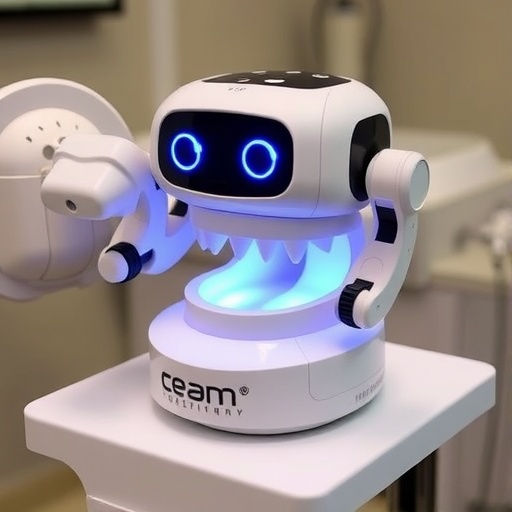
In a groundbreaking advancement poised to revolutionize dental care, researchers at the University of Basel have engineered a miniature robotic system designed to automate the preparation of teeth for dental crowns. This innovation, heralded for its remarkable precision and patient-centric design, aims to streamline dental procedures, significantly reducing the number of visits traditionally required for crown treatment. The device, known as the Miniature Intraoral Robot (MIR), represents a convergence of cutting-edge robotics and biomedical engineering with the potential to redefine patient experience and clinical workflow in dentistry.
Currently, the process of fitting a dental crown involves multiple steps spread over several appointments. Initially, dentists must meticulously remove decayed material, prepare the tooth structure, capture dental impressions, and fit a provisional crown. The final, permanent crown is fabricated externally using the impression and later installed in a subsequent visit. MIR seeks to condense and enhance this protocol by enabling precise tooth preparation following a comprehensive digital plan, thereby expediting the entire treatment cycle.
The compact scale of the MIR robot is an engineering feat in itself, measuring approximately 43 by 26 by 28 millimeters—comparable in size to a wine cork. Such dimensions ensure the device can comfortably operate within the confines of an open human mouth. Unlike fully autonomous units, MIR’s motors and control systems reside outside the oral cavity, connected via flexible drive shafts, cables, and tubes. This unique design addresses spatial constraints while maintaining operational efficacy, as highlighted by Dr. Yukiko Tomooka, the first author on the key publication describing its development.
A key feature distinguishing the MIR robot is its integration with digital dentistry workflows. Following an initial intraoral scan during the patient’s first visit, detailed treatment planning allows for precise mapping of the areas requiring material removal. Subsequently, a bespoke dental splint is fabricated to securely anchor the robot to the patient’s teeth, ensuring that MIR moves synchronously with natural head movements—an essential consideration for maintaining preparation accuracy in a dynamic environment.
Laboratory assessments have provided promising data on MIR’s performance. The device employs a two-step drilling approach: initially, a broad drill shapes the occlusal (top) surface by reducing excess tooth material; subsequently, a slender, elongated drill meticulously contours the lateral aspects of the tooth. This method mirrors the tactile and procedural nuances employed by skilled dentists but executed under robotic precision. Despite the prototype’s current lack of integrated positional sensors, its positional deviation remains impressively below 0.2 millimeters, suggesting that sensory augmentation could further refine its accuracy.
Force measurements during the robotic drilling process serve as a testament to its patient-friendly mechanics. The system exerts forces under five newtons—comparable to the gentle weight of a half-liter water bottle. Maintaining low applied forces is critical for patient comfort and safety, minimizing risks such as excessive tooth stress or inadvertent damage to surrounding tissues. Additionally, preliminary acoustic analyses are underway to evaluate whether the noise generated by the device remains within acceptable limits for dental practice environments.
Looking ahead, the research team is focused on embedding sensors and a miniature camera within the MIR framework. These enhancements aim to enable real-time feedback on the robot’s position and monitor treatment progression, crucial for dynamic adjustments during procedures. An important resilience feature will be the robot’s ability to retain its positional awareness even after unexpected interruptions, like power outages, ensuring seamless continuation of treatment without compromising outcomes or patient safety, all while preserving the device’s diminutive size.
The collaboration underpinning MIR’s development is notably interdisciplinary and translational. The project benefits from close cooperation between engineers, clinicians, and industry partners, including the Center for Dentistry at the University of Zurich, Camlog Biotechnologies GmbH based in Basel, and the University of Bern. Funding support provided by Switzerland’s innovation agency Innosuisse underscores the project’s potential to contribute significantly to both the scientific community and commercial clinical dental practice.
MIR exemplifies the broader trend in medical robotics towards minimally invasive, precision-guided technologies that enhance therapeutic delivery while reducing patient burden. By automating a labor-intensive manual procedure, the robot not only promises to improve clinical precision and reproducibility but also to transform patient workflows, potentially minimizing chair time and discomfort. Such innovations have the capacity to make dental care more accessible, efficient, and patient-friendly.
The ongoing research into integrating sensory modalities and optimizing user interfaces aims to prepare MIR for the rigors of clinical validation and eventual regulatory approval. As the device evolves, attention will also be given to sterilization protocols and ergonomic deployment within diverse dental practice settings. Through iterative development informed by clinical feedback, MIR aspires to set new standards for robotic dental interventions.
This pioneering effort stands as a vivid illustration of how robotics and artificial intelligence can be harnessed to address practical challenges in healthcare. MIR’s precise, controlled execution of complex dental tasks offers a glimpse into future possibilities where automated systems enhance human expertise, improving outcomes and patient satisfaction simultaneously. The successful translation of such technologies from laboratory prototypes to everyday clinical instruments will mark a significant milestone in dental medicine’s evolution.
The University of Basel’s miniaturized dental robot not only makes waves in the field of dental robotics but also exemplifies the potential for micro-scale engineering solutions in medicine. Through meticulous design, innovative engineering, and cross-disciplinary collaboration, the MIR platform is positioned to eventually transform routine dental treatments into streamlined, highly precise procedures, ultimately benefiting clinicians and patients alike.
News Publication Date: Not explicitly provided; implied recent (circa 2024).
Web References: DOI: 10.1109/TMRB.2026.3682629
References: Publication in IEEE Transactions on Medical Robotics and Bionics.
Cite Scienmag News
Denise Maddox. (June 23, 2026). Mini Robot Revolutionizes Dental Treatment. Scienmag. https://scienmag.com/mini-robot-revolutionizes-dental-treatment/
Denise Maddox. "Mini Robot Revolutionizes Dental Treatment." Scienmag, 23 June 2026, https://scienmag.com/mini-robot-revolutionizes-dental-treatment/. Accessed 3 September 2026.
Denise Maddox. "Mini Robot Revolutionizes Dental Treatment." Scienmag. June 23, 2026. https://scienmag.com/mini-robot-revolutionizes-dental-treatment/


