


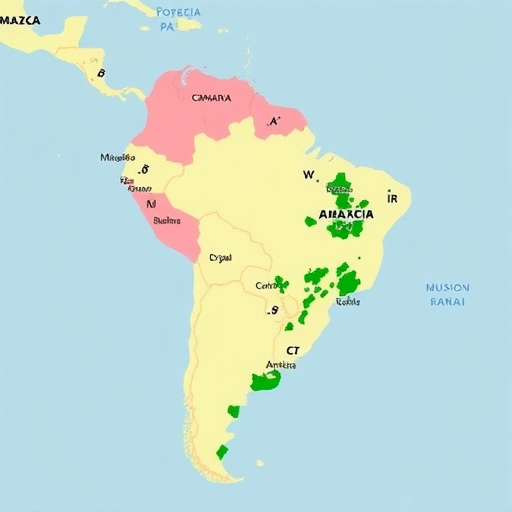
In the dense and biodiverse expanse of the Brazilian Amazon, the interplay between human activity and ecological systems has long shaped the epidemiology of vector-borne diseases. Recent research delves into how the agrarian economy and socioenvironmental contexts are critical determinants of disease co-occurrence patterns in this pivotal region. This investigation illuminates the complex network of factors influencing vector-borne illnesses, shedding light on how environmental modifications and economic activities intertwine to affect human health.
Vector-borne diseases, illnesses transmitted by organisms such as mosquitoes, ticks, and other arthropods, represent a significant burden in tropical regions worldwide. The Amazon Basin, renowned for its vast tropical rainforest and intricate ecosystems, harbors multiple pathogens that cause diseases like malaria, dengue, Chagas disease, and leishmaniasis. However, it has been increasingly evident that these diseases do not occur in isolation but rather exhibit notable patterns of co-occurrence that hinge on intertwined environmental and socioeconomic factors.
The study conducted by Barbosa, Lana, Dal’Asta, and colleagues offers a groundbreaking analysis by mapping disease co-occurrence in relation to various agrarian economic practices and socioenvironmental variables across the Brazilian Amazon. By integrating epidemiological data with land use, climatic, and demographic information, the researchers constructed a multifaceted framework to explore how agricultural modalities and human livelihood strategies modulate disease dynamics.
One of the most compelling insights emerging from this research is the pivotal role agrarian economies play in shaping vector habitats and human-vector interactions. Agricultural activities, ranging from subsistence farming to extensive cattle ranching, transform the landscape in ways that can either amplify or mitigate vector proliferation. For instance, deforestation and land clearing for agriculture often create breeding grounds for mosquitoes by generating stagnant water pools, while simultaneously disrupting natural predator populations that help control vector species.
Moreover, the socioeconomic context of rural communities—encompassing aspects such as housing quality, access to healthcare, education levels, and income—profoundly influences vulnerability to vector-borne diseases. Poor infrastructure and limited resources hinder effective disease prevention and treatment, escalating the risk of infection and complicating public health responses. The researchers underscore that social inequities intersect with environmental changes to intensify disease co-occurrence, reinforcing the notion that health outcomes in the Amazon cannot be disentangled from broader societal patterns.
Importantly, the co-occurrence of multiple vector-borne diseases in the same geographic and demographic spaces introduces unique challenges for surveillance, diagnosis, and management. Overlapping symptomatology and co-infection potential complicate clinical decision-making, while co-transmission by shared or distinct vector species demands integrated vector control strategies. The study’s nuanced approach highlights how tailored interventions must consider the local agrarian economies and socioenvironmental backdrops to effectively disrupt transmission cycles.
The analysis further integrates spatial-temporal modeling techniques to detect hotspots of disease co-occurrence. These mathematical and computational models, employing advanced geostatistical methods, reveal dynamic patterns aligning with seasonal changes, land-use shifts, and population movements. Such data-driven insights facilitate the prioritization of resources toward areas most susceptible to simultaneous outbreaks, providing a robust tool for public health planning.
Beyond pointing out correlations, the researchers propose mechanisms by which agrarian economies precipitate ecological alterations favoring vector adaptation. For example, cattle ranching often promotes water storage and drainage systems, which inadvertently become breeding sites for vector mosquitoes, while crop cultivation could affect microclimate conditions conducive to vector survival. These ecological cascades underscore the need for interdisciplinary research, combining epidemiology, ecology, economics, and social sciences.
The Brazilian Amazon, a hotspot of both biodiversity and infectious diseases, thus exemplifies the intricate feedback loops between human economic activity and ecosystem health. As the global climate shifts and land-use change accelerates, understanding the socioenvironmental determinants of disease distribution assumes critical importance. This research not only advances scientific comprehension but also has major policy implications—highlighting sustainable agricultural practices and socioeconomic improvements as dual levers to reduce the burden of vector-borne diseases.
The possibility of co-infections and their synergistic effects on morbidity is another hallmark finding. Patients living in agrarian settings characterized by poverty and environmental degradation often face exposure to multiple pathogens simultaneously. The immune system’s response to co-infection may alter disease severity and treatment outcomes, posing a public health conundrum that demands integrated diagnostic approaches and targeted therapies.
Encouragingly, the research paves the way for community-based participatory strategies that align disease control with livelihood enhancement. Recognizing local knowledge and integrating agricultural best practices with vector management can potentiate sustainable interventions. For example, modifying irrigation practices to minimize stagnant water or improving housing conditions can substantially reduce vector habitats while supporting agricultural productivity.
Sustainability emerges as a key theme, emphasizing that controlling vector-borne disease co-occurrence transcends medical interventions. Policies fostering economic diversification, education, and infrastructure development are integral to disrupting the pervasive cycles of infection. The researchers advocate for cross-sector collaboration encompassing health agencies, agricultural planners, environmental managers, and local stakeholders to forge resilient systems adaptable to evolving ecological and social landscapes.
As Brazil grapples with competing pressures of economic development and environmental conservation, this research underscores the necessity of nuanced approaches that balance agrarian growth with health. It reveals that unchecked agrarian expansion without attention to socioenvironmental variables could exacerbate disease risks, indicating a path toward integrated, eco-health oriented policy frameworks.
The study also calls attention to the potential impact of climate variability, which synergizes with agrarian and socioenvironmental factors to influence vector ecology. Changes in precipitation, temperature, and seasonality may alter the geographic range and population dynamics of vectors, further complicating disease control. This underscores the urgency for adaptive monitoring systems that incorporate climatic data to anticipate and mitigate emerging threats.
In conclusion, this pioneering research presents an intricate tapestry of how agrarian economies and socioenvironmental contexts shape vector-borne disease co-occurrence in the Brazilian Amazon. By weaving together ecological, economic, and social threads, it provides a powerful lens through which to understand and address infectious disease challenges in one of the world’s most complex biomes. The implications reach far beyond the Amazon, offering global lessons in navigating the nexus of agriculture, environment, and health in a rapidly changing world.
Cite Scienmag News
Violet Maxwell. (June 21, 2026). Agrarian Economy Shapes Amazon Vector-Borne Disease Patterns. Scienmag. https://scienmag.com/agrarian-economy-shapes-amazon-vector-borne-disease-patterns/
Violet Maxwell. "Agrarian Economy Shapes Amazon Vector-Borne Disease Patterns." Scienmag, 21 June 2026, https://scienmag.com/agrarian-economy-shapes-amazon-vector-borne-disease-patterns/. Accessed 3 September 2026.
Violet Maxwell. "Agrarian Economy Shapes Amazon Vector-Borne Disease Patterns." Scienmag. June 21, 2026. https://scienmag.com/agrarian-economy-shapes-amazon-vector-borne-disease-patterns/


