


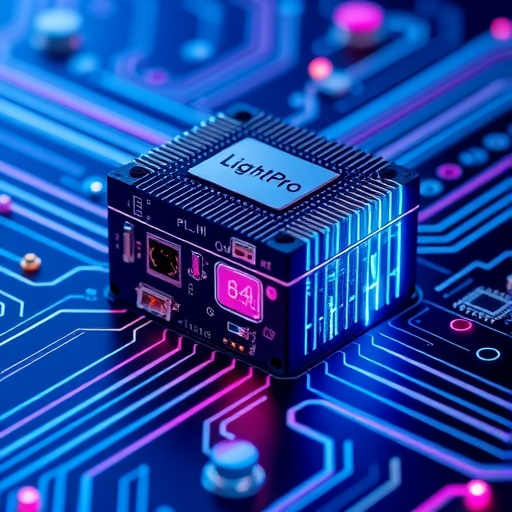
In the relentless pursuit of faster, more efficient, and scalable computing technologies, photonic processors have emerged as a promising frontier, poised to revolutionize the way information is processed and transmitted. A groundbreaking development in this arena has just been unveiled by researchers Shafiee, Ghanaatian, Charbonnier, and their team with the introduction of LightPro, a linear photonic processor boasting unprecedented full programmability. Published in the forthcoming 2026 issue of Communications Engineering, LightPro represents a major leap forward, potentially redefining the capabilities and applications of optical computing architectures.
LightPro capitalizes on the unique advantages of photonics—namely the ability to manipulate and transmit information at the speed of light with minimal energy loss and thermal interference. Unlike traditional electronic processors that rely on electron flow through semiconductors, photonic processors use photons within integrated optical circuits, allowing for ultra-high bandwidth and parallelism. What sets LightPro apart is its linear architecture combined with full programmability, enabling reconfiguration of the processor post-fabrication to suit a broad spectrum of computational tasks without the need for hardware alteration or costly redesigns.
At the heart of LightPro is an innovative linear optical circuit design that harnesses arrays of beam splitters, phase shifters, and interferometers to perform a variety of matrix operations, which serve as the cornerstone for numerous signal processing and machine learning algorithms. The capacity for full programmability is achieved through a sophisticated control system that dynamically adjusts phase and amplitude parameters across the integrated photonic network. This level of control is critical for implementing complex linear transformations in real time, a capability that has eluded previous photonic processors constrained by fixed-function designs or limited tuning ranges.
One hallmark of LightPro’s architecture is its scalability. By employing advanced waveguide fabrication techniques and leveraging mature silicon photonics platforms, the researchers have engineered a compact chip that can accommodate thousands of configurable optical elements while maintaining low insertion loss and high signal fidelity. This dense integration is instrumental in scaling photonic processors up to sizes where they can tackle large-scale computational problems, offering a pathway toward practical deployment in data centers, telecommunications, and AI accelerators.
Underpinning LightPro’s performance is a meticulous error-correction and calibration protocol designed to compensate for fabrication imperfections and thermal fluctuations inherent in photonic circuits. The team developed an adaptive feedback mechanism interfaced with on-chip photodetectors to continuously monitor and adjust operational parameters, ensuring reliable execution of operations even under variable environmental conditions. This resilience is vital for real-world adoption where robustness and repeatability are non-negotiable.
The implications of fully programmable linear photonic processors like LightPro extend far beyond improved speed and efficiency; they open new horizons in application domains such as quantum computing simulation, deep learning inference, and real-time analog signal processing. For instance, the processor’s ability to implement arbitrary linear transformations natively aligns with the requirements of optical neural networks, where weights correspond to matrix elements that can be rapidly reprogrammed to accommodate changing tasks or models without downtime or reconfiguration overhead.
This adaptability also translates to enhanced flexibility in optical communications. As networks evolve and dynamic bandwidth allocation becomes increasingly crucial, devices like LightPro could serve as agile, programmable nodes capable of performing inline optical routing, switching, and signal conditioning with unprecedented speed and energy efficiency. Consequently, the technology heralds a future where optical data transmission and computation converge seamlessly, pushing the limits of network throughput and latency.
From a fabrication standpoint, LightPro leverages the precision of state-of-the-art lithography and material engineering to integrate complex optical elements along a single chip platform. The team’s choice of materials and design optimizations afford the system a balance between low propagation loss, moderate footprint, and the ability to function at telecommunications wavelengths around 1550 nm. These considerations ensure compatibility with existing fiber-optic infrastructure, smoothing the path to industrial adoption.
Addressing the challenges associated with on-chip programmability in photonic circuits, the researchers employed microelectromechanical systems (MEMS) actuators and thermo-optic phase shifters as their tuning mechanisms. These devices permit fine-grained, continuous modulation of optical signals without introducing significant noise or crosstalk, preserving computational accuracy. Furthermore, the integration of these mechanisms avoids the bulky external components traditionally needed for photonic tuning, resulting in a streamlined, robust package.
The computational paradigm underlying LightPro also embodies a shift from task-specific processors to universal linear operators capable of reconfiguring their functional logic instantaneously. This universality enables the execution of diverse linear algebra operations, including matrix-vector multiplications fundamental to a wide range of algorithms. The photonic nature of the computations allows LightPro to perform these operations at terahertz bandwidths, far surpassing the gigahertz speeds typical of electronic counterparts and opening a fundamentally new era of high-throughput computing.
In terms of energy consumption, LightPro demonstrates a remarkable efficiency profile. Since photons do not suffer from resistive losses as electrons do, and optical interconnects avoid capacitive charging delays, the overall system requires significantly less power to perform equivalent calculations. This characteristic is especially beneficial in the context of large-scale data centers and edge computing devices where energy budgets critically constrain operation.
Despite LightPro’s significant advancements, the technology is not without challenges. Photonic integration requires extraordinary precision, and the thermal sensitivity of optical components still necessitates elaborate control schemes. Additionally, integrating fully programmable photonic processors with existing electronic systems calls for hybrid architectures and novel interface protocols to translate between optical and electronic domains. The research team openly discusses these hurdles and outlines ongoing efforts to develop seamless electronic-photonic co-design frameworks.
Looking ahead, the potential for LightPro and similar devices is immense. Future iterations could integrate nonlinear optical components to extend capabilities beyond linear transformations, enabling true optical neural networks and even quantum photonic processors. The researchers envision extending programmability to higher-dimensional tensor operations and exploring on-chip photonic memory elements for truly autonomous optical computing systems.
Ultimately, LightPro signifies a vital milestone on the path toward photonics-driven computation. By combining full programmability with scalable linear architectures, it presents a compelling alternative to conventional electronics, especially in applications demanding ultra-high-speed, low-latency, and energy-conscious processing. As the technology matures, it promises to reshape diverse fields from artificial intelligence and telecommunications to quantum simulation and beyond, marking a transformative era in information technology.
The unveiling of LightPro by Shafiee, Ghanaatian, Charbonnier, and colleagues represents not just a technical achievement but a paradigm shift, emphasizing the symbiosis of linear optical physics and programmable architectures. This confluence sets the stage for a new generation of photonic processors that can adapt dynamically while leveraging the inherent advantages of light to perform computations at speeds and scales hitherto unimaginable.
Cite Scienmag News
Denise Maddox. (June 17, 2026). LightPro: Fully Programmable Linear Photonic Processor. Scienmag. https://scienmag.com/lightpro-fully-programmable-linear-photonic-processor/
Denise Maddox. "LightPro: Fully Programmable Linear Photonic Processor." Scienmag, 17 June 2026, https://scienmag.com/lightpro-fully-programmable-linear-photonic-processor/. Accessed 3 September 2026.
Denise Maddox. "LightPro: Fully Programmable Linear Photonic Processor." Scienmag. June 17, 2026. https://scienmag.com/lightpro-fully-programmable-linear-photonic-processor/


