


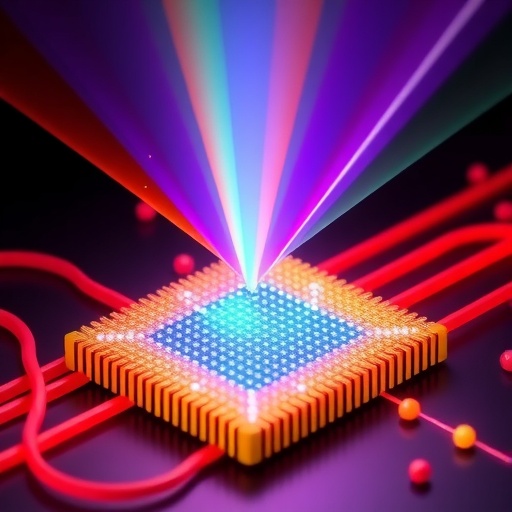
In a groundbreaking advancement for optoelectronic technology, researchers have unveiled a novel approach harnessing the unique properties of Si₃N₄/n-Si hybrid devices to achieve interface-controlled broadband photodetection. This development promises to revolutionize the efficiency and spectral range of photodetectors, devices integral to a wide array of applications from telecommunications to environmental monitoring. The study, recently published in Scientific Reports, highlights how meticulous control over material interfaces can dramatically enhance device performance, marking a significant leap forward in photodetector design and fabrication.
Photodetectors serve as the eyes of modern electronic systems, converting light into electrical signals that enable everything from digital imaging to fiber optic communication. Traditional photodetectors, however, have long been limited by narrow operational bandwidths and sensitivity constraints, curbing their effectiveness in emerging high-performance applications. By integrating silicon nitride (Si₃N₄) with n-type silicon (n-Si), the researchers have engineered a hybrid platform that deftly overcomes these limitations, exploiting interface phenomena to extend detection capabilities across a broad spectrum of electromagnetic radiation.
At the heart of this innovation lies the strategic manipulation of the Si₃N₄/n-Si interface. Silicon nitride, known for its excellent dielectric properties and chemical stability, acts as both a passivation layer and an optical modulator when interfaced with silicon. This interplay at the atomic and electronic scale shapes charge carrier dynamics, reduces surface recombination losses, and enhances photon absorption efficiency. Such interface engineering ensures that the hybrid device is not only highly sensitive but also capable of operating seamlessly over a wide range of wavelengths, from ultraviolet through visible to near-infrared.
The research team deployed advanced fabrication techniques to precisely control the deposition and interface formation of Si₃N₄ on the n-Si substrate. Utilizing plasma-enhanced chemical vapor deposition (PECVD), they achieved a uniform and defect-minimized nitride layer that adheres perfectly to the silicon surface. This meticulous fabrication step is essential as interface traps, commonly induced by imperfections, can severely degrade photodetector responsiveness and noise levels. By minimizing such imperfections, the hybrid device attains an unprecedented signal-to-noise ratio crucial for sensitive detection tasks.
Optical characterization of the Si₃N₄/n-Si hybrids revealed remarkable broadband responsivity, a parameter quantifying the device’s ability to convert incoming photons across various wavelengths into electric current. The devices demonstrated enhanced photoresponse not only in the visible spectrum but also extended into ultraviolet and infrared regions, surpassing conventional silicon-based photodetectors limited by the bandgap constraints of pure silicon. This broadband sensitivity opens the door to new applications where multispectral light detection is necessary without the need for separate sensors.
One of the pivotal mechanisms for this extended response is the formation of interfacial states that facilitate charge transfer and broaden the spectral detection range. These states effectively lower the energy barriers that typically restrict silicon’s photoresponse, enabling efficient utilization of photons with energies both above and below the traditional silicon bandgap. This effect is modulated by the thickness and stoichiometric composition of the Si₃N₄ layer, parameters finely tuned during device fabrication to optimize performance.
Beyond spectral coverage, the temporal response of these hybrid photodetectors is equally impressive. The devices exhibited fast switching times and low dark currents, essential characteristics for high-speed communications and low-light detection scenarios. Reduced dark current, a measure of unwanted noise in the absence of illumination, directly correlates with enhanced sensitivity, thereby allowing the detection of weak optical signals with unprecedented clarity.
Integration compatibility is another striking advantage of the Si₃N₄/n-Si system. Both materials are well-established in mainstream semiconductor manufacturing, meaning that this innovation can be seamlessly incorporated into existing silicon-based electronic platforms. This compatibility facilitates scaling production while maintaining cost efficiency, a critical factor for commercial adoption in industries such as consumer electronics, healthcare diagnostics, and environmental sensing.
The research also delves into the underlying physics governing the device operation. Through combined experimental and theoretical analyses, the study elucidates charge carrier transport across the interface, the role of interface dipoles, and modulation of the built-in electric field that directs photogenerated carriers. Such detailed understanding offers a roadmap for further improvements, potentially inspiring future hybrid systems with tailored optoelectronic properties suitable for specific industrial applications.
In terms of real-world application, these hybrid photodetectors could significantly enhance the performance of cameras, optical coherence tomography devices, and remote sensing instruments. The broadband detection capability reduces the reliance on multiple sensors, simplifying device architectures and improving reliability. Additionally, their fast response times and stability under various environmental conditions are promising for deployment in harsh or variable environments, including space exploration and autonomous vehicle navigation.
This research marks a notable shift in photodetector technology by emphasizing interface engineering to transcend inherent material limitations. By capitalizing on the complementary properties of Si₃N₄ and n-Si junctions, the study injects fresh momentum into the pursuit of universal photodetectors that excel in speed, sensitivity, and spectral range. The findings underscore the vast potential lying in hybrid material systems, motivating continued exploration into interface-controlled photonic devices.
Looking forward, the researchers suggest exploring further modifications to the Si₃N₄ layer such as doping or introducing nanoscale structuring to tailor the interface behavior. Such advancements may unlock new functionalities like polarization sensitivity or even tunable wavelength selectivity, pushing hybrid photodetectors beyond current performance frontiers. These directions align with the broader scientific quest to develop smarter, more adaptable optoelectronic components for the next generation of information and sensing technologies.
In conclusion, the Si₃N₄/n-Si hybrid photodetector described in this study represents a pivotal development that combines material science innovation with practical engineering to address longstanding challenges in photodetection. Its broadband capability, operational stability, and integration potential poise it as a top candidate for a wide spectrum of applications demanding fast, efficient, and reliable light detection. As industries continue to demand more from photonic devices, such interface-controlled systems stand out as a transformative solution poised to redefine the future of photodetection technology.
Cite Scienmag News
Denise Maddox. (June 16, 2026). Broadband Photodetection via Si3N4/n-Si Interface. Scienmag. https://scienmag.com/broadband-photodetection-via-si3n4-n-si-interface/
Denise Maddox. "Broadband Photodetection via Si3N4/n-Si Interface." Scienmag, 16 June 2026, https://scienmag.com/broadband-photodetection-via-si3n4-n-si-interface/. Accessed 7 September 2026.
Denise Maddox. "Broadband Photodetection via Si3N4/n-Si Interface." Scienmag. June 16, 2026. https://scienmag.com/broadband-photodetection-via-si3n4-n-si-interface/


