


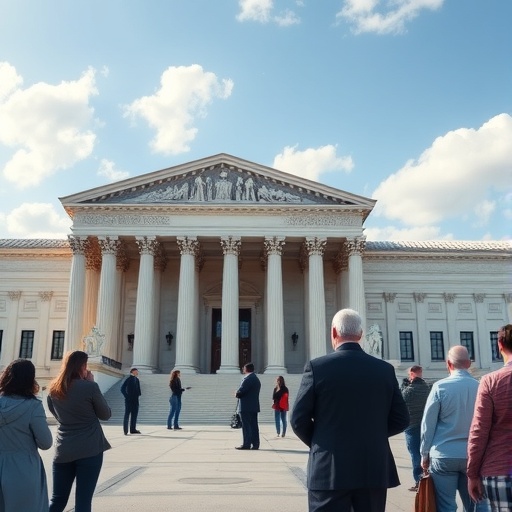
Amid a striking decline in public trust toward the U.S. Supreme Court, emerging research from the Annenberg Public Policy Center (APPC) at the University of Pennsylvania illuminates how jury service tangibly enhances Americans’ perceptions of the judiciary. This extensive study, published in the law journal Judicature by Duke University, rigorously examines nationally representative survey data, revealing that those who have recently engaged in jury duty demonstrate significantly more positive attitudes not only toward courts broadly but also toward judges personally. However, this promising connection exists against the backdrop of a substantial reduction in jury trials nationwide, limiting the public’s direct exposure to the judicial process and, by extension, opportunities for democratic engagement and trust-building.
One of the most alarming findings of the research is the precipitous drop in trust in the Supreme Court over the past several years. Data from a March 2025 survey show that only 41 percent of U.S. adults express moderate or high trust in this institution—a steep decrease from 68 percent documented in 2019. This erosion of confidence parallels a marked increase in those expressing low or no trust, which now amounts to 59 percent of respondents, underscoring a crisis of legitimacy that could have profound implications for the American legal system and democracy overall.
Jury service presents itself as a critical but underappreciated mechanism for fostering positive judicial attitudes. Survey participants who served on juries within the past five years identified courts as more legitimate institutions and reported greater trust in their operations. Furthermore, these individuals attributed notably more favorable qualities to judges, such as fairness and impartiality, even after accounting for demographic and political differences. These findings suggest that firsthand experience within the judicial process cultivates a nuanced understanding and can counteract prevailing skepticism about the judiciary.
However, the practical reality tells a sobering story: jury trials are vanishing at an alarming rate. Historical trends indicate that federal civil jury trials fell dramatically from 5.5 percent of cases in 1962 to less than 1 percent by 2013, while federal criminal jury trials declined from 8.2 percent to 3.6 percent over the same time frame. The number of individuals called to serve on federal juries also plummeted by over a third between 2006 and 2016. This stark contraction means far fewer Americans experience the courts firsthand, limiting the opportunity for experiential trust-building.
The survey data reflect this troubling national trend; the proportion of adults reporting jury service in the previous five years halved from an average of 9% before the COVID-19 pandemic to just 4% by 2025. This decline not only diminishes civic engagement but also leaves a void in the mechanisms that underpin trust and legitimacy in the judiciary. Ultimately, fewer jury trials translate into fewer citizens connecting directly with the justice system, undermining one of the few democratic experiences that confront individuals with the gravity and fairness of legal processes.
Beyond the experiential benefits of jury service, the research highlights the paramount role of civic knowledge in shaping attitudes toward courts. Individuals demonstrating higher levels of civic literacy exhibited even greater perceived legitimacy of the judiciary than those with jury experience alone. Specifically, civic knowledge corresponded to an approximately 14-percentage-point increase in court legitimacy perceptions, compared with a 9-point increase associated with jury service. This finding underscores the power of education in cultivating informed, engaged citizens capable of assessing legal institutions accurately.
Experts involved in the study emphasize the ramifications of these findings for democratic health. Shawn Patterson Jr., an APPC research analyst, points to the shrinking frequency of jury trials as a critical concern, warning that the dwindling pool of jurors reduces the public’s firsthand exposure to the principles and operations of the legal system. This decline risks eroding the foundational belief in judicial fairness and legitimacy necessary to uphold the rule of law.
Matthew Levendusky, director of APPC’s Institutions of Democracy division, elaborates on the experiential dimension of trust formation, noting that courts’ visibility and transparency through jury service foster deeper appreciation and confidence among citizens. Such direct participation demystifies judicial procedures and humanizes judges, mitigating abstract distrust fueled by media portrayals or political rhetoric.
Given the contraction in jury trial opportunities, the researchers advocate for bolstering civic education as a vital alternative to nurture public trust. They propose an integrated educational framework that bridges K-12 curriculum with adult learning environments—including workplaces, community organizations, and specialized civic engagement centers associated with courts. This approach aims to enhance baseline civic literacy, enabling citizens to engage with the judicial branch and democracy more meaningfully despite diminishing jury service exposure.
Institutional efforts such as the Stephen G. Breyer Community Learning Center on Courts and the Constitution in Boston and the Justice & Democracy Centers of Minnesota exemplify initiatives designed to bring civic learning directly into community spaces. These centers offer interactive programming focused on constitutional literacy, judicial processes, and democratic participation, fostering awareness and trust where traditional jury experiences become scarce.
In times marked by political polarization and widespread misinformation, the emphasis on civic education transcends academic interest, emerging as a cornerstone of democratic resilience. Lance Holbert, director of the Leonore Annenberg Institute for Civics at APPC, asserts that enhancing civic knowledge is indispensable for empowering individuals to participate fully in democratic decision-making and to maintain social cohesion in a fragmented political landscape.
The study, titled “To Know Courts Is to Love Them?” and published in the June 2026 issue of Judicature, represents a collaborative effort among scholars Shawn Patterson Jr., Abby Murray, Matthew Levendusky, R. Lance Holbert, and Kathleen Hall Jamieson. By linking empirical data with democratic theory, the work contributes valuable insight into how direct engagement with judicial institutions and systemic education initiatives can together stem the tide of declining institutional trust.
As the judiciary grapples with legitimacy challenges, these findings underscore the urgency of preserving and reinvigorating pathways for public participation and awareness. While the decline of jury trials constrains one such pathway, concerted investment in civic education and community-based learning infrastructures offers a promising route to restore faith in courts and the legal system, ultimately buttressing the democratic fabric of the United States.
Cite Scienmag News
Courtney Benton. (June 16, 2026). Jury Duty Enhances Public Confidence in Courts, Yet Participation Declines Among Americans. Scienmag. https://scienmag.com/jury-duty-enhances-public-confidence-in-courts-yet-participation-declines-among-americans/
Courtney Benton. "Jury Duty Enhances Public Confidence in Courts, Yet Participation Declines Among Americans." Scienmag, 16 June 2026, https://scienmag.com/jury-duty-enhances-public-confidence-in-courts-yet-participation-declines-among-americans/. Accessed 4 September 2026.
Courtney Benton. "Jury Duty Enhances Public Confidence in Courts, Yet Participation Declines Among Americans." Scienmag. June 16, 2026. https://scienmag.com/jury-duty-enhances-public-confidence-in-courts-yet-participation-declines-among-americans/


