


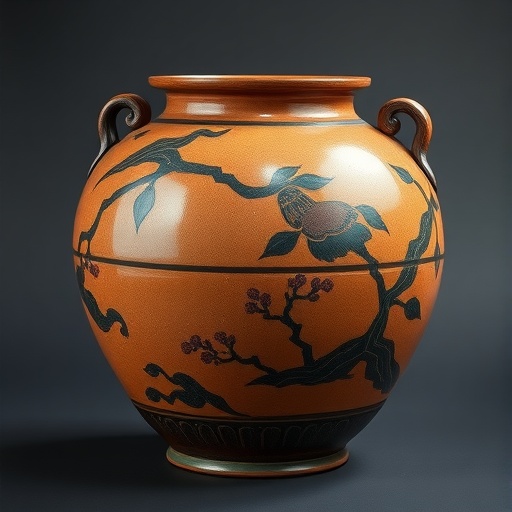
A humble storage jar is helping archaeologists rewrite the history of early modern Japan. Using artificial intelligence, geometric morphometrics, and statistical analysis, researchers have shown that large ceramic vessels known as “Ogame” became increasingly standardized during the Edo period while also developing distinct forms for everyday use and burial. The study offers the first quantitative evidence that major political and economic changes affected not only luxury porcelain, but also the ordinary pottery used by people across Japanese society.
Ogame were among the most versatile containers of the Edo period, which lasted from 1603 to 1868. They were used to store water and soy sauce, transport agricultural fertilizers, collect human waste, and, in some cases, serve as burial jars. Their widespread use made them an important part of daily life, yet their historical significance has often been overlooked because archaeological research has traditionally focused on more valuable ceramics and written records associated with political elites. The new analysis suggests that these unglazed or utilitarian vessels preserve a detailed record of technological organization, changing markets, and social practices.
Associate Professor James Frances Loftus of the Institute of Future Science, the Institute for Liberal Arts, and the School of Environment and Society at the Institute of Science Tokyo examined 243 Ogame recovered from 11 kiln and mortuary sites in the Saga and Fukuoka regions of Japan. The vessels came from different periods of the Edo era, and some lacked secure archaeological dates. To overcome that problem, Loftus combined geometric morphometrics, a method for measuring biological and cultural forms, with a Random Forest machine-learning model capable of identifying chronological patterns in vessel shape.
The analysis began by converting each jar’s outline into digital data. Loftus used Elliptical Fourier Analysis, a geometric morphometric technique that represents a complex contour through a series of mathematical coefficients. These coefficients capture subtle variations in the curvature and proportions of a vessel, including the width of its shoulders, the shape of its rim, the profile of its body, and the form of its base. Instead of relying on visual judgments such as whether one jar “looks taller” or “appears more rounded” than another, the method allows researchers to compare hundreds of vessels according to consistent numerical measurements.
The results revealed a striking transformation. Ogame made during the early seventeenth century showed substantial variation in their overall shape, suggesting that production was relatively diverse and may have been influenced by local traditions, individual workshops, or flexible manufacturing practices. By the eighteenth century, however, the jars had become much more uniform. Their forms converged in ways that indicate increasingly standardized production, possibly reflecting stronger regulation, more specialized kiln operations, and the expansion of distribution networks that connected producers and consumers across regions.
This shift occurred during a period of profound change in Japan. The Tokugawa shogunate was consolidating political control, domestic production systems were expanding, and international commerce was being reshaped by developments such as the Qing maritime trade ban. Earlier studies have shown that these forces transformed the production and circulation of porcelain, which was expensive and often associated with elite consumption. The Ogame findings indicate that the same broad developments reached into the manufacture of practical household pottery. Standardization was not limited to luxury objects; it also influenced containers used for food, liquids, agriculture, sanitation, and funerary practices.
The machine-learning analysis also detected a clear relationship between vessel shape and function. Ogame recovered from kiln sites typically had broad shoulders, flared rims, and relatively compact lower bodies. These characteristics would have made them practical for filling, emptying, storing, and transporting liquids or fertilizers. Their broad upper sections could provide useful capacity while allowing access to the contents. By contrast, jars found at burial sites tended to be taller, narrower, and more enclosed. Their morphology suggests that they were made or selected for funerary use rather than simply being ordinary domestic vessels repurposed after years of service.
The Random Forest model provided a way to estimate the chronological placement of jars without reliable excavation dates. Random Forest is an ensemble machine-learning method that combines the results of many decision trees, each trained on different subsets of data and shape variables. By comparing undated vessels with jars from known chronological stages, the model could assign likely time periods based on their morphological characteristics. This approach does not replace archaeological context, but it can identify patterns that would be difficult to detect through visual comparison alone and can help researchers organize incomplete historical collections.
The findings also demonstrate why everyday objects can be powerful historical evidence. Political documents may describe the decisions of rulers, trade restrictions, or economic policies, but they rarely reveal how those changes affected ordinary manufacturing or routine household activities. Ogame provide a different perspective because their shapes record the interaction between technical knowledge, consumer needs, workshop organization, and cultural practices. The increasing uniformity of the jars suggests that production systems were becoming more controlled, while the differences between domestic and funerary vessels show that standardization did not eliminate functional adaptation.
“This study provides the first quantitative evidence that Edo-period Ogame became increasingly standardized over time while also adapting to different functions in response to broader historical developments,” Loftus says. The work highlights the potential of artificial intelligence to transform archaeological research, not by allowing machines to interpret the past independently, but by giving researchers precise tools for measuring patterns that are too subtle or complex to evaluate consistently by eye. Shape analysis can reveal changes in production and use even when written records are limited or absent.
The study, published in Open Archaeology, points toward a broader future for computational archaeology. Loftus plans to combine quantitative shape analysis with portable X-ray fluorescence and compositional studies, which can identify the chemical signatures of clays, minerals, and manufacturing materials. Linking a jar’s shape to its composition could help determine where it was made, how production was organized, and how vessels moved through regional exchange networks. Applying the same methods to ceramics from other parts of Japan and from different historical periods could reveal whether similar patterns of standardization and functional specialization occurred elsewhere. Together, these techniques may allow archaeologists to reconstruct past manufacturing systems and social change with a level of precision once considered impossible for ordinary pottery.
News Publication Date: 19-Aug-2026
Web References: https://doi.org/10.1515/opar-2025-0083
References: Open Archaeology, DOI: 10.1515/opar-2025-0083
Cite Scienmag News
Courtney Benton. (August 20, 2026). AI Reveals How Edo-Period Japanese Ceramic Jars Evolved. Scienmag. https://scienmag.com/ai-reveals-how-edo-period-japanese-ceramic-jars-evolved/
Courtney Benton. "AI Reveals How Edo-Period Japanese Ceramic Jars Evolved." Scienmag, 20 August 2026, https://scienmag.com/ai-reveals-how-edo-period-japanese-ceramic-jars-evolved/. Accessed 5 September 2026.
Courtney Benton. "AI Reveals How Edo-Period Japanese Ceramic Jars Evolved." Scienmag. August 20, 2026. https://scienmag.com/ai-reveals-how-edo-period-japanese-ceramic-jars-evolved/


