


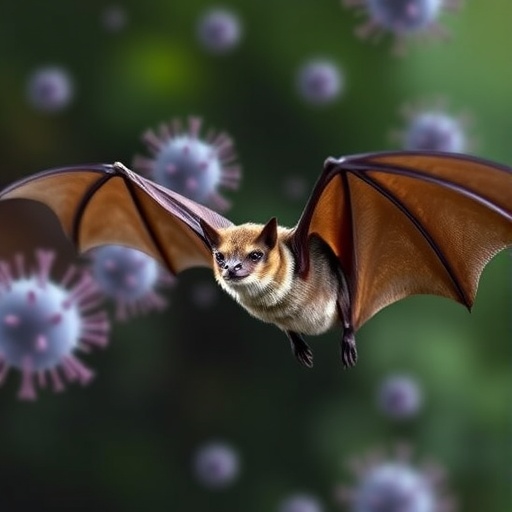
The emergence of pandemics often hinges on intricate molecular interactions that enable viruses to cross species barriers. Among the various zoonotic events, the COVID-19 pandemic stands as a stark reminder of how viruses harbored in animal reservoirs, such as bats, can adapt to infect humans with devastating consequences. Recent pioneering research has shed light on how a single amino acid alteration in a viral protein facilitates this leap by modulating immune responses in both bats and humans.
Scientists from the University of California, San Francisco (UCSF) Quantitative Biosciences Institute, in collaboration with the Icahn School of Medicine at Mount Sinai, Institut Pasteur, and Fred Hutchinson Cancer Center, have identified a critical molecular switch in coronaviruses responsible for the ease with which such pathogens may spill over from wildlife into human populations. This key finding points to a singular amino acid substitution within a viral protein that distinctly influences the immune signaling landscapes in bat and human lung cells.
Their investigations centered around comparative studies of SARS-CoV-2, the coronavirus responsible for COVID-19, and RaTG13, a closely related coronavirus found exclusively in bats. Both viruses possess a protein known as OrfB9, which was discovered to differ by only one amino acid—a subtle change in a protein sequence of roughly 100 residues. Intriguingly, this small variance exerts dramatic effects on how the virus interacts with the host immune system, steering the infection outcome in remarkably different directions depending on the species.
In human lung cells, the SARS-CoV-2 variant of OrfB9 plays a sabotaging role by disabling a key immune alarm system. By effectively undermining host defense mechanisms, the virus can replicate unimpeded, thereby contributing to its pathogenic success. In contrast, the RaTG13 counterpart in bat cells triggers the activation of immune proteins that work to suppress viral replication, illustrating how bats maintain a delicate balance with coronaviruses that inhabit them without succumbing to disease.
To achieve these insights, the researchers leveraged cutting-edge techniques and utilized the world’s first laboratory-grown lung cell line derived from the greater horseshoe bat. This breakthrough in cell culture technology allowed them to conduct meticulous side-by-side comparisons of molecular interactions in cell types native to each species, capturing the subtle yet decisive influence of the amino acid variation on immune signaling pathways.
The importance of this study extends beyond academic curiosity, as it elucidates a molecular signature that may serve as an early warning indicator for spillover risk. According to Dr. Nevan J. Krogan, director of the UCSF Quantitative Biosciences Institute and senior author of the study, the trajectory of a virus from a benign passenger in bats to a catastrophic human pathogen can be dictated by these cryptic genetic switches. Mapping such interactions at the protein level provides an unprecedented window into viral evolution and host adaptation.
This research underscores the complexity of host-pathogen interactions where single molecular changes can reprogram the immune landscape of infected cells. The differential modulation of immune alarm systems highlights a co-evolutionary arms race, where viruses refine their mechanisms to evade immune detection in one host while being constrained in another. Elucidating these dynamics is essential for understanding the emergence of new infectious diseases originating in wildlife.
Emerging infectious diseases often originate in bats due to their unique physiology and immune system traits, which tolerate viral persistence without overt pathology. By dissecting the molecular determinants that govern virus-host interactions, this study offers clues to why certain coronaviruses remain confined to bat reservoirs, whereas others successfully breach species boundaries, leading to human outbreaks.
Beyond its virological implications, the study represents a tour de force in integrative biomedical research. Combining expertise in molecular biology, immunology, virology, and computational biology, the consortium unveiled the impact of minute viral genetic differences on the broader scale of public health. This approach paves the way for predictive models that can anticipate spillover events before they materialize.
Understanding how single amino acid changes in viral proteins influence immune responses also has direct ramifications for vaccine development and antiviral strategies. Targeting such molecular nodes may offer new avenues for therapeutic intervention that preempt viral adaptation and prevent future pandemics.
The findings, detailed in the May 13 publication of the esteemed journal Cell Host & Microbe, stand as a testament to the power of molecular biosciences to decode the hidden language of viral evolution. They reinforce the critical need for surveillance and research efforts focusing on viral diversity in animal reservoirs and their molecular interplay with host immune systems.
As humanity continues to confront the challenges posed by zoonotic pathogens, studies like this offer both caution and hope. By demystifying the molecular switches that enable viruses to jump across species, researchers equip societies with tools to better predict, prevent, and respond to infectious disease threats at their source.
News Publication Date: May 13, 2026
Web References: https://qbi.ucsf.edu/, https://www.cell.com/cell-host-microbe/fulltext/S1931-3128(26)00171-X
References: Includes contributions by Nevan J. Krogan, Jyoti Batra, Yuan Zhou, and colleagues from UCSF, Icahn School of Medicine at Mount Sinai, Institut Pasteur, and Fred Hutchinson Cancer Center.
Cite Scienmag News
Kristina Jarvis. (June 16, 2026). Single Amino Acid Mutation Could Enable Viruses to Leap from Bats to Humans. Scienmag. https://scienmag.com/single-amino-acid-mutation-could-enable-viruses-to-leap-from-bats-to-humans/
Kristina Jarvis. "Single Amino Acid Mutation Could Enable Viruses to Leap from Bats to Humans." Scienmag, 16 June 2026, https://scienmag.com/single-amino-acid-mutation-could-enable-viruses-to-leap-from-bats-to-humans/. Accessed 3 September 2026.
Kristina Jarvis. "Single Amino Acid Mutation Could Enable Viruses to Leap from Bats to Humans." Scienmag. June 16, 2026. https://scienmag.com/single-amino-acid-mutation-could-enable-viruses-to-leap-from-bats-to-humans/


