


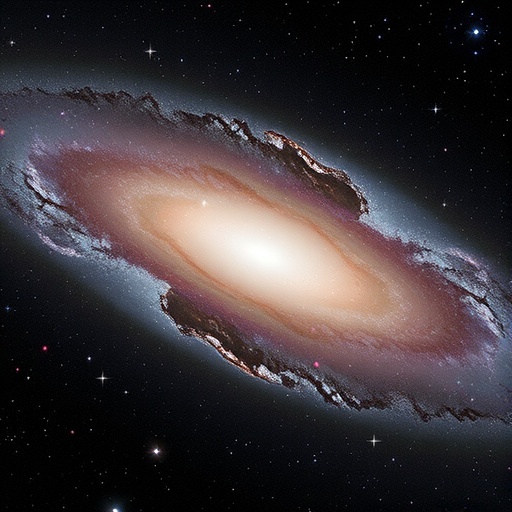
In a groundbreaking exploration of the cosmos, an international team of astronomers has pierced back nearly 13 billion years to unveil new insights into the formative years of our Universe. Using the Atacama Large Millimeter/submillimeter Array (ALMA), researchers focused on detecting the elusive [O I] 145-micron emission line — a unique signature emitted by neutral oxygen atoms. This achievement marks the most distant direct observation of neutral gas within typical star-forming galaxies at a redshift of approximately 7, corresponding to just 700 to 800 million years after the Big Bang. This discovery represents a pivotal breakthrough in understanding the primordial conditions that spurred the growth of galaxies and the stars within them.
Neutral gas, the fundamental ingredient fueling star formation, has remained cryptic in early galaxies due to technological limitations. While advanced observatories like the James Webb Space Telescope (JWST) and the Hubble Space Telescope (HST) reveal vivid images of young stars and ionized gas, they fall short of directly probing the reservoir of neutral gas. Neutral gas, being neither ionized nor starlit, emits radiation primarily in far-infrared and submillimeter wavelengths, making its detection particularly challenging. This study circumvents these difficulties by employing the [O I] 145 µm emission line as a direct tracer, enabling astronomers to isolate neutral gas from its ionized counterparts for the first time with this level of precision.
Traditionally, researchers have relied on the [C II] 158 µm emission line to trace star-forming gas. However, this line can originate from both ionized and neutral regions, complicating interpretation. To disentangle these contributions, the team incorporated observations of the [N II] 205 µm emission line, which exclusively traces ionized gas. The relatively faint or absent [N II] emission in the studied galaxies provides compelling evidence that the detected [O I] line predominantly arises from neutral gas reservoirs. This nuanced approach refines our understanding of the interstellar medium in early galaxies, clarifying the roles different gas phases play in nurturing star formation.
Leading this ambitious project is Assistant Professor Yoshinobu Fudamoto and Professor Masamune Oguri from Chiba University, Japan. Their collaborative study is slated for publication in the prestigious Astrophysical Journal in June 2026. Alongside them are experts from Waseda University, Hiroshima University, and the University of Tsukuba, forming a remarkable consortium of astronomers united in unraveling cosmic history. The success of their observations underscores the indispensable synergy between ALMA’s unparalleled resolution and sensitivity and JWST’s complementary infrared capabilities.
The galaxies targeted in this survey are representative of typical star-forming systems roughly 700 million years post-Big Bang, a period commonly referred to as the cosmic dawn. By detecting the [O I] line emission in all four galaxies, the team conclusively demonstrated the presence of substantial neutral gas beyond the reach of previous studies. This neutral oxygen emission traces dense, cool regions where stars are actively forming, providing a direct window into the fueling process behind early star formation.
The simultaneous assessment of [O I] and [C II] emissions allowed the researchers to model physical conditions prevailing in the interstellar medium of these primordial galaxies. They uncovered that neutral gas densities were strikingly high — comparable to those found in nearby starburst galaxies known for their intense and rapid star formation. Despite this density, the radiation environment was discerned to be moderately less intense than in classical starbursts, suggesting a unique early phase of galaxy evolution characterized by dense yet less energetic star-forming regions.
This pioneering use of the [O I] emission line not only advances observational cosmology but also enriches the diagnostic toolkit astronomers use to study the early Universe. Whereas previous studies grappled with ambiguous signals from mixed gas phases, the ability to pinpoint neutral gas with greater confidence renews prospects for accurately charting star formation history in the first billion years. Such detailed investigations help refine theoretical models of galaxy formation by anchoring them to empirical, spectral evidence.
“Our results represent the most distant direct detection of neutral gas in typical star-forming galaxies to date,” Dr. Fudamoto emphasizes. “This analysis unlocks the wealth of existing [C II] observations as a probe of neutral gas in the early Universe.” By anchoring prior ambiguous observations with firm detections of neutral gas, this work enables a reinterpretation of a large body of data collected over the past decade, reinvigorating efforts to map baryonic matter in the cosmic infancy.
Furthermore, this study showcases the indispensable power of combining data from cutting-edge facilities like ALMA and JWST. Together, they provide complementary views: ALMA probes cool gas via far-infrared spectral lines while JWST captures starlight and ionized gas through infrared imaging and spectroscopy. This multi-wavelength synergy is vital for decoding multifaceted astrophysical environments where gas phases coexist and interact intricately.
Looking towards the future, Dr. Inoue, an integral member of the team, highlights the broader implications, stating, “Our work establishes the [O I] emission line as an effective tool for studying an elusive gas component in the early Universe, opening a new window onto the ‘fuel’ behind star formation.” Expanding these observations to a larger sample promises to illuminate the diversity of star-forming environments and trace how galaxies transitioned from primordial clouds to the richly structured systems seen in the modern cosmos.
Assistant Professor Fudamoto envisions a comprehensive roadmap for further research: “We plan to extend these observations to a larger sample of galaxies and, by combining ALMA with JWST and other facilities, build a comprehensive picture of how galaxies formed and evolved from the cosmic dawn to the present day. Basic research of this kind addresses one of humanity’s most fundamental questions, namely how the Universe and our own Milky Way came to be what it is today.”
This breakthrough heralds a new era for extragalactic astronomy, where direct detection and spectral characterization of neutral gas in the early Universe become routine. By sensorily unlocking the ‘fuel tanks’ of star formation in the first galaxies, scientists are now poised to delve into fundamental questions surrounding galaxy assembly, star formation efficiency, and cosmic reionization with unprecedented clarity.
For more than a decade, astronomers have speculated about the physical processes governing early galaxy growth. Thanks to these innovative observations of [O I] emissions, they can now transition from speculation to detailed empirical mapping of interstellar gas reservoirs. Such progress underscores the essential role of international collaboration and state-of-the-art instrumentation in pushing the boundaries of knowledge about the cosmos.
Ultimately, unraveling how galaxies like our Milky Way emerged from primordial hydrogen and helium clouds enriches our understanding of cosmic origins and the conditions that enabled life’s evolution. As data accumulate and techniques refine, humanity edges closer to comprehending its place within the Universe’s grand narrative.
News Publication Date: June 15, 2026
Web References: https://doi.org/10.3847/1538-4357/ae5bad
References: Fudamoto, Y., Inoue, A. K., Bouwens, R., Inami, H., et al. (2026). ALMA Observations of [O I] 145 µm and [N II] 205 µm Emission lines from Star-Forming Galaxies at z ∼ 7. The Astrophysical Journal. https://doi.org/10.3847/1538-4357/ae5bad
Keywords
Neutral gas, [O I] 145 µm emission line, early Universe, star formation, ALMA, JWST, cosmic dawn, galaxy evolution, interstellar medium, high redshift galaxies, astrophysics, cosmology
Cite Scienmag News
Grant Pearson. (June 15, 2026). Breakthrough: First Direct Observation of Star-Forming Gas in Early Galaxies. Scienmag. https://scienmag.com/breakthrough-first-direct-observation-of-star-forming-gas-in-early-galaxies/
Grant Pearson. "Breakthrough: First Direct Observation of Star-Forming Gas in Early Galaxies." Scienmag, 15 June 2026, https://scienmag.com/breakthrough-first-direct-observation-of-star-forming-gas-in-early-galaxies/. Accessed 4 September 2026.
Grant Pearson. "Breakthrough: First Direct Observation of Star-Forming Gas in Early Galaxies." Scienmag. June 15, 2026. https://scienmag.com/breakthrough-first-direct-observation-of-star-forming-gas-in-early-galaxies/


