


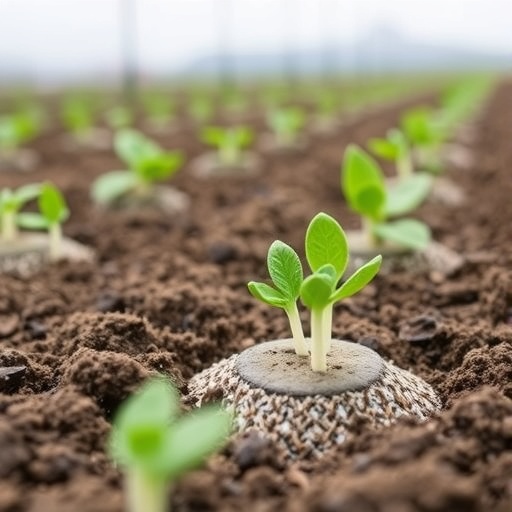
In an era where climate change poses escalating threats to agriculture, scientists have unveiled a groundbreaking living material that promises to revolutionize water management and thermal regulation in farming systems. This innovative biomaterial, developed through the strategic cultivation of the mycelium of Pleurotus ostreatus on a cellulose scaffold, demonstrates a sophisticated architectural design capable of harvesting atmospheric moisture and mitigating soil heat stress. Addressing the twin challenges of water scarcity and extreme thermal conditions, this living mulch could pave the way for sustainable, resilient agricultural practices on a global scale.
The research hinges upon a clever manipulation of fungal growth under precisely controlled gas exposure gradients, which directs the mycelium hyphae to grow in a vertically ordered fashion. The hierarchical structure comprises two distinct yet integrated regions: a hydrophilic fused cellulose-mycelium composite submerged in soil, vital for water transport, and an aerial, porous network of mycelium fibers above the soil surface. This spatial organization results in a built-in wettability gradient — an intrinsic property that enables directional water movement from the atmosphere into the soil strata below.
What sets this biomulch apart from conventional soil covers is its unique wettability pattern. As the mycelium grows upward into the air, it self-assembles hydrophobin proteins along the aerial fibers, which confer hydrophobic characteristics. Meanwhile, the cellulose scaffold and submerged mycelium remain hydrophilic. This carefully engineered dichotomy facilitates unidirectional water transport, effectively capturing atmospheric moisture that condenses on the aerial network and channeling it safely into the soil to irrigate crops.
Intriguingly, the porous aerial mycelium structure also plays a critical role in thermal regulation. Its light-scattering properties reflect and backscatter a substantial portion of incoming solar radiation, thereby reducing the heat load on the soil surface. Concurrently, this network enhances thermal emissivity, allowing accumulated heat to dissipate through infrared radiation during cooler periods. This dual action cools the biomulch surface, promoting water vapor condensation from the ambient air and further aiding moisture capture.
The integration of biological design and materials science culminates in a multifunctional material whose dynamic living components adapt during growth to environmental cues, resulting in a responsive system. This symbiosis between fungal biology and physical scaffold engineering underscores a burgeoning trend in sustainable bioinspired materials — leveraging living organisms to solve pressing environmental problems. The research team’s ability to impose asymmetric gas conditions during fungal growth is a key technical advancement that underpins the vertical organization, demonstrating precise control over the microstructure and macroscopic function of the material.
Beyond laboratory experimentation, the biomulch underwent rigorous field trials focusing on tomato cultivation. The results were remarkable: tomatoes grown with the living mycelium soil cover exhibited approximately a 28% increase in wet weight yield relative to those cultivated on bare soil. This substantial yield improvement validates the material’s functional benefit in real-world agricultural contexts, directly linking enhanced water availability and moderated soil temperatures to plant productivity gains.
The practical implications of this work are vast. Incorporating biomanufactured mycelium mats into farming practices offers a sustainable, low-cost substitute for synthetic mulching films and irrigation systems, which often suffer from environmental and economic drawbacks. Furthermore, the living mulch’s ability to self-repair and adapt to environmental stressors may reduce maintenance needs and increase longevity, enhancing long-term farming sustainability.
Technically, the researchers employed thorough characterization techniques to elucidate the material’s wettability profile, microstructure, and optical properties. Scanning electron microscopy revealed the aligned hyphal architecture, while contact angle measurements confirmed the pronounced hydrophobic gradient from aerial to submerged zones. Spectroscopic analyses showed enhanced reflectance and emissivity in relevant solar and thermal bands, linking structure to function. These multi-modal evaluations affirm the disciplined integration of biological growth manipulation and material performance.
The living mycelium material also represents a crucial step toward climate resilience in agriculture. Globally, increasing heat waves and drought periods threaten food security by escalating evaporative losses and reducing soil moisture retention. By harnessing passive atmospheric water collection coupled with thermal load moderation, this novel system offers a biomimetic, eco-friendly approach that mitigates such stresses at the microenvironment scale around plant roots.
From a biofabrication standpoint, the work exemplifies the power of directed mycelial growth as a strategy for programmable living materials. Unlike inert foams or films, mycelium’s ability to grow and organize in three dimensions imbues dynamic adaptability and complex functionalities that are challenging to achieve with synthetic analogs. Embedding these fibers onto a cellulose substrate not only provides structural integrity but also introduces synergistic hydrophilic properties that enhance water transport pathways.
Moreover, the material’s environmental footprint aligns with sustainable development goals. Cellulose, an abundant and renewable plant polymer, combined with fungal biomass, offers a fully biodegradable solution that fits naturally into agroecosystems. It circumvents the pollution problems associated with plastic mulch films and reduces dependence on chemical irrigation inputs, fostering circular agriculture paradigms.
Looking ahead, the research opens exciting avenues for expanding living mycelium materials to address other agronomic challenges. By tailoring fungal species, scaffold design, and environmental stimuli, it may be possible to engineer biomulches with additional functionalities such as nutrient delivery, pathogen suppression, or soil structure enhancement. This bespoke biomanufacturing platform holds transformative potential for future smart agricultural systems.
The interdisciplinary approach bridging Mycology, materials science, environmental engineering, and agronomy showcased in this study highlights the power of convergent innovation. It epitomizes how ancient organisms like fungi, historically overlooked in high-tech applications, can become pivotal agents in next-generation sustainable technologies. Through painstaking cultivation control and structural design, these researchers have realized a responsive living mulch that literally rewrites the rules of soil-water interaction.
Importantly, the system’s scalability and ease of production suggest that widespread adoption could be feasible even in resource-limited settings. Since the mycelium grows readily on inexpensive cellulose substrates under ambient conditions, this approach circumvents barriers related to complex manufacturing infrastructure. Farmers worldwide could benefit from locally produced living mulch tailored to their climatic conditions, enhancing global food security.
In sum, this pioneering study delivers a paradigm shift in how we conceive agricultural water management tools. By elegantly melding biological growth processes with materials engineering, it reveals a compelling path toward multifunctional, self-sustaining, and environmentally harmonious farming aids. As climate volatility intensifies, such innovations will be indispensable for cultivating crops under increasingly challenging conditions.
The living mycelium biomulch developed by Liu, Tian, Xu, and colleagues is a tangible example of how directed biofabrication can generate novel functional materials with immediate applicability. It is a testament to the potential lying at the intersection of biology and engineering — where living organisms become materials scientists’ collaborators rather than mere subjects. With further development and deployment, this technology could become a cornerstone of climate-resilient agriculture worldwide, fostering sustainable food production for generations to come.
Cite Scienmag News
Violet Maxwell. (June 15, 2026). Mycelium Biomulch Harvests Water, Boosts Soil Irrigation. Scienmag. https://scienmag.com/mycelium-biomulch-harvests-water-boosts-soil-irrigation/
Violet Maxwell. "Mycelium Biomulch Harvests Water, Boosts Soil Irrigation." Scienmag, 15 June 2026, https://scienmag.com/mycelium-biomulch-harvests-water-boosts-soil-irrigation/. Accessed 4 September 2026.
Violet Maxwell. "Mycelium Biomulch Harvests Water, Boosts Soil Irrigation." Scienmag. June 15, 2026. https://scienmag.com/mycelium-biomulch-harvests-water-boosts-soil-irrigation/


