


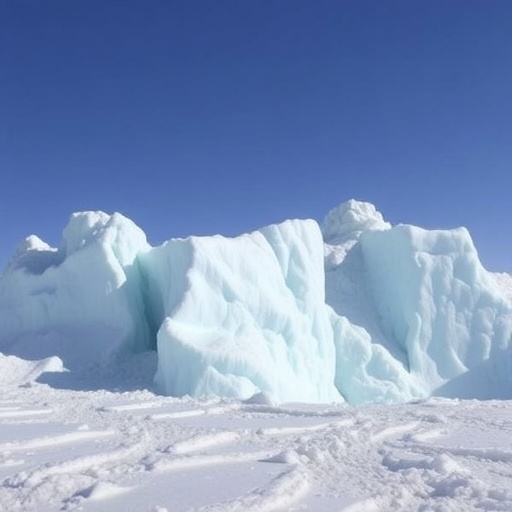
In the rapidly evolving landscape of polar science, a groundbreaking study has unveiled critical insights into the mechanisms driving the disintegration of significant glacial structures in northwest Greenland. This investigation sheds light on the complex interactions between Atlantic water currents and the fragile ice tongues that extend from the Greenland Ice Sheet into the surrounding ocean. The focus lies on the C.H. Ostenfeld Gletsjer, an imposing glacier whose ice tongue has experienced dramatic break-up events in recent years. Understanding these dynamics is not only pivotal for climate science but also crucial for refining predictive models related to sea level rise and global ocean circulation patterns.
The C.H. Ostenfeld Gletsjer is an iconic feature of northwest Greenland, extending a prominent ice tongue into adjacent fjord waters. Unlike typical marine-terminating glaciers that calve icebergs directly into the open ocean, ice tongues represent floating extensions of glacier ice, anchored to the land yet exposed to oceanic forces. The integrity of these structures is highly sensitive to the temperature, salinity, and flow dynamics of the underlying and surrounding water masses. Over the past decades, changes in oceanographic conditions have altered these interactions profoundly, leading to concerns about an accelerating pace of ice mass loss.
Previous studies have hinted at the role of Atlantic water inflows—warm, saline waters originating from the North Atlantic—in modulating the basal melting rates beneath ice tongues. However, quantifying the extent and timing of Atlantic water access to fjords and its direct impact on ice stability has remained elusive. The new research conducted by Jakobsson and colleagues employs an integrative approach, combining high-resolution oceanographic data, satellite imagery, and ice flow modeling to dissect these intricate processes. Their methodology enables unprecedented clarity in tracing how Atlantic water penetrates fjord systems and destabilizes ice tongues such as that of the C.H. Ostenfeld Gletsjer.
Central to the study’s findings is evidence that episodic pulses of warm Atlantic water intrude into the fjord system, penetrating beneath the ice tongue and accelerating basal melting. This process effectively undermines the ice’s structural integrity from below, promoting calving and subsequent disintegration. The researchers document that variations in ocean current pathways and water column stratification dictate the timing and magnitude of these warm water episodes. These oceanographic shifts are linked to broader climate variability patterns, suggesting that regional climate shifts can have outsized impacts on glacial stability.
Detailed analyses reveal that the intrusion of Atlantic water leads to melt rates that vary both seasonally and interannually. Notably, during summer months, increased solar heating and reduced sea ice cover facilitate the propagation of warm water into the fjord, enhancing melting beneath the floating ice tongue. Conversely, colder winter conditions impose a temporary reprieve though do not halt the overall trend of basal thinning. This seasonal interplay underscores the importance of multidisciplinary monitoring efforts to capture the full temporal dynamics involved.
A particularly striking aspect of the study is the use of satellite remote sensing to chart the break-up stages of the C.H. Ostenfeld Gletsjer ice tongue. High-resolution imagery chronicles the progressive retreat and fragmentation of the ice tongue over recent decades, revealing patterns that correlate strongly with periods of increased Atlantic water influx. This synergy between in-situ oceanographic measurements and space-based observations provides a powerful validation framework for assessing glacier responses to environmental forcings.
The research team also incorporates ice flow modeling to simulate the mechanical consequences of basal melting induced by Atlantic water intrusion. These models demonstrate that as the ice tongue thins and weakens, its ability to buttress inland glacier ice diminishes. This reduction in resistive stress accelerates glacier flow toward the ocean, contributing to the overall mass loss from the Greenland Ice Sheet. The feedback mechanism elucidated highlights how ocean-ice interactions can amplify glacier retreat beyond direct melting effects.
Implications of these findings extend far beyond a regional scale. The northwest Greenland region’s glaciers contribute significantly to global sea level rise, and their accelerated retreat could have cascading effects on ocean circulation systems, particularly the Atlantic Meridional Overturning Circulation (AMOC). Changes in freshwater input from melting glaciers influence ocean salinity and density profiles, which are fundamental drivers of deep ocean currents. Therefore, unraveling the pathways by which Atlantic water accesses glacial fjords is key to forecasting potential perturbations in large-scale climate systems.
The study emphasizes the need for enhanced monitoring of ocean conditions within Greenland’s fjord systems, advocating for sustained observational networks that integrate autonomous underwater vehicles, moored instruments, and satellite platforms. Continuous, high-resolution datasets are indispensable for tracking evolving conditions in real-time and improving the fidelity of predictive ice-ocean interaction models. Such efforts can ultimately inform mitigation and adaptation strategies for coastal regions vulnerable to rising sea levels.
Moreover, Jakobsson et al. highlight the role of climate change in modulating the frequency and intensity of Atlantic water incursions. Anthropogenic warming has altered atmospheric circulation patterns, which in turn influence wind-driven ocean currents responsible for funneling warm water into Greenland’s fjords. These interactions form a complex nexus of climate feedbacks with tightly coupled marine and cryospheric components, underscoring the urgency of integrating oceanographic processes into glacial stability research.
One of the novel aspects of this research is the detailed vertical profiling of water masses within the fjord, revealing sharp temperature and salinity gradients associated with the interleaving of Atlantic water and colder polar waters. This stratification influences melting rates and ice dynamical responses, illustrating the intricate physical environment that controls glacial front behavior. By mapping these fine-scale features, the study advances the understanding of how water mass properties translate into glaciological outcomes.
In addressing the broader scientific community, this investigation provides a compelling case for revisiting assumptions about ice tongue resilience in a warming world. The susceptibility of floating glacier extensions to ocean-mediated melting has significant ramifications for projections of ice sheet evolution. The refined conceptual framework emerging from this work calls for nuanced consideration of fjord hydrography and its temporal variability as integral components of ice sheet models used in climate assessments.
The Greenland Ice Sheet, as a major contributor to present and future sea level change, remains a focal point for climate science research. Findings such as these, derived from multidisciplinary approaches combining oceanography, glaciology, and remote sensing, exemplify the kind of integrative science necessary to tackle the complexities of ice-ocean interactions. This study not only enhances the understanding of regional glacier dynamics but also offers critical insights applicable to other glaciated regions experiencing similar oceanic forcings.
Ultimately, this pioneering work enriches the dialogue on cryospheric responses to climate perturbations and emphasizes the interconnectedness of oceanic and glacial systems. As warming trends persist, the mechanisms elucidated here will likely become more prevalent, driving accelerated ice mass loss and reshaping the physical geography of polar environments. Continued research efforts following this trajectory are essential to anticipate and manage the multidimensional impacts of a changing Arctic.
Cite Scienmag News
Violet Maxwell. (June 11, 2026). Atlantic Water Drives Break-Up of Greenland’s Ice Tongue. Scienmag. https://scienmag.com/atlantic-water-drives-break-up-of-greenlands-ice-tongue/
Violet Maxwell. "Atlantic Water Drives Break-Up of Greenland’s Ice Tongue." Scienmag, 11 June 2026, https://scienmag.com/atlantic-water-drives-break-up-of-greenlands-ice-tongue/. Accessed 3 September 2026.
Violet Maxwell. "Atlantic Water Drives Break-Up of Greenland’s Ice Tongue." Scienmag. June 11, 2026. https://scienmag.com/atlantic-water-drives-break-up-of-greenlands-ice-tongue/


