


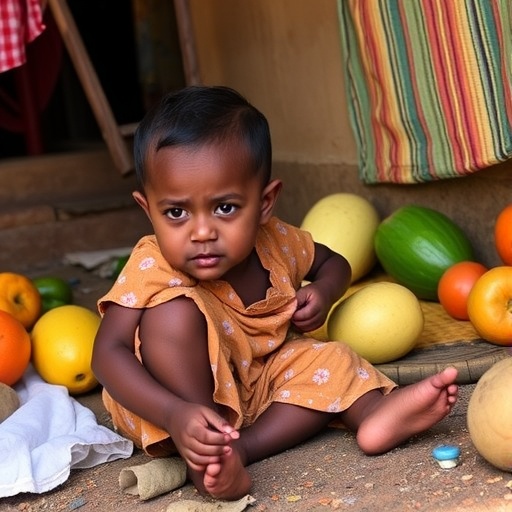
In 2022, childhood stunting afflicted approximately 149 million children under the age of five globally, signaling a profound public health crisis that transcends simple physical growth metrics. Stunting, a biological marker of chronic undernutrition, compromises not only height but also cognitive development, immunity, and economic potential over a lifetime. A groundbreaking study recently published in the Proceedings of the National Academy of Sciences by researchers from the University of Notre Dame elucidates the exacerbating role of anthropogenic climate change in this crisis, particularly within African nations.
The study presents a robust quantitative analysis spanning sixteen years of data across 34 African countries, revealing a stark correlation between human-induced temperature anomalies and rising rates of childhood stunting. Specifically, each increment of 1°C in human-caused warming correlates to a 3.45 percent increase in stunting prevalence among young children. These findings emerge from an elaborate methodological framework that integrates ERA5 daily near-surface temperature data with ensemble climate simulations from the Detection and Attribution Model Intercomparison Project. This dual data approach effectively isolates warming driven by human activities from natural climatic variability, underscoring the direct physiological impact global emissions impart on child health.
Arun Agrawal, Pulte Family Professor of Development Policy and co-author of the study, describes climate-induced stunting as a “direct physical translation of global emissions into child undernutrition.” The mechanism is multifaceted: elevated temperatures disrupt agricultural productivity, leading to reduced food availability and escalating food prices. This chain reaction disproportionately impacts children, whose developing neurological and bodily systems demand constant, adequate nutrition. Without nutritional sufficiency, children entrench into a cyclical poverty trap that is both intergenerational and inescapable by the age of five.
Importantly, the research reveals that stunting is not driven merely by natural weather fluctuations; rather, it is specifically linked to climate anomalies caused by human activity. By disentangling the natural variations in weather from the consistent upward trends in temperature due to anthropogenic emissions, the scientists demonstrate a significant causative link that positions climate warming as a primary risk factor, beyond the background noise of everyday weather.
The study also addresses the intricate relationship between climate change and socioeconomic inequality, elucidating a “double whammy” effect that compounds child undernutrition. Socioeconomic disparities on a community level serve as persistent predictors for stunting, independent but additive to the effects of climate change. This means that as climate-induced stresses mount, communities already burdened with inequity see the most severe outcomes. Poorer households lack the financial buffers to compensate for climate shocks like heatwaves or droughts, leading to reduced access not just to food but also to essential services such as healthcare, sanitation, and education, thereby deepening the malnutrition crisis.
Regions characterized by low service accessibility—encompassing unreliable sanitation infrastructure, insufficient maternal education, and limited healthcare networks—are particularly vulnerable to the aggravated impacts of rising temperatures. Rural populations living far from urban centers face a compounded risk because the infrastructure and institutional supports necessary to mitigate climate-related shocks are often absent or underdeveloped, escalating the vulnerability of young children to stunting.
The research team’s approach underscores the necessity of viewing climate adaptation through a comprehensive lens that integrates social determinants of health. Merely implementing environmental fixes, such as heat-resistant crop varieties or infrastructural projects, is insufficient. Successful interventions must simultaneously confront entrenched social inequalities to shield children from worsening nutritional deficits. Investments that enhance maternal education, improve household sanitation and hygiene, and build economic resilience are paramount not only for public health but also as strategies for climate adaptation.
Maternal education emerges as a critical factor, with educated mothers more inclined to adopt and enforce optimal nutritional practices and proactively seek medical care for childhood illnesses. These behaviors directly mitigate the biological pathways through which heat and food insecurity impair nutrient absorption and physiological development. Similarly, reliable access to potable water and improved sanitation infrastructure substantially reduce infection rates that otherwise exacerbate nutrient loss, providing dual benefits for health and climate resilience.
Looking forward, the study authors advocate for moving beyond macro-level observational analyses to more granular, household-level experimental research. Such in-depth studies would elucidate causal mechanisms and help tailor interventions that can better buffer children against the joint pressures of climate change and social inequality. This approach promises to generate actionable insights and empirically grounded policies essential to breaking the cycle of stunting in a warming world.
This research is emblematic of an urgent call not only for climate mitigation but also for integrated social reform as a sine qua non for safeguarding vulnerable populations. By positioning childhood stunting as a sentinel indicator of climate and social health crises, the study galvanizes interdisciplinary dialogue and action, beckoning stakeholders worldwide to adopt holistic strategies that align environmental sustainability with social equity.
The revelations from Notre Dame’s research underscore the urgent need for international aid agencies and local governments to reformulate priorities. Climate change cannot be siloed as a singular environmental problem; it is inseparable from the social fabric of inequality that determines human resilience. Only through initiatives coupling climate adaptation with social support—maternal education programs, comprehensive WASH (water, sanitation, and hygiene) policies, and economic empowerment—can the trajectory of childhood stunting be reversed.
In sum, this pivotal study illustrates how global climate change inflicts tangible, quantifiable harm on the most vulnerable—young children in Africa—through pathways amplified by existing socioeconomic inequalities. It compels the global community to reckon with the entwined nature of environmental and social determinants, crafting nuanced, multifaceted responses to protect a generation teetering on the edge of stunted futures.
News Publication Date: 1-Jun-2026
Web References:
- PNAS Study
- ERA5 Weather Reanalysis Data
- Detection and Attribution Model Intercomparison Project
- Notre Dame Keough School of Global Affairs
Cite Scienmag News
Sloane Callahan. (June 9, 2026). From Global Warming to Malnutrition: New Study Connects Climate Change, Childhood Stunting, and Local Inequality. Scienmag. https://scienmag.com/from-global-warming-to-malnutrition-new-study-connects-climate-change-childhood-stunting-and-local-inequality/
Sloane Callahan. "From Global Warming to Malnutrition: New Study Connects Climate Change, Childhood Stunting, and Local Inequality." Scienmag, 9 June 2026, https://scienmag.com/from-global-warming-to-malnutrition-new-study-connects-climate-change-childhood-stunting-and-local-inequality/. Accessed 3 September 2026.
Sloane Callahan. "From Global Warming to Malnutrition: New Study Connects Climate Change, Childhood Stunting, and Local Inequality." Scienmag. June 9, 2026. https://scienmag.com/from-global-warming-to-malnutrition-new-study-connects-climate-change-childhood-stunting-and-local-inequality/


