


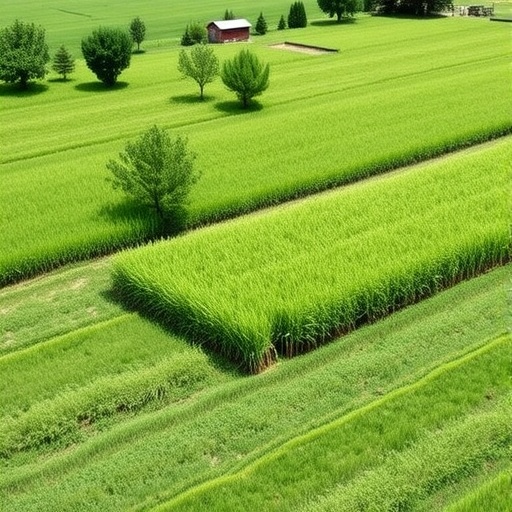
Healthy soils aren’t just an environmental goal—they’re the foundation of stable crop yields. Yet soil degradation is accelerating in many places as agricultural intensification ramps up, while climate change and biodiversity loss add additional pressure. Governments have responded by introducing land-protection measures, but the big question has been whether these policies truly translate into better land conditions on the ground.
A new global study from the University of Bonn suggests that, in many cases, they do. Researchers compared satellite observations spanning 2001 to 2019, tracking year-to-year changes in agricultural biomass across farming regions worldwide. Biomass can reflect vegetation vigor, but it does not automatically reveal soil quality—weather shifts or changes in farm inputs can also boost plant growth.
To separate these effects, the team combined satellite data with high-resolution information about local microclimate conditions and agricultural management variables, including fertilizer use and irrigation. This allowed them to estimate trends in soil condition more reliably rather than mistaking short-term greening for long-term land improvement.
The analysis covered an enormous scale: more than 83 million pixels, with each pixel representing roughly one square kilometer. In total, the researchers assessed around 250,000 mapped areas distributed across the planet’s croplands. Such granularity made it possible to observe patterns where policy changes occurred.
Rather than relying solely on broad comparisons, the researchers used a “natural experiment” strategy. They focused on pairs of neighboring countries where one adopted new protections while the other did not, comparing changes in border regions before and after regulations took effect. Border areas helped reduce the influence of local geographic quirks.
The results indicate that government action can measurably improve cropland conditions. Policies that provide financial incentives for farmers—rewarding better nutrient management, more environmentally friendly weedkillers and pesticides, or erosion-preventing measures like hedgerows—were particularly effective.
Other measures also mattered, including rules that directly shape land management practices, such as crop rotation requirements. Mandatory landscape features—like wildflower strips—were associated with significant positive impacts as well.
The study also highlights that success depends on governance. Countries with stronger institutions showed larger improvements, while places with limited monitoring, weak enforcement, or high corruption saw fewer benefits. Investment levels mattered too: the more money governments spent protecting soil, the more successful outcomes tended to be.
Overall, the researchers frame the findings as a timely signal for environmental protection and food security: well-designed regulations, supported by effective institutions and real resources, can improve land quality at meaningful scale.
Cite Scienmag News
Alan Morgan. (July 17, 2026). Agri-environmental Policies Boost Cropland Quality Globally. Scienmag. https://scienmag.com/agri-environmental-policies-boost-cropland-quality-globally/
Alan Morgan. "Agri-environmental Policies Boost Cropland Quality Globally." Scienmag, 17 July 2026, https://scienmag.com/agri-environmental-policies-boost-cropland-quality-globally/. Accessed 3 September 2026.
Alan Morgan. "Agri-environmental Policies Boost Cropland Quality Globally." Scienmag. July 17, 2026. https://scienmag.com/agri-environmental-policies-boost-cropland-quality-globally/


