


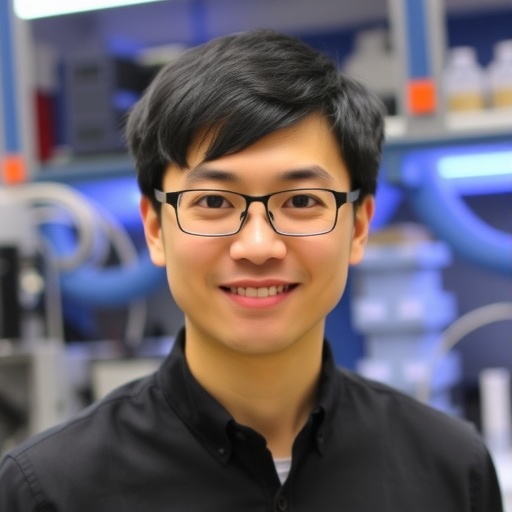
Dr. Kaiwen Hsiao, an esteemed faculty member in the Department of Materials Science and Engineering at Texas A&M University, has recently been honored with the prestigious Faculty Early Career Development (CAREER) Award from the National Science Foundation (NSF). This accolade is reserved for early-career researchers who demonstrate exceptional promise as academic role models and leaders in advancing their respective fields through integrated research and educational initiatives. The award signifies strong recognition of Dr. Hsiao’s innovative approach and her commitment to pioneering research in the realm of materials science and engineering.
Dr. Hsiao’s academic trajectory is marked by a distinctive blend of rigorous scientific inquiry and valuable industrial experience. Beginning her career with an intense focus on molecular dynamics, she meticulously explored how individual molecules move and interact, grounding her understanding in fundamental physical chemistry and materials science. Her subsequent tenure at technological giants Intel and Apple afforded her a rare insider’s perspective on material applications within cutting-edge manufacturing environments. This exposure was further enhanced during her postdoctoral fellowship at Stanford University, where she concentrated on advanced manufacturing techniques. Such a multifaceted career laid a robust foundation for the sophisticated research program she nurtures today.
Central to Dr. Hsiao’s NSF-supported research is the development of a highly precise form of 3D printing known as light-based additive manufacturing, tailored to fabricate microscopic structures from polymeric materials. This approach leverages photopolymerization — a process where light initiates polymer curing — to construct features at scales previously unattainable with conventional manufacturing methods. The implications of this technology are vast, particularly for the microelectronics sector, where the fabrication of intricate, three-dimensional microstructures is essential for next-generation computing hardware development. By pushing the boundaries of resolution and complexity, Dr. Hsiao’s platform stands to revolutionize how components are designed and fabricated at the nanoscale.
The challenge that Dr. Hsiao’s research addresses is deeply technical: traditional microfabrication techniques such as photolithography and etching encounter inherent limitations when attempting to construct three-dimensional components with extremely fine features. Existing manufacturing processes often fall short in creating the complex geometries required for advanced photonic integrated circuits and multi-layered packaging solutions, such as passivation redistribution layers. Through her novel 3D printing platform, Dr. Hsiao aims to enable rapid prototyping and mass production of these essential elements with unparalleled precision, potentially streamlining the supply chain and reducing costs for future computing technologies.
Moreover, the ramifications of this breakthrough extend well beyond electronics. In biomedical engineering, the ability to fabricate polymer structures at the micro- and nano-scale with light-directed precision opens avenues for developing implantable devices that interact seamlessly with biological systems. Similarly, in the realm of energy storage, the capacity to engineer battery components with intricately controlled architectures may lead to enhanced performance metrics, including energy density and charge-discharge rates. This cross-disciplinary utility underscores the transformative potential of Dr. Hsiao’s work.
Equally significant is Dr. Hsiao’s dedication to integrating artificial intelligence (AI) into materials characterization and manufacturing processes. The NSF CAREER Award supports educational initiatives designed to merge AI-driven predictive modeling with experimental analysis, thereby equipping students with cutting-edge tools essential for future materials scientists and engineers. By developing coursework that emphasizes AI-enabled data interpretation, alongside producing accessible tutorial content, Dr. Hsiao’s program ensures that emerging professionals are fluent in both the foundational science and the computational techniques reshaping the manufacturing landscape.
Dr. Hsiao’s educational philosophy reflects a futuristic vision where human intuition synergizes with AI to accelerate material innovation. In addition to academic instruction, she plans to host industry-led panels, fostering dialogue between students and leaders from regional manufacturing sectors. This holistic approach prepares students not only to grasp complex scientific concepts but also to navigate the practical aspects of careers intersecting materials science, computation, and manufacturing technologies.
From laboratory research to real-world applications, Dr. Hsiao’s career path exemplifies how seamless transitions between academia and industry can enrich scientific innovation. Her experiences across diverse environments have imbued her with a unique perspective: every professional encounter contributes to a cumulative reservoir of knowledge that fuels continuous curiosity and problem-solving. This mindset positions her students to embrace flexibility and interdisciplinarity as they contribute to evolving technological frontiers.
The NSF CAREER Award will facilitate expanded experimentation and refinement of Dr. Hsiao’s photopolymerization-based 3D printing platform. With enhanced resources, her lab intends to push resolution limits, optimize polymer formulations, and integrate real-time monitoring systems governed by AI algorithms. Such advancements could enable the manufacture of structures with hierarchical complexity and functional gradations, previously unattainable in microscale additive manufacturing.
Technically, the platform’s success hinges on precise control of polymerization kinetics and light modulation patterns. By tuning factors such as light intensity, exposure duration, and photoinitiator chemistry, Dr. Hsiao’s research aims to tailor material properties spatially within printed components. This level of control has the potential to imbue fabricated structures with custom mechanical, optical, or electrical characteristics, opening a new paradigm in functional materials design tailored specifically for next-generation devices.
The downstream impact on the microelectronics industry could be profound. Photonic integrated circuits, which rely heavily on the manipulation of light signals for advanced computing and communication, require components with nanoscale features and intricate three-dimensional architectures. Similarly, advances in back-end microelectronic packaging—crucial for protecting and interconnecting semiconductor devices in compact assemblies—demand manufacturing techniques that can produce complex geometries with precision and repeatability. Dr. Hsiao’s technology promises to bridge these gaps, enabling faster innovation cycles and more efficient device assembly.
Dr. Hsiao candidly emphasizes the importance of cultivating an adaptive, inquisitive mindset among her students. Her scientific journey – straddling molecular theory, corporate innovation, and academic research – serves as a testament to the value of diverse professional experiences. “No path is ever taken in vain,” she reflects, encouraging aspiring engineers to immerse themselves in varied environments, extract lessons, and maintain an enduring sense of curiosity.
Ultimately, Dr. Kaiwen Hsiao’s research stands at the confluence of materials science, manufacturing technology, and artificial intelligence. Her NSF CAREER Award recognition underscores her potential as a forward-thinking leader poised to reshape how microscopic structures are fabricated, characterized, and applied. Through fundamental discovery, technological innovation, and dedicated mentorship, she exemplifies the transformative spirit driving the future of engineering research and education.
News Publication Date: Not provided
Web References: https://engineering.tamu.edu/materials/profiles/hsaio-kaiwen.html
Cite Scienmag News
Denise Maddox. (June 9, 2026). Hsiao Receives NSF CAREER Award for Advancing Nanoscale Manufacturing. Scienmag. https://scienmag.com/hsiao-receives-nsf-career-award-for-advancing-nanoscale-manufacturing/
Denise Maddox. "Hsiao Receives NSF CAREER Award for Advancing Nanoscale Manufacturing." Scienmag, 9 June 2026, https://scienmag.com/hsiao-receives-nsf-career-award-for-advancing-nanoscale-manufacturing/. Accessed 4 September 2026.
Denise Maddox. "Hsiao Receives NSF CAREER Award for Advancing Nanoscale Manufacturing." Scienmag. June 9, 2026. https://scienmag.com/hsiao-receives-nsf-career-award-for-advancing-nanoscale-manufacturing/


