


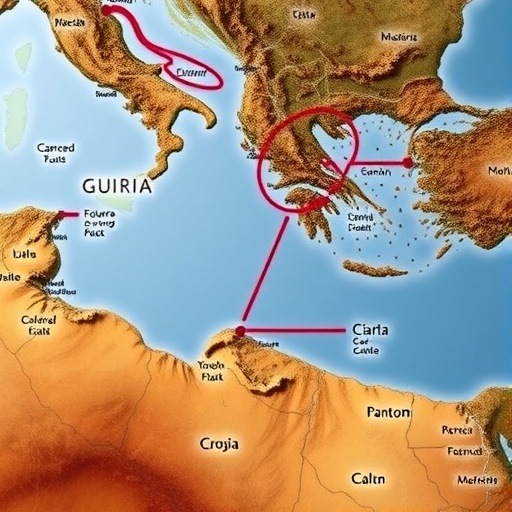
Remote Mediterranean islands were settled long before agriculture—challenging a key assumption about the limits of Europe’s last hunter-gatherers at sea. A new study released today argues that these communities were not merely coastal wanderers. Instead, they repeatedly crossed open water over distances of at least 100 kilometers, likely linking Sicily and Malta for centuries.
The work, published in PNAS Nexus (28 July 2026), focuses on Malta’s long Mesolithic timeline, reporting evidence of continuous human presence from at least 8,400 to 7,400 years ago. That span is significant because it implies not just a single arrival, but sustained occupation.
Researchers say Malta’s ecology would not have supported a large, self-sustaining hunter-gatherer population once the islands were cut off from Sicily by rising seas about 14,000 years ago. Without access to a broader resource base, the island’s carrying capacity would remain too limited for a population to persist in isolation over a millennium.
To test this, the team combined modern ethnographic population patterns with palaeoclimate reconstructions and sea-level modeling. Their approach uses climate-linked relationships between environment and hunter-gatherer group size to estimate what populations Malta could have supported after isolation.
The results suggest Malta’s post-isolation population ceiling was very small, with maximum plausible figures around 170–144 individuals, and more conservative estimates likely far lower. Even if those individuals existed simultaneously, long-term survival across generations would require hundreds of reproductive-age adults, not a sparse island population.
The analysis therefore points toward a persistent problem: such small numbers would increase inbreeding risk and demographic collapse. The only solution, the authors argue, is regular genetic and social renewal through connections to other regions.
Those connections, they propose, depended on a seagoing network capable of repeated voyages. The study describes this as a major transition in human history, when maritime frontiers shifted from barriers to bridges—Mesolithic voyaging enabling new connections across islands and coastlines.
“In the Mediterranean, single-stage, long-distance open-water sea voyaging is first documented in the Mesolithic,” the paper’s senior author notes, adding that Malta’s record likely reflects an established network rather than an accidental landing.
Cite Scienmag News
Violet Maxwell. (July 28, 2026). Earliest Mediterranean long-distance sea routes lasted for at least a millennium. Scienmag. https://scienmag.com/earliest-mediterranean-long-distance-sea-routes-lasted-for-at-least-a-millennium/
Violet Maxwell. "Earliest Mediterranean long-distance sea routes lasted for at least a millennium." Scienmag, 28 July 2026, https://scienmag.com/earliest-mediterranean-long-distance-sea-routes-lasted-for-at-least-a-millennium/. Accessed 5 September 2026.
Violet Maxwell. "Earliest Mediterranean long-distance sea routes lasted for at least a millennium." Scienmag. July 28, 2026. https://scienmag.com/earliest-mediterranean-long-distance-sea-routes-lasted-for-at-least-a-millennium/


