

Tuesday, July 28, 2026
Science
No Result
View All Result
  • Login
  • HOME
  • SCIENCE NEWS
  • CONTACT US
  • HOME
  • SCIENCE NEWS
  • CONTACT US
No Result
View All Result
Scienmag
No Result
View All Result
Home Science News Policy

Global North-South Income Gap Widens Sharply, New Analysis Finds

July 28, 2026
in Policy
Reading Time: 2 mins read
0
Global North-South Income Gap Widens Sharply, New Analysis Finds

Global North-South Income Gap Widens Sharply, New Analysis Finds

65
SHARES
587
VIEWS
Share on FacebookShare on Twitter
ADVERTISEMENT

A new cross-country analysis from the Institute for Environmental Science and Technology at Universitat Autònoma de Barcelona (ICTA-UAB) reports that income inequality between the global North and the global South has widened dramatically since 1960. Published in New Political Economy, the study by Jason Hickel and Dylan Sullivan directly challenges the widely repeated claim that poorer countries are steadily “catching up” through capitalist growth.

The paper, “The myth of catch-up development: trends in core–periphery inequality from 1960 to 2023,” examines complete annual data for 173 countries accounting for 99.9% of the world population. By tracking long-run income trajectories rather than short windows of rapid growth, the authors isolate the role of the global economic structure in shaping outcomes for different regions.

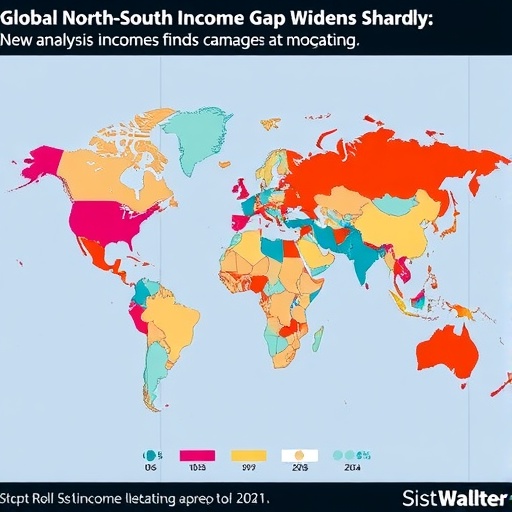
Their results show a striking pattern of divergence: the core captures between four and ten times more income growth than the periphery depending on the currency conversion approach used. In other words, global development has not operated as a convergence machine; it has behaved more like a redistribution system tilted toward advanced economies.

On relative measures, the periphery’s income relative to the core improves only marginally. Since 1960, the ratio rises by no more than three percentage points, and the limited progress is attributed entirely to China. Elsewhere, relative standing deteriorates, indicating that “catch-up” is not a broadly shared pathway.

The study also finds that the core is increasingly exclusive in population terms. Although a small number of peripheral states have been reclassified as advanced for geopolitical reasons, the majority of the world remains outside the core. The share of people living in the periphery increases from 80% in 1960 to 86% in 2023.

A key technical contribution is the authors’ separation of general development dynamics from exceptional political integration. They document cases of reclassification that cluster in Southern Europe, East Asia, and along the eastern EU border, forming a geopolitical buffer rather than a replication-ready route to prosperity.

The paper highlights the neoliberal era as a period of intensifying inequality. During the 1980s and 1990s, IMF and World Bank–associated reforms coincided with sharp, long contractions in several peripheral regions, including Latin America, Middle East and North Africa, Eastern Europe and Central Asia, and Sub-Saharan Africa.

By contrast, core recessions during the same broad period were shallower and recovered faster. The authors frame this asymmetry as evidence that recession experiences are structured by position in the world economy—not merely by domestic policy choices.

To spur genuine development, the authors argue for “delinking” from the imperial core, expanding sovereign industrial capacity, strengthening South–South trade, and reducing dependence on core currencies. Their central conclusion is blunt: catch-up will not emerge within existing rules of the capitalist system.

Article Title: The myth of catch-up development: trends in core–periphery inequality from 1960 to 2023.
News Publication Date: 15-Jul-2026
Web References: http://dx.doi.org/10.1080/13563467.2026.2659076
References: New Political Economy. (2026). “The myth of catch-up development: trends in core–periphery inequality from 1960 to 2023.”
Image Credits: Not provided.
Keywords: core–periphery inequality, catch-up development, neoliberalism, IMF, World Bank, structural adjustment, global South, capitalist world economy

Tags: core-periphery economic divergencecritique of convergence theory in global developmenteffects of globalization on income disparityglobal economic structure and income distributionGlobal North-South income inequalityimpact of capitalism on income inequalityincome disparity between developing and developed countriesincome growth comparison between advanced and emerging economiesincome ratio evolution from 1960 to 2023long-term income trajectory analysisregional economic growth disparitiestrends in global development and inequality
Share26Tweet16
Previous Post

Study Finds Targeted School Closures Can Strengthen Pandemic Response

Next Post

Molecule Enables High-Precision Quantum Sensing

Related Posts

New Treatment for Hepatitis C in Former Medical Experiment Chimpanzees
Policy

New Treatment for Hepatitis C in Former Medical Experiment Chimpanzees

July 27, 2026
Global partnership launches Lancet Public Health series advancing sex workers’ health equity
Policy

Global partnership launches Lancet Public Health series advancing sex workers’ health equity

July 27, 2026
New report examines US role in allies’ wars and conflicts
Policy

New report examines US role in allies’ wars and conflicts

July 27, 2026
Europeans Increasingly Concerned About Climate Change
Policy

Europeans Increasingly Concerned About Climate Change

July 27, 2026
Many Countries Overusing Potent Antibiotics, Fuels Growing Resistance
Policy

Many Countries Overusing Potent Antibiotics, Fuels Growing Resistance

July 27, 2026
Reinforcement Learning Boosts Wave Energy Converter Output by Up to 14%
Policy

Reinforcement Learning Boosts Wave Energy Converter Output by Up to 14%

July 27, 2026
Next Post
Molecule Enables High-Precision Quantum Sensing

Molecule Enables High-Precision Quantum Sensing

  • Mothers who receive childcare support from maternal grandparents show more

    Mothers who receive childcare support from maternal grandparents show more parental warmth, finds NTU Singapore study

    27656 shares
    Share 11059 Tweet 6912
  • University of Seville Breaks 120-Year-Old Mystery, Revises a Key Einstein Concept

    1061 shares
    Share 424 Tweet 265
  • Bee body mass, pathogens and local climate influence heat tolerance

    682 shares
    Share 273 Tweet 171
  • Researchers record first-ever images and data of a shark experiencing a boat strike

    546 shares
    Share 218 Tweet 137
  • Groundbreaking Clinical Trial Reveals Lubiprostone Enhances Kidney Function

    531 shares
    Share 212 Tweet 133
Science

Embark on a thrilling journey of discovery with Scienmag.com—your ultimate source for cutting-edge breakthroughs. Immerse yourself in a world where curiosity knows no limits and tomorrow’s possibilities become today’s reality!

RECENT NEWS

  • DNA Damage Response Pathways Inform New Cancer Immunotherapy Strategies
  • Review Finds Stable Circular RNAs as Noninvasive Biomarkers for Cancer Detection
  • Algorithms Generate Foundry-Ready Photonic Circuits Beyond Human Intuition
  • Xi’an Jiaotong Achieves Low-Cost Roll-to-Roll 3D Nanobowl Light-Trapping Films

Categories

  • Agriculture
  • Anthropology
  • Archaeology
  • Athmospheric
  • Biology
  • Biotechnology
  • Blog
  • Bussines
  • Cancer
  • Chemistry
  • Climate
  • Earth Science
  • Editorial Policy
  • Marine
  • Mathematics
  • Medicine
  • Pediatry
  • Policy
  • Psychology & Psychiatry
  • Science Education
  • Social Science
  • Space
  • Technology and Engineering

Subscribe to Blog via Email

Enter your email address to subscribe to this blog and receive notifications of new posts by email.

Join 5,146 other subscribers

© 2025 Scienmag - Science Magazine

Welcome Back!

Login to your account below

Forgotten Password?

Retrieve your password

Please enter your username or email address to reset your password.

Log In
No Result
View All Result
  • HOME
  • SCIENCE NEWS
  • CONTACT US

© 2025 Scienmag - Science Magazine

Discover more from Science

Subscribe now to keep reading and get access to the full archive.

Continue reading
