


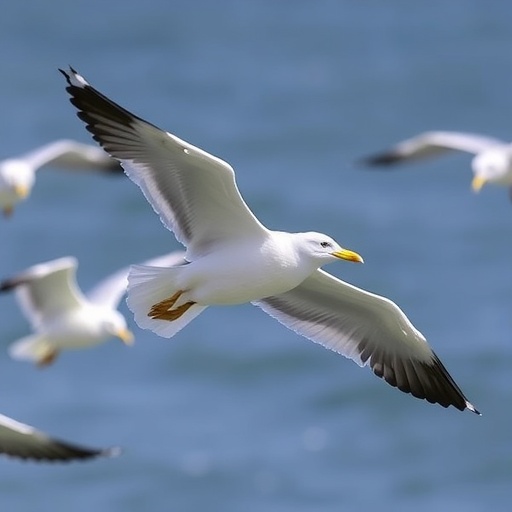
In a groundbreaking study shedding light on seabird behavior around offshore wind farms, ecologists from the Netherlands have uncovered intriguing patterns of avoidance in lesser black-backed gulls, sparking new questions about the ecological impacts of wind energy infrastructure at sea. This comprehensive investigation centered on the colony residing on the Dutch island of Neeltje Jans, situated near the expansive wind farm off the Zeeland coast. The research aimed to discern whether these gulls, known to scavenge discarded fishery bycatch, are attracted to or actively avoid the offshore turbines.
Rosemarie Kentie, an ecologist at the Royal Netherlands Institute for Sea Research (NIOZ), spearheaded the study by equipping 58 gulls with GPS transmitters capable of recording their foraging routes with high spatial resolution. The technology allowed for unprecedented insight into the spatial choices these birds made relative to both the wind farm’s restricted fishing zone and the surrounding commercial fishing areas. Data gathered spanned periods before, during, and after the birds’ breeding season, providing a robust temporal framework for behavioral analysis.
Advanced Step Selection Analysis models, a sophisticated statistical approach that evaluates animal decision-making by contrasting utilized locations with those potentially available but unused, were applied to the GPS data. This method enabled researchers to probe whether gulls showed a statistically significant preference or aversion to the wind farm areas. The findings consistently revealed a marked avoidance of the wind farm by the gull population, despite the expectation that the birds might be drawn to the site due to its prohibition of fishing, which could theoretically lead to higher prey availability.
Particularly fascinating was the discovery of variation in behavior among individual gulls, especially males, who demonstrated more frequent visits within the wind farm’s perimeter relative to females. Kentie hypothesizes that this sexual dimorphism in habitat use relates to the differing foraging strategies — males tend to range widely over the sea, while females often forage inland. However, this observation opens further questions regarding the drivers behind individual foraging decisions, as some gulls exhibited highly site-faithful routines, traveling considerable distances daily to specific locations hundreds of kilometers away, revealing complex spatial ecology.
Despite comprehensive attempts to correlate gull presence with fishing intensity using the Global Fishing Watch database—which details spatial and temporal fishing vessel activity—no relationship emerged. The birds did not venture into the wind farm more often during weekends when fishing activity dwindles, challenging the assumption that bycatch availability governs seabird distribution near offshore infrastructures. This independence suggests that other unknown factors influence gull avoidance behavior, an enigma that continues to captivate the researchers.
The ecological stakes of these findings extend beyond behavioral curiosity; offshore wind farms, increasingly vital for sustainable energy, pose tangible risks to seabird populations. Collision risk models estimating avian fatalities due to turbine blade strikes currently suffer from considerable uncertainties, particularly at sea where carcass detection is impractical, and nocturnal or poor weather observations hamper direct monitoring. Kentie’s work contributes to refining these models by clarifying spatial usage patterns and avoidance behaviors, critical inputs for accurate risk assessments.
Moreover, the height at which lesser black-backed gulls forage places them at moderate risk, as they tend to fly within the rotor sweep zone of turbines. Their natural agility and impressive aerial feeding skills allow them to catch prey mid-flight, but when visually focused downward to search for fish, they may fail to detect imminent turbine hazards. The combination of these factors underscores the pressing need for nuanced approaches in designing and situating offshore wind installations to mitigate avian mortality.
The collaborative nature of the research is notable, involving partnerships with ecological organizations and academic institutions including Waardenburg Ecology, the Research Institute for Nature and Forest (INBO) in Flanders, IBED at the University of Amsterdam, Deltamilieu Projecten, and Buijs Eco Consult. Funded by Eneco, the wind farm owner, and Rijkswaterstaat, the responsible Dutch government agency for maritime infrastructure, the study exemplifies the growing integration of industrial stakeholders and scientific inquiry in addressing the environmental dimensions of renewable energy deployment.
Despite the robust dataset and innovative analytical approaches, the study acknowledges limitations inherent to GPS tracking technology, particularly its temporal resolution. With location fixes taken at approximately twenty-minute intervals, granular behavioral states of the gulls—such as whether individuals were resting at turbine bases, engaging in active foraging, or merely transiting—remain uncertain. Future research employing higher-frequency tracking or complementary observational techniques promises to yield deeper insights into these interactions.
Published recently in the Journal of Animal Ecology, the paper entitled “Offshore wind farm avoidance by a discard-feeding seabird is independent of local fishing activity,” marks a significant contribution to marine ecology and renewable energy science. It opens new avenues for investigating how anthropogenic structures alter animal landscapes and how wildlife adapts to rapidly transforming coastal and offshore environments.
As Europe and the world accelerate toward ambitious offshore wind energy targets, understanding the complex nexus between renewable infrastructure and marine biodiversity will be indispensable for balancing ecological preservation with climate change mitigation. The findings from Rosemarie Kentie and her colleagues underscore the intricacies inherent in wildlife responses to human developments, cautioning against assumptions of uniform attraction or avoidance and highlighting the sophistication of seabirds’ spatial ecology.
With offshore wind park installations proliferating, the study provides a timely call for comprehensive, multi-disciplinary monitoring frameworks that can inform adaptive management strategies. Ultimately, safeguarding the survival of species such as the lesser black-backed gull while harnessing sustainable energy resources demands integrated approaches combining robust field research, advanced modeling, and a commitment to ecological stewardship.
News Publication Date: 9-Jun-2026
Web References:
- Journal of Animal Ecology Article
- Global Fishing Watch (for fishing data integration)
References:
Kentie, R., van Bemmelen, R. S. A., Shamoun-Baranes, J., Stienen, E. W. M., & Fijn, R. C. (2026). Offshore wind farm avoidance by a discard-feeding seabird is independent of local fishing activity. Journal of Animal Ecology. https://doi.org/10.1111/1365-2656.70279
Keywords
Lesser black-backed gull, offshore wind farm, seabird avoidance, GPS tracking, collision risk, Step Selection Analysis, marine ecology, renewable energy, fishing activity, behavioral ecology, spatial habitat use, environmental impact
Cite Scienmag News
Denise Maddox. (June 9, 2026). Lesser Black-Backed Gulls Unaffected by Windfarms Despite Fishing Activity. Scienmag. https://scienmag.com/lesser-black-backed-gulls-unaffected-by-windfarms-despite-fishing-activity/
Denise Maddox. "Lesser Black-Backed Gulls Unaffected by Windfarms Despite Fishing Activity." Scienmag, 9 June 2026, https://scienmag.com/lesser-black-backed-gulls-unaffected-by-windfarms-despite-fishing-activity/. Accessed 3 September 2026.
Denise Maddox. "Lesser Black-Backed Gulls Unaffected by Windfarms Despite Fishing Activity." Scienmag. June 9, 2026. https://scienmag.com/lesser-black-backed-gulls-unaffected-by-windfarms-despite-fishing-activity/


