


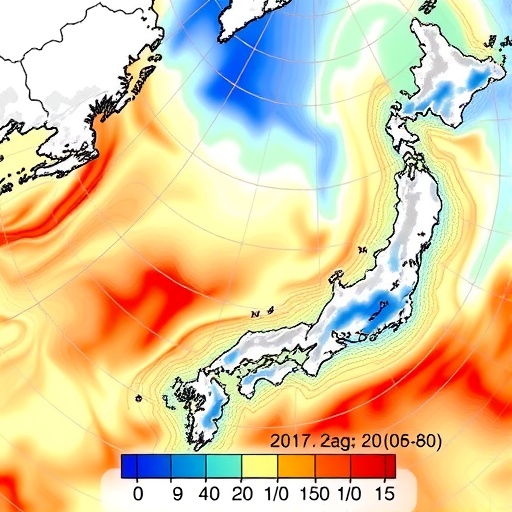
As global warming continues to reshape the climate landscape, understanding the ocean’s complex interplay with atmospheric systems has become crucial. Recent research published in Communications Earth & Environment by Wang, Li, Wu, and colleagues sheds new light on how the Atlantic multidecadal variability (AMV) influences the decadal variability in the North Pacific’s Kuroshio–Oyashio Extension (KOE) region, a discovery with profound implications for climate prediction and marine ecosystem management. This study unravels the intricate teleconnections between two distant ocean basins, revealing how long-term oscillations in the Atlantic amplify variability in the Pacific under a warming climate.
The Kuroshio–Oyashio Extension, where the warm Kuroshio and the cold Oyashio currents converge, forms a dynamic boundary critical to North Pacific climate and marine ecosystems. Variations in this region influence seasonal weather patterns, ocean productivity, and fisheries. Until now, much of the variability observed in the KOE was attributed to local atmospheric forcing or Pacific internal modes. However, the new findings suggest the Atlantic Ocean’s multidecadal oscillations play a significant amplifying role, particularly under global warming conditions.
The Atlantic multidecadal variability refers to fluctuations in sea surface temperature anomalies occurring over scales of several decades. Its phases modulate not only regional climate conditions in the Atlantic basin but also influence distant regions via atmospheric and oceanic teleconnections. This study demonstrates that during the positive phase of the AMV, sea surface temperature anomalies propagate signals that amplify the inherent decadal variability in the KOE region, potentially triggering stronger fluctuations in ocean currents, heat transport, and atmospheric coupling.
Global warming intensifies this inter-basin linkage by enhancing background mean state changes in sea surface temperature and atmospheric circulation patterns. The researchers employed advanced climate models integrating observational data sets to simulate these complex interactions, allowing them to isolate the AMV’s contribution to Pacific variability. Their simulations reveal that under warming scenarios, the amplitude of decadal variability in the KOE region significantly increases when the AMV is in its positive phase.
The amplification of variability in the KOE has ramifications for regional climate predictability. Decadal climate forecasts rely on accurate representations of coupled ocean-atmosphere dynamics, and neglecting the role of remote signals such as the AMV could lead to systematic prediction errors. This study’s insights suggest that incorporating Atlantic-Pacific teleconnections explicitly into predictive models could enhance skill in forecasting North Pacific climate variability on decadal timescales, thereby benefiting sectors dependent on climate-sensitive resources.
Moreover, the enhanced decadal variability affects marine ecosystems, which are highly sensitive to the physical environment. Fluctuations in ocean currents alter nutrient upwelling, water temperature, and habitat connectivity, thereby influencing species distributions, fishery yields, and biodiversity. Understanding how external drivers like the AMV modulate these dynamics offers a pathway to predicting and managing ecosystem responses under climate change.
The findings challenge the prevailing notion that Pacific decadal variability operates largely independent of Atlantic influences. By documenting a robust teleconnection mechanism amplified by anthropogenic warming, this research broadens the conceptual framework of ocean-climate interaction. Specifically, it highlights the importance of accounting for multidecadal cycles in the Atlantic when interpreting Pacific climate records and projecting future variability.
The study identifies atmospheric bridge mechanisms—patterns of atmospheric circulation anomalies that transmit signals from the Atlantic to the Pacific—as key facilitators of this inter-basin connection. Changes in the Atlantic modulate the Pacific jet stream and storm tracks, subsequently imprinting on SST patterns and ocean circulation in the KEO region. These mechanisms become more active or pronounced under enhanced greenhouse gas concentrations, underscoring a future wherein ocean basins are dynamically interlinked in unprecedented ways.
Methodologically, the research leverages coupled ocean-atmosphere general circulation models with high spatial and temporal resolution, calibrated against decades of observed climate data. Such sophisticated modeling frameworks are essential to disentangle the feedback processes and to quantify the relative roles of internal climate variability and forced changes due to rising greenhouse gas levels.
Importantly, the study also delves into potential nonlinearities in the system. As global warming progresses, the response of ocean basins to teleconnected signals may not scale linearly, possibly leading to abrupt shifts or intensifications in regional climate variability. These complex dynamics highlight the urgent need to monitor ocean conditions continuously and to refine climate models for better risk assessment.
Implications extend beyond physical climate science to socio-economic domains. Coastal communities and fisheries dependent on the KOE region’s stability could experience heightened vulnerability with stronger decadal oscillations influencing marine resource availability. Policymakers and resource managers may thus need to incorporate these findings into adaptive planning and resilience-building strategies.
This research heralds a paradigm shift in how scientists view ocean basin interactions amid a changing climate. Rather than isolated systems, the Atlantic and Pacific Oceans comprise a coupled framework where long-term variability in one basin can amplify decadal climate fluctuations thousands of miles away. Recognizing and quantifying such integrated behavior improve our capacity for anticipating climate extremes and their cascading impacts.
Looking forward, the study encourages continued observational campaigns and model development targeted at inter-basin teleconnections. Such efforts would refine our understanding of the mechanisms underpinning variability and inform predictive capabilities essential for managing the global climate system’s future trajectory.
In summary, Wang and colleagues’ groundbreaking work elucidates how Atlantic multidecadal variability strengthens decadal fluctuations in the North Pacific’s Kuroshio–Oyashio Extension region, particularly under the influence of anthropogenic warming. Their multidisciplinary approach merges oceanography, atmospheric science, and climate modeling to reveal teleconnections critical for advancing climate prediction and managing ecosystem resilience in a warming world. This study marks a significant leap toward holistic climate science, emphasizing the intertwined fates of ocean basins and highlighting the nuanced complexities introduced by a changing climate.
Cite Scienmag News
Violet Maxwell. (June 9, 2026). Atlantic Variability Boosts Kuroshio Decadal Changes. Scienmag. https://scienmag.com/atlantic-variability-boosts-kuroshio-decadal-changes/
Violet Maxwell. "Atlantic Variability Boosts Kuroshio Decadal Changes." Scienmag, 9 June 2026, https://scienmag.com/atlantic-variability-boosts-kuroshio-decadal-changes/. Accessed 4 September 2026.
Violet Maxwell. "Atlantic Variability Boosts Kuroshio Decadal Changes." Scienmag. June 9, 2026. https://scienmag.com/atlantic-variability-boosts-kuroshio-decadal-changes/


