


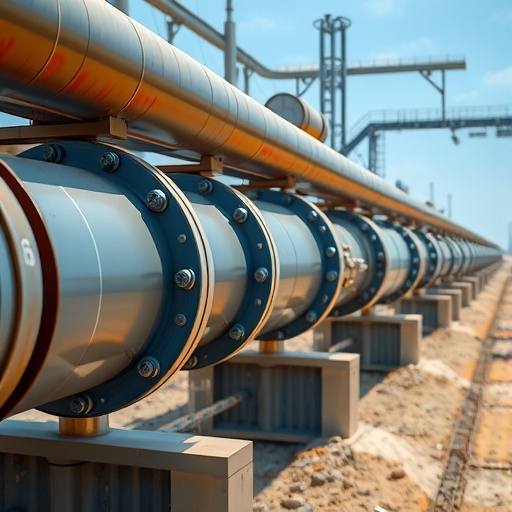
In a groundbreaking systematic review recently published in the Journal of Pipeline Science and Engineering, researchers have charted the transformative advances of machine learning (ML) applied to pipeline integrity management across the complete lifecycle. This sweeping analysis consolidates findings from 95 core studies and synthesizes them against 24 preceding reviews, creating the most comprehensive framework to date that encompasses reliability-based design, structural integrity evaluation, condition monitoring, inspection planning, and maintenance decision support in pipeline systems. Their contribution fundamentally reframes how data-driven approaches and physical engineering principles intersect to safeguard critical energy infrastructure.
The evolution of ML methods in pipeline monitoring marks a departure from traditional, highly specialized supervised learning models towards more versatile, hybrid frameworks. These include transferable learning algorithms, metaheuristic optimization strategies, and physics-informed models that embed domain-specific knowledge. Such approaches process complex signal decompositions, quantify uncertainties, employ graph-based knowledge representations, and incorporate soft constraints derived from physical laws to dramatically enhance model generalizability across diverse pipeline scenarios. This blending of data and mechanics not only yields improved predictive accuracy but also pushes towards interpretable models that foster stakeholder trust.
Within the crucial phase of reliability design and safety assessment, innovative ML frameworks have emerged to reduce computational costs while maintaining the rigor of probabilistic safety evaluations. Techniques such as LFS-SSA-BPNN, LSBES-ELM, and GC-GAN integrated with random forest algorithms approximate Monte Carlo simulations with impressive fidelity. These generative and heuristic models expertly handle the chronic scarcity and noise inherent in field data. Meanwhile, interpretability tools like SHAP and LIME are deployed to demystify complex ML black-box models, opening doors for regulatory acceptance and certification in safety-critical domains.
Structural integrity assessment and degradation modeling benefit significantly from ML surrogates that replace traditionally expensive and time-consuming numerical simulations such as finite element analysis (FEA) and smoothed particle hydrodynamics (SPH). Models like gradient-boosted regression trees (GBRT), random forests (RF), temporal graph neural networks (TGNN), and physics-informed neural networks (PINNs) deliver near-physical fidelity. They accelerate computation by factors ranging from hundreds to tens of thousands while accurately modeling phenomena such as burst and collapse pressure, corrosion growth, crack propagation, and geohazard-induced strain. Hybrid learning architectures and residual correction techniques outperform classical standards set by DNV and API by effectively addressing intrinsic model biases.
Pipeline inspection and maintenance planning have also experienced a renaissance through advanced sensor fusion and cutting-edge ML algorithms. Integration of LiDAR, CCTV, acoustic emission (AE), magnetic flux leakage (MFL), and other multispectral data streams creates a rich mosaic of defect signatures. Coupled with convolutional neural networks (CNN), Transformers, graph neural networks (GNN), and isolation forest algorithms, these techniques achieve unparalleled accuracy in defect detection, spatial localization, and classificatory precision amid noisy operational environments. Beyond detection, spatial ML combined with geographic information systems (GIS) facilitates hotspot mapping and prioritization, while deep reinforcement learning (DRL) and Bayesian networks enable dynamic optimization of maintenance intervals and network reliability.
Despite the impressive accuracy exhibited by many models—often with R² metrics exceeding 0.95—the field confronts ten persistent and formidable challenges that constrain further industrial adoption. Foremost among these is the profound scarcity and questionable quality of real-world benchmark datasets, which hampers robust model training and validation. An overreliance on laboratory and simulated datasets limits the ecological validity of findings, necessitating expansive field validation efforts. Additionally, the absence of standardized evaluation protocols creates barriers to fair and transparent comparison among competing methods, fueling duplication and confusion.
Opaqe “black-box” ML models remain a major hurdle, impeding operator confidence and regulatory approval due to their inscrutability. While the potential of multisensor fusion is recognized, it remains insufficiently exploited to unlock synergistic insights. Computational scalability challenges impede network-scale deployment, and current solutions largely focus narrowly on isolated subsystems rather than adopting a holistic lifecycle perspective. Cross-domain generalization across varied geographic regions and material compositions remains weak, undermining transferability. Furthermore, inadequate uncertainty quantification limits robust risk-aware decision-making, and regulatory, ethical, and operational pathways are under-addressed, curtailing broad deployment.
Looking to the future, three primary research frontiers crystallize as pivotal for elevating ML-assisted pipeline integrity management from experimental promise to industrial mainstay. First is the creation of expansive multi-source benchmark datasets, richly annotated with verified field failure labels, to provide a rigorous training bedrock that captures real-world complexities. Second is the development of physics-informed, interpretable ML frameworks that meld fundamental mechanics with advanced algorithmic sophistication, bridging long-standing divides between empirical data and theoretical models. Third, the establishment of standardized evaluation protocols and comprehensive field validation paradigms aligned with industry codes such as API, ASME, and DNV will propel the maturation of trustworthy, certifiable solutions.
The authors advocate a decision-matrix roadmap to harmonize efforts among researchers, operators, and regulatory bodies. They emphasize prioritizing ML frameworks that are physics-constrained, uncertainty-aware, and integrated throughout the pipeline lifecycle. Rather than attempting wholesale replacement of existing engineering codes, ML should serve as a calibrated surrogate layer updating code inputs to enhance responsiveness and precision. Coupling predictive accuracy with reliability metrics, cost-benefit analyses, and auditability is paramount to achieving regulatory compliance and operational confidence in complex, safety-critical pipeline networks.
Envisioning the trajectory of this field, the review anticipates that future machine learning-powered pipeline integrity management systems will evolve into sophisticated, physics-consistent, self-adaptive digital twins. These digital avatars will enable real-time asset monitoring, predictive maintenance scheduling, and continuous reliability assessment, fostering safer, more resilient, and sustainable energy transport pipelines worldwide. The convergence of domain expertise and data science thus heralds a new era in infrastructure management with transformative societal and environmental implications.
This landmark review not only encapsulates state-of-the-art advances but also charts an ambitious and actionable research agenda aimed at bridging critical gaps. As pipelines remain vital arteries for global energy supply, integrating machine learning in integrity management emerges as a frontier with unmatched promise to revolutionize safety, optimize maintenance, and extend asset lifetimes amidst evolving operational contexts.
Contact Information:
Ardeshir Savari, Department of Mechanical Engineering, Petroleum University of Technology, Ahvaz, Iran. Email: savari.ardeshir@gmail.com
Web References:
http://dx.doi.org/10.1016/j.jpse.2026.100528
Keywords
Machine Learning, Pipeline Integrity Management, Reliability-based Design, Structural Health Monitoring, Condition Monitoring, Predictive Maintenance, Physics-informed Machine Learning, Digital Twins, Inspection Planning, Sensor Fusion, Deep Reinforcement Learning, Uncertainty Quantification
Cite Scienmag News
Teresa Odom. (June 8, 2026). Latest Advances in Machine Learning Transform Pipeline Design, Integrity Assessment, Inspection, and Maintenance. Scienmag. https://scienmag.com/latest-advances-in-machine-learning-transform-pipeline-design-integrity-assessment-inspection-and-maintenance/
Teresa Odom. "Latest Advances in Machine Learning Transform Pipeline Design, Integrity Assessment, Inspection, and Maintenance." Scienmag, 8 June 2026, https://scienmag.com/latest-advances-in-machine-learning-transform-pipeline-design-integrity-assessment-inspection-and-maintenance/. Accessed 3 September 2026.
Teresa Odom. "Latest Advances in Machine Learning Transform Pipeline Design, Integrity Assessment, Inspection, and Maintenance." Scienmag. June 8, 2026. https://scienmag.com/latest-advances-in-machine-learning-transform-pipeline-design-integrity-assessment-inspection-and-maintenance/


