


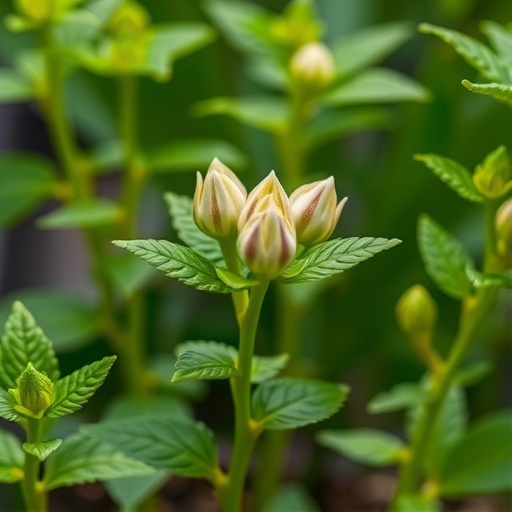
In an extraordinary leap toward sustaining human life during prolonged space voyages, engineers at the University of California San Diego have pioneered a groundbreaking method that enables plants to produce pharmaceuticals on-demand in space-like environments. This innovation promises to revolutionize medical supply logistics for astronauts, offering a sustainable and efficient alternative to traditional drug transportation in extraterrestrial missions.
Space travel imposes daunting challenges, none more pressing than the preservation of effective medications. The harsh environment of space accelerates drug degradation, significantly diminishing their shelf life. For instance, medications aboard the International Space Station often expire within three years, barely sufficient for distant space missions such as Mars expeditions, which span approximately 200 days each way. The impracticality of frequent resupply missions accentuates the need for shipboard pharmaceutical production.
Harnessing plants as bioreactors offers a compelling solution. Unlike conventional pharmaceutical manufacturing that demands vast sterile infrastructures and complex bioreactors, plants convert light, water, and nutrients into complex therapeutic molecules with inherent efficiency. They are already part of the extraterrestrial ecosystem aboard spacecraft, contributing to air and water recycling—further underscoring their potential for pharmaceutical biosynthesis in space.
At the heart of this research lies the cowpea mosaic virus (CPMV), a plant virus recognized not merely for its infectivity but for its unique capacity to modulate immune responses against cancer. Nicole Steinmetz, the study’s senior author and a prominent figure in chemical and nano engineering, highlights CPMV’s promising therapeutic applications. Over the past decade, her team has focused on leveraging CPMV’s immunostimulatory properties, demonstrated in preclinical models and canine clinical studies.
The process utilizes Nicotiana benthamiana and black-eyed pea plants, both celebrated for their rapid biomass accumulation—a critical factor enhancing pharmaceutical yield. While cultivating these plants is straightforward, the extraction of CPMV has historically posed significant challenges. Traditional methods involve destructive leaf harvesting, grinding into homogenates that resemble nutritional smoothies, creating a complex slurry from which recovering pure viral particles is demanding. Moreover, such processes require bulky equipment incompatible with the confines of spacecraft.
To overcome these limitations, the team explored a novel approach inspired by secretion methods in bacterial and mammalian cell cultures. Unlike destructive extraction, this technique capitalizes on the plant’s natural secretion mechanisms, wherein bioactive compounds accumulate within the apoplast—a network of extracellular spaces within leaves. By submerging leaves in a buffer solution, applying vacuum pressure to flood the apoplast, and subsequently centrifuging, CPMV particles can be collected in a liquid fraction, leaving the leaf tissue intact. This gentle extraction is both efficient and non-destructive, enabling potentially continuous harvesting cycles.
This streamlined protocol is remarkably scalable; the researchers successfully processed more than fifty plants within two hours, a testament to its practicality for future application in constrained environments like spacecraft or remote terrestrial locations. The integrity of the leaves post-extraction not only permits sustained pharmaceutical production but also reduces biomass waste, aligning with ecological sustainability principles vital in space habitats.
Simulating the extraterrestrial environment was paramount to validate the method’s viability. Collaborating with mechanical and aerospace engineers, the researchers employed a custom-designed random positioning machine that simulates microgravity by random, multidirectional rotation of the plants. This innovative apparatus effectively negates gravitational vectors, replicating a space-like reduced gravity environment. Further exposure to temperature variability and oxidative stress mimicked cosmic radiation’s biological impact.
Intriguingly, these stress conditions appeared to slightly enhance CPMV production. The researchers speculate that the heightened susceptibility of plants to viral infection under stress inadvertently boosts the output of the virus-derived therapeutic compound. This adaptive response could be harnessed to optimize pharmaceutical yields in the unforgiving environment of space, turning a vulnerability into an asset.
Looking ahead, the team envisions adapting their methodology to entire living plants rather than isolated leaves, potentially transforming spacecraft into miniature pharmaceutical factories. By refining this approach, future missions could continuously harvest essential medicines, dramatically improving crew health management without dependence on Earth resupply.
Further investigative efforts will intensify on understanding how microgravity and space radiation influence plant physiology, including nutrient assimilation and cellular processes fundamental to drug biosynthesis. Additionally, experiments will assess the resilience of seeds and genetic constructs during rocket launches, crucial for ensuring plant viability post-deployment.
This pioneering work not only advances space medicine but also harbors significant potential for low-resource areas on Earth, where traditional pharmaceutical manufacturing infrastructure is lacking. The simplicity and scalability of this plant-based system could democratize access to life-saving medicines, bridging glaring healthcare disparities.
Funded by the National Institutes of Health and NASA’s Translational Research Institute for Space Health, this research exemplifies the interdisciplinary collaboration essential for translating terrestrial biotechnology into practical space applications. While ethical disclosures remind us of the commercial interests involved, the scientific community widely recognizes the transformative potential of this approach.
By bridging molecular farming and space science, UC San Diego’s researchers have charted a visionary path toward sustainable, on-demand pharmaceutical production beyond our planet. This technology heralds a future where astronauts are not merely passengers but self-sufficient bioengineers, cultivating the medicines they need amidst the stars.
News Publication Date: 5-Jun-2026
Web References: DOI: 10.1038/s44383-026-00030-y
References: Published in npj Science of Plants, June 5, 2026
Keywords
Space pharmaceuticals, molecular farming, cowpea mosaic virus, CPMV, plant therapeutics, microgravity simulation, random positioning machine, plant virus extraction, space medicine, biopharmaceuticals in space, molecular biotechnology, space mission healthcare
Cite Scienmag News
Grant Pearson. (June 8, 2026). Study Shows Plants Can Be Used to Grow Medicines in Space. Scienmag. https://scienmag.com/study-shows-plants-can-be-used-to-grow-medicines-in-space/
Grant Pearson. "Study Shows Plants Can Be Used to Grow Medicines in Space." Scienmag, 8 June 2026, https://scienmag.com/study-shows-plants-can-be-used-to-grow-medicines-in-space/. Accessed 3 September 2026.
Grant Pearson. "Study Shows Plants Can Be Used to Grow Medicines in Space." Scienmag. June 8, 2026. https://scienmag.com/study-shows-plants-can-be-used-to-grow-medicines-in-space/


