


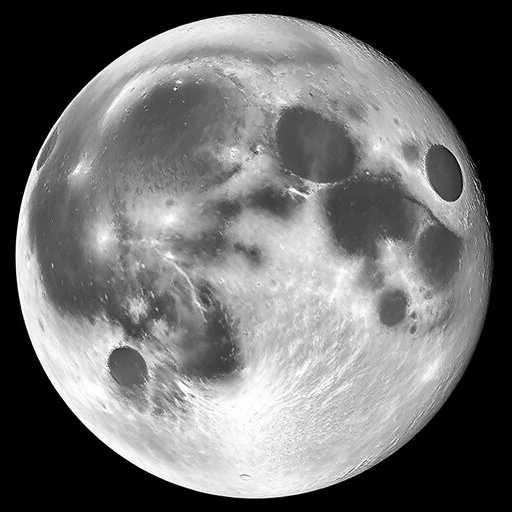
Ancient moon rocks from the lunar far side are giving scientists a clearer—and more surprising—picture of how asteroid impacts shaped the early Solar System. The new work suggests that bombardment did not unfold as a single, dramatic spike. Instead, it appears to have faded gradually over time, reshaping a long-standing narrative about when the most intense impacts occurred.
Because Earth’s surface has been heavily reworked by erosion, plate tectonics, and volcanic recycling, the planet’s oldest impact record is largely missing. The Moon, by contrast, preserves impact scars for billions of years, acting like a natural archive of space violence that Earth can no longer read.
A research team analyzed ancient fragments of lunar material to determine when impact-generated melts formed. Using 40Ar/39Ar geochronology, they dated events across a wide span of lunar history, reconstructing more than three billion years of bombardment activity. This approach relies on the predictable radioactive decay of argon isotopes, letting scientists translate trapped gas signals into absolute ages.
The key advance comes from where the samples were taken: the Moon’s far side. Since almost all previous lunar samples came from the near side facing Earth, this dataset enables a direct comparison between two distinct regions of lunar geology. The far side is thought to preserve a “cleaner” timeline because it has been less altered by later processes that can obscure earlier impact signatures.
The results point to impact events ranging from about 4.33 billion years ago to roughly 1.13 billion years ago. Rather than reflecting a brief, catastrophic bombardment window, the pattern suggests a prolonged decline in impact intensity—one that better matches a Solar System gradually settling into a calmer phase.
These findings also matter beyond the Moon. Earth and the Moon formed together and experienced many of the same early bombardment conditions, even if Earth’s geological record has been erased. By refining the Moon’s timeline, scientists can place tighter constraints on the environment early Earth faced, including how frequent impacts may have influenced planetary evolution.
The study arrives as lunar sample-return science accelerates. China’s Chang’e-6 mission—reported as the first to return far-side lunar samples—has opened a new chapter in how researchers can test Solar System history with better regional coverage.
Led by scientists from the Guangzhou Institute of Geochemistry, Chinese Academy of Sciences, the work is published in Science Advances. The research is titled “The bombardment history on the lunar farside revealed by 40Ar/39Ar geochronology of Chang’e-6 impact melt rocks.”
Keywords
Lunar far side, asteroid impacts, 40Ar/39Ar geochronology, Chang’e-6, impact melt rocks, early Solar System, bombardment history, planetary evolution
Cite Scienmag News
Grant Pearson. (July 26, 2026). Rocks from the Moon’s unexplored far side reshape lunar history. Scienmag. https://scienmag.com/rocks-from-the-moons-unexplored-far-side-reshape-lunar-history/
Grant Pearson. "Rocks from the Moon’s unexplored far side reshape lunar history." Scienmag, 26 July 2026, https://scienmag.com/rocks-from-the-moons-unexplored-far-side-reshape-lunar-history/. Accessed 4 September 2026.
Grant Pearson. "Rocks from the Moon’s unexplored far side reshape lunar history." Scienmag. July 26, 2026. https://scienmag.com/rocks-from-the-moons-unexplored-far-side-reshape-lunar-history/


