


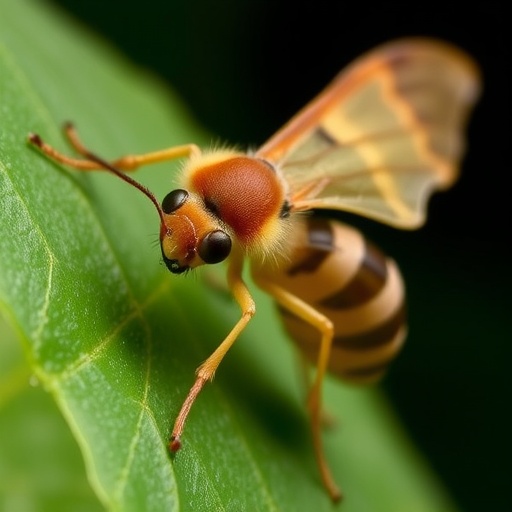
In the evolving landscape of infectious disease research, a remarkable breakthrough has been achieved that promises to revolutionize how scientists study bacterial virulence. Researchers at the Helmholtz Institute for One Health (HIOH) in Greifswald, Germany, have pioneered the use of the greater wax moth larva (Galleria mellonella) as a standardized, scalable, and ethically sound model to investigate the pathogenicity of Klebsiella pneumoniae, a highly dangerous human pathogen. This innovation offers an unprecedented avenue to explore bacterial virulence on a larger scale, reducing dependency on mammalian models that are often costly, ethically contentious, and time-intensive.
For decades, assessing how virulent certain bacterial strains are has required complex animal testing, predominantly in mammals such as mice. These traditional models, while invaluable, come with significant logistical and ethical challenges. The increasing need for high-throughput screening of numerous bacterial isolates or novel antimicrobial compounds has strained the traditional frameworks. The Greifswald team’s introduction of Galleria mellonella larvae into this arena addresses these challenges head-on by providing a living organism platform that supports extensive, reproducible infection studies without the ethical and resource-related burdens of mammalian testing.
Klebsiella pneumoniae is a pathogen of profound clinical interest, notorious for causing severe infections, especially in hospital environments. It exhibits diverse virulence profiles across strains, complicating treatment and prevention strategies. The research ambitiously tested 80 distinct Klebsiella pneumoniae strains within the larval model, successfully differentiating between classic and highly virulent strains under rigorously standardized experimental conditions. This scalability marks a significant advancement in virulence assessment, allowing broad-spectrum analysis previously unattainable using conventional animal models.
Central to the triumph of this new approach is the strict adherence to and optimization of standardized protocols within the insect model, addressing past criticisms regarding inconsistencies in wax moth larvae research. Professor Katharina Schaufler, leading the study, emphasized the ethical imperatives underpinning their work, particularly the 3R principles—Replacement, Reduction, and Refinement. These principles advocate for minimizing animal use and suffering while maximizing research quality. By establishing precise infection parameters, incubation temperatures, and dosage regimens, the researchers have transformed Galleria mellonella into a reliable, reproducible system conducive to infection studies.
The study meticulously optimized these variables through iterative experimentation. Critical factors such as larval age, bacterial inocula concentration, and incubation conditions were standardized, ensuring that data collected from different laboratories and experiments could be seamlessly compared. This reproducibility addresses a major gap in previous insect infection models, which often suffered from heterogeneous methodologies leading to variable outcomes and diminished scientific confidence in results.
Dr. Elias Eger, corresponding author of the study, underscored the model’s utility as a resource-efficient prescreening tool. While he acknowledges that the Galleria model cannot replace mammalian studies entirely, it enables researchers to drastically reduce the number of mammalian experiments by funneling only the most promising bacterial variants and therapeutic candidates into these more complex systems. This preselection process diminishes resource expenditure and animal use in downstream research, aligning scientific rigor with ethical responsibility.
Beyond efficiency, the Galleria mellonella model is markedly versatile. The larva’s innate immune system exhibits considerable homology to mammalian innate immunity, including cellular and humoral responses, allowing for relevant investigations into host-pathogen interactions. This biological similarity facilitates the extrapolation of infection kinetics and virulence determinants, providing meaningful insights into Klebsiella pneumoniae pathogenic mechanisms.
From a methodological standpoint, the infection protocol involves injecting larvae with quantified bacterial suspensions, followed by monitoring survival rates and physiological responses over time. High-throughput capabilities are achieved through the use of well-defined larval cohorts maintained under controlled laboratory conditions. The model accommodates longitudinal studies, allowing researchers to map the progression of infection, assess bacterial burden, and evaluate host immune responses with considerable precision.
The implications of this advancement extend far beyond Klebsiella pneumoniae research. The established standardized Galleria mellonella infection model lays a foundation applicable to an array of pathogenic bacteria, including those with emerging antimicrobial resistance profiles. In a global health context increasingly threatened by antibiotic-resistant organisms, rapid and ethical virulence screening is essential for identifying dangerous strains and accelerating the development of novel therapeutics.
The interdisciplinary, international collaboration fueling this study combined expertise across microbiology, veterinary medicine, ecology, and pharmacology. Partners from institutions including the University Medical Centers of Greifswald, Kiel, and Münster, as well as research entities in Vietnam, contributed to a robust study design that bridges diverse scientific disciplines. This cooperation models the holistic One Health approach that integrates human, animal, and environmental health perspectives to advance infectious disease research.
Moreover, by embracing the 3R principles and innovating with invertebrate models, the researchers demonstrate a paradigm shift in experimental infectious disease research ethics. The successful transition to alternative hosts not only alleviates ethical concerns but also accelerates research throughput, making it feasible to conduct large-scale virulence and resistance screenings that were previously prohibitive.
Future directions include expanding the usage of the Galleria model to assess the efficacy of novel antimicrobial compounds and investigating complex host-pathogen interactions under varied environmental conditions. Additionally, integration with genomic and transcriptomic analyses can enrich the biological insights gleaned from larval infections, pinpointing novel virulence determinants and resistance mechanisms at the molecular level.
The study’s publication in The Lancet Microbe attests to its significance and impact within the infectious disease research community. It reframes virulence screening methodologies and offers a practical, ethical, and scalable approach that can be readily adopted worldwide, setting a new standard for bacterial pathogenicity research.
In conclusion, the Greifswald team’s work with Galleria mellonella larvae signals a transformative advance in infection biology. By combining rigorous standardization, ethical innovation, and high-throughput capacity, this infection model empowers researchers to rapidly and reliably assess Klebsiella pneumoniae virulence. Such breakthroughs are timely and critical as the scientific community grapples with rising antimicrobial resistance and seeks efficient pathways to develop effective interventions.
News Publication Date: 28-Apr-2026
Web References:
- Helmholtz Institute for One Health: www.helmholtz-hioh.de/en
- Helmholtz Centre for Infection Research: www.helmholtz-hzi.de/en
References:
Cite Scienmag News
Kristina Jarvis. (June 8, 2026). From Pest to Ally: How Wax Moth Larvae Are Revolutionizing Animal Testing in Research. Scienmag. https://scienmag.com/from-pest-to-ally-how-wax-moth-larvae-are-revolutionizing-animal-testing-in-research/
Kristina Jarvis. "From Pest to Ally: How Wax Moth Larvae Are Revolutionizing Animal Testing in Research." Scienmag, 8 June 2026, https://scienmag.com/from-pest-to-ally-how-wax-moth-larvae-are-revolutionizing-animal-testing-in-research/. Accessed 3 September 2026.
Kristina Jarvis. "From Pest to Ally: How Wax Moth Larvae Are Revolutionizing Animal Testing in Research." Scienmag. June 8, 2026. https://scienmag.com/from-pest-to-ally-how-wax-moth-larvae-are-revolutionizing-animal-testing-in-research/


